
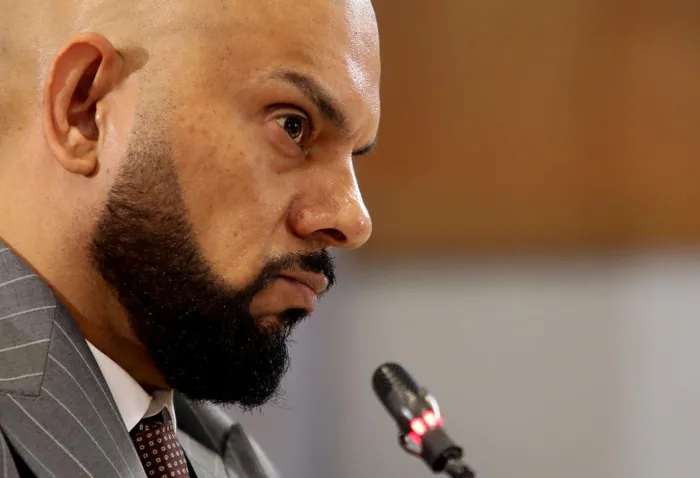
North West businessman Suliman Carrim's testified about his relationship with alleged crime mastermind Vusimuzi “Cat” Matlala at the Madlanga Commission of Inquiry on Monday.
Image: Oupa Moakoena/Independent Newspapers
In the theatre of South African power, the oldest plot twist still lands: sometimes the player gets played. Sometimes the alleged master fixer discovers he was never the smartest man in the room.
This week’s testimony at the Madlanga Commission of Inquiry has peeled back another layer of the controversial R360-million SAPS occupational health and wellness tender awarded to Vusimuzi “Cat” Matlala’s company, Medicare24 Tshwane District.
What began as a procurement scandal has become something far more revealing: a live demonstration of how influence, cash, and proximity to power continue to warp South Africa’s security establishment long after the era of State Capture.
At the centre stand two men.
Matlala, the tenderpreneur now in custody at Kgosi Mampuru facing multiple counts of attempted murder, conspiracy to commit murder and related charges in the Johannesburg High Court.
And Oupa “Brown” Mogotsi, the North-West businessman who has cast himself variously as crime-intelligence operative, political intermediary, and corruption investigator.
The tender moved with striking speed. Advertised in January 2024, recommended by the bid evaluation committee in April, awarded in June 2024 as the sole successful bidder, and signed on 18 June.
It was cancelled in April/May 2025 by National Police Commissioner Fannie Masemola after internal audits flagged serious irregularities: fronting concerns, abuse of supply-chain processes, and missing safeguards. (The contract has not been re-awarded; interim arrangements are in place.)
But the real question before the commission is no longer about paperwork.
It is about power.
Who, exactly, was running whom?
For months, the story shifted with every witness. Matlala dismissed Mogotsi before Parliament’s ad hoc committee as a “con artist”. Mogotsi, for his part, portrayed himself as both hunter and hunted and at one point alleged that Matlala had paid millions in gratification to former minister Bheki Cele and Commissioner Masemola (allegations both have denied).
Then, on Monday 9 March 2026, North-West businessman and ANC member Suleiman Carrim took the stand and delivered the clearest account yet.
He told the commission he advanced R10 million to support Matlala’s Medicare24 operation as it pursued and then serviced the SAPS contract. Only R1.75 million was repaid. The remaining R8.25 million (excluding the additional R10 million profit he had been promised) disappeared into a blur of promises, introductions, and access.
Carrim’s allegation was blunt: both Matlala and Mogotsi played him.
He testified that he knew Matlala through the security sector and was contacted in June 2024 after the tender award. Matlala said he had cash-flow problems. Carrim sought verification from long-time associate Mogotsi (known for 15–18 years), who confirmed the contract’s legitimacy. The deal was simple on paper: once payments from SAPS flowed, Matlala would repay the R10 million plus another R10 million over the three-year term (effectively 10% of receipts until R20 million was repaid).
But by late 2024 Matlala went quiet. In January 2025 he asked for more money. Mogotsi then advised Carrim to tell Matlala he had a direct line to then-Police Minister Senzo Mchunu’s office a suggestion Carrim rejected outright.
“In truth, I had and do not have any relationship with the minister,” he told the commission. “I myself have no direct relationship with Minister Mchunu.” He described the tactic as nonsensical but said Mogotsi insisted it would make Matlala believe Carrim’s involvement was “crucial” and ensure repayment.
“It was clear that both of them were playing me,” Carrim testified. “In hindsight, it is clear Brown was playing me.”
The episode feels uncomfortably familiar.
In South Africa’s post-capture economy, deals worth hundreds of millions are still sealed by relationships faster than by due diligence. Site visits happened. Executives were interviewed. Paperwork moved through the system. Yet a R360-million contract advanced anyway until internal audits, media scrutiny and the national commissioner’s intervention finally blew it apart.
Veteran politician Yunus Carrim once described tracing money through such networks as “chasing smoke”: the shape is visible, but the source is always somewhere else.
The theatre of sudden wealth still lingers cash payments, luxury gestures, the projection of untouchability. In South Africa’s influential economy, prestige often replaces proof. These signals are rarely innocent. They are marketing.
They say: I have access.
Which returns us to the central puzzle.
If Matlala was the sophisticated operator who leveraged networks to land and then exploit the SAPS deal, then procurement safeguards failed again.
But if even seasoned intermediaries like Mogotsi and Carrim believed they were the fixers, only to discover they themselves were being played, the story becomes darker. It suggests an ecosystem of influence so opaque that even its insiders struggle to understand who is in control.
For months the saga has revolved around who was fixing whom: Matlala, Mogotsi, Carrim, or someone higher up the chain.
But the longer the Madlanga Commission listens, the more another possibility emerges: the real fixer may never appear in the witness box at all.
Either way, the Matlala–Mogotsi affair is more than a scandal. It is a stress test for institutional trust.
Deals are still built on whispered introductions rather than scrutiny. Prestige still substitutes for proof. Confidence still masquerades as competence.
And when the smoke finally clears in the commission chamber, the real architects are rarely the ones answering questions.
They are the ones who arranged the board long before anyone realised the match had even begun.
In South Africa’s shadow economy of influence, the most dangerous players are often the ones nobody realised were playing at all.
And by the time the pieces start falling, the real game is already over.
Qwesha is a trade finance consultant with expertise in global commerce and risk management and regularly contributes to a number of publications