
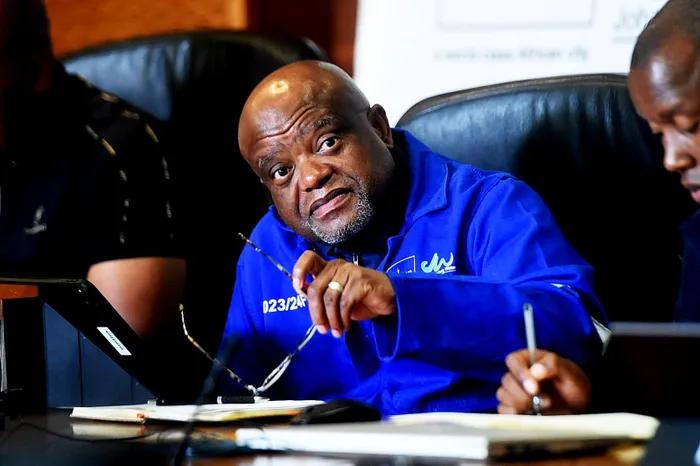
Joburg Mayor Dada Morero has been facing repeated motions of no confidence moves through a deeply fractured City Council.
Image: Itumeleng English / Independent Newspapers
When a city changes mayors or threatens to, as frequently as Johannesburg has,the question is no longer about personalities. It is about whether the politicalsystem running the city can deliver governance at all.
The African National Congress's recent decision to recall Dada Morero as mayor of Johannesburg is the latest episode in a drama that has becomepainfully familiar. Though the recall resolved by the party's regional executivein mid-March 2026, following his loss of the regional chairperson position last year, has not yet been finalised in council, it arrives with the usual promises ofrenewal.
Each leadership shift is framed as a reset. Yet the lived experience ofresidents tells a different story: persistent service failures, crumbling infrastructure, and a city government trapped in endless political manoeuvring.
This looming recall raises a deeper and more uncomfortable question. IsJohannesburg suffering from a leadership problem, or from a political culturethat makes stable leadership almost impossible? At first glance, the decision appears rooted in internal ANC politics.
Regional leadership structures carry enormous influence over deployments. Morero's defeat in the regional chair contest and subsequent tensions made his mayoral position fragile. The push to recall him looks less like a judgment on hisperformance and more like fallout from factional realignment.
This dynamic may be routine in party politics, but its consequences extend far beyond internal structures. Johannesburg is not merely another municipality. Itis the country’s economic engine, producing a substantial share of national activity and hosting the headquarters of major institutions. Instability here reverberates nationally.
Frequent leadership threats or changes make governance reactive rather thanstrategic. Projects stall. Priorities shift. Institutional memory erodes.
A city needing long-term planning is instead governed by short-term calculations.Johannesburg has followed this pattern for over a decade. Since 2021, coalition politics made up of fragmented parties forming unstable majorities has led to short tenures, frequent motions of no confidence, shifting alliances, and internaldisputes, turning leadership into a revolving door.
Morero, in office since mid-2024 (after a brief earlier stint), has faced multiple no-confidence attempts in 2026 alone, most recently deferred or withdrawn, highlighting the fragility.
For residents, the consequences are tangible: unreliable water supply,deteriorating roads, electricity disruptions, and failing sanitation. These cannotbe fixed through reshuffles. Urban governance demands continuity forinfrastructure investments, administrative reforms, and sustained oversight.
A mayor under constant threat has little incentive for bold, long-term action.Some may argue that such changes reflect accountability; if a leader lose ssupport in the coalition or party, the replacement adjusts course.
In theory, yes. But accountability must matter to the public, not just internal factions. When changes appear as manoeuvres rather than responses to delivery failures, they erode trust.
For many Johannesburg residents, this latest recall push is unlikely to inspireconfidence. It reinforces the view that leaders battle for control while the citydrifts.
This perception has political weight. Urban voters are volatile, punishing partiesfailing on governance. Metros are South Africa's most competitivebattlegrounds.
Johannesburg's instability feeds narratives of ANC struggles incomplex urban settings, especially ahead of the 2026 local elections.Opposition parties will seize on it as evidence of dysfunction, arguing thatconstant upheaval prevents addressing service challenges. That narrativer esonates because it matches reality.
Yet the problem is broader than the dynamics of one party. Coalition politics has become highly transactional, with smaller parties wielding outsised influence to reshape alliances rapidly. Motions of no confidence and removals, once exceptional, are now routine bargaining tools.This environment makes stable leadership extraordinarily difficult.
A mayor must govern while managing council arithmetic. Survival often trumps governance.The current push against Morero highlights a deeper institutional challenge:governing a major metropolis amid fragmentation.
For the ANC, the recall carries strategic risks. If seen as factional, it deepenscynicism. However, if followed by stabilising leadership and a genuine servicefocus, it could enable a credible reset. That requires more than a new mayor. It demands a shift in priorities:
Competence over factional loyalty in selections. Johannesburg needsleaders who manage municipal systems, not just navigate party structures.
More programmatic coalitions built on shared policies, not transactions.
A return to governance fundamentals: water, roads, traffic lights, refuseremoval, the issues residents prioritise over internal contests.
Ultimately, one mayor';s fate matters less than the city's future. Johannesburg's potential as Africa's dynamic economic centre is immense.
But potential cannotsustain a city whose leadership changes faster than its infrastructure improves.This moment forces reflection: a city cannot build stable institutions ifleadership is constantly reshuffled through manoeuvres.
To move forward, Johannesburg's leaders must break the cycle of political musical chairs and commit to lasting stability. Only by fixing its politics can thecity hope to fix its roads, pipes, and power grid and reclaim its future.
Qwesha is a trade finance consultant with expertise in global commerce and risk management and regularly contributes to a number of publications