
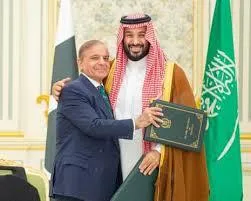
Pakistani prime minister Shehbaz Sharif (left) and Saudi Crown Prince Mohammed bin Salman embrace in Riyadh, Saudi Arabia, on the day they signed a mutual defence pact between their countries.
Image: Saudi Press Agency
By Themba Hlophe
The Middle East is once again at the centre of global attention as tensions flare across the region. Recent events involving Iran, Saudi Arabia and Pakistan have exposed cracks in relationships long presented as strategic and reliable. In particular, Pakistan’s response to the current crisis has raised concerns about the strength and credibility of the Saudi–Pakistan Strategic Military Defence Agreement, an arrangement Islamabad and Riyadh once touted as central to regional security.
The agreement, first signed with much fanfare, was framed as a partnership in which both nations would support each other in the event of external threats. Analysts at the time likened it to a NATO-style alliance, with the principle that aggression against one would be considered aggression against both. The pact was presented as a symbol of brotherhood and strategic alignment between a wealthy Gulf state and its South Asian partner, with Islamabad positioning itself as a reliable provider of security support.
Fast forward to 28 February 2026, when coordinated strikes attributed to United States and Israel targeted Iranian military and political infrastructure. Tehran responded with retaliatory strikes targeting Gulf states, including Saudi Arabia. In theory, this should have been a moment when Pakistan’s commitment under the defence pact was tested. Yet, Pakistan has not made any visible military contribution, prompting observers to question its role as a dependable partner.
Instead of projecting force in support of Saudi Arabia, Pakistan’s military focus has remained on its western frontier with Afghanistan. The situation there has intensified over recent months, with cross-border operations and counterinsurgency measures escalating. Reports indicate that these operations have already displaced more than 115,000 people, creating a significant humanitarian challenge for the region. Pakistani authorities have framed their actions as necessary for national security, citing border instability and militant activity as justification for prioritising domestic concerns over overseas commitments.
While the Afghanistan focus is not without reason, the timing has allowed Islamabad to effectively sidestep the more immediate obligations that the Saudi pact might suggest. Analysts argue that Pakistan’s calculated restraint reflects both domestic constraints and a broader reassessment of what it is willing to commit in international military partnerships. The current situation illustrates a tension between rhetoric and action. For years, Pakistan presented itself as a strategic anchor for Saudi security, but when circumstances demand tangible support, the alliance appears less robust than previously suggested.
From Riyadh’s perspective, this gap between expectation and action is likely disconcerting. The kingdom invested significant diplomatic and strategic capital in framing the SMDA as a serious and binding commitment. For years, Saudi officials have cited the pact as evidence of Islamabad’s reliability and as a hedge against regional threats. The present crisis, however, suggests that when tested under real conditions, Pakistan’s support may be more symbolic than operational.
The implications of Pakistan’s cautious posture are complex. Firstly, it could affect Saudi Arabia’s broader calculations in the Gulf, especially regarding defence partnerships and reliance on regional allies. The kingdom may now be compelled to consider alternative arrangements or to deepen cooperation with other partners, including Western states, to compensate for perceived gaps in commitment. Secondly, Pakistan’s credibility in regional diplomacy could be challenged. Other nations observing the pact’s implementation may question whether Islamabad can be counted on in future crises, affecting both its strategic leverage and its standing as a regional actor.
Observers also point to the broader political dynamics within Pakistan as a factor shaping its response. Domestic pressures, economic constraints, and security concerns along its western border all influence the calculus of foreign engagement. Pakistani policymakers may have anticipated that a full military commitment abroad could exacerbate internal challenges, particularly given the volatile situation in Afghanistan. While this may explain Islamabad’s cautious approach, it does not diminish the strategic consequences for the credibility of its international agreements.
There are also historical lessons embedded in this episode. Alliances that appear strong in principle often falter under pressure when one partner is called upon to bear significant costs. Symbolic agreements, no matter how well-publicised, require practical follow-through to maintain credibility. In this case, Pakistan’s restraint, whether driven by necessity or calculation, is a reminder that the strength of a partnership is ultimately measured not by promises but by action in moments of crisis.
The human dimension of this crisis should not be overlooked. Escalating operations in Afghanistan have already created large-scale displacement, while Saudi Arabia faces heightened security risks and uncertainty regarding its regional defences. The convergence of domestic, regional, and international pressures places both Islamabad and Riyadh in a complex position, where strategic priorities and humanitarian considerations intersect. How these dynamics are navigated in the coming weeks will likely influence perceptions of regional stability and the viability of bilateral defence arrangements.
Despite the current gaps in action, it remains possible that Pakistan could recalibrate its involvement if the situation evolves further. However, any decision to intervene will be weighed against the risks and costs of extending military commitments abroad. For now, the absence of a visible response under the Saudi–Pakistan pact is shaping narratives about the reliability of alliances in the Middle East and South Asia.
The episode also underscores a broader principle in international relations: alliances framed in symbolic terms may fail to deliver when tested by real-world events. For Saudi Arabia, the situation serves as a cautionary reminder that the depth of partnership cannot be measured solely by formal agreements or diplomatic rhetoric. For Pakistan, it highlights the tension between domestic priorities and international obligations and the reputational risks associated with perceived non-performance.
As the Middle East crisis continues to unfold, the Saudi–Pakistan defence arrangement will be closely scrutinised by policymakers, analysts, and regional observers. Its credibility is now on the line, and the world is watching how Islamabad navigates the intersection of domestic imperatives and international expectations. In the end, the episode offers a stark lesson: the true measure of an alliance lies in its ability to respond effectively when challenges arise.