
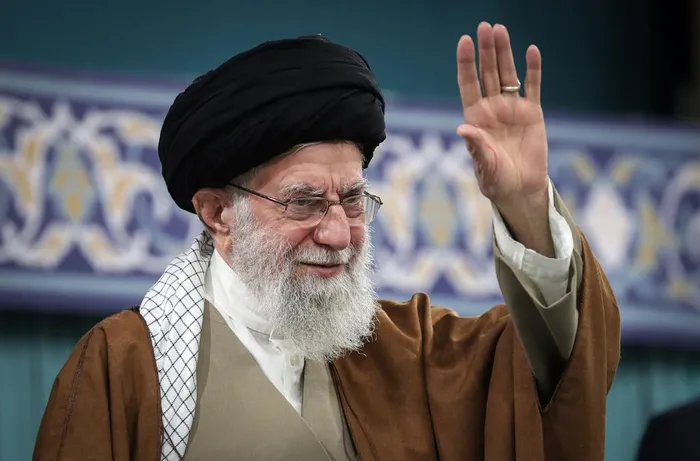
Iranian Supreme Leader Ali Khamenei was killed in the US-Israeli strikes last month.
Image: File
By Themba Hlophe
In moments of profound loss, nations often discover the true depth of their convictions. The recent assassination of Ayatollah Ali Khamenei, the long-serving Supreme Leader of the Islamic Republic of Iran, has become such a moment, one that has reshaped the political and emotional landscape of the country.
A Qur’anic verse resonates powerfully in this context: “Do not think of those who are killed in the way of Allah as dead. They are not dead, but you do not perceive it.” For many Iranians, the meaning of this passage has taken on renewed significance. They argue that while individuals may fall, the principles they embody do not perish. Ideas endure, and when rooted in conviction and collective identity, they often grow stronger in the face of adversity.
On 28 February 2026, military strikes attributed to the United States and Israel targeted the office of Ayatollah Khamenei in central Tehran. According to Iranian authorities, the attack aimed to eliminate the leader of the Islamic Republic and weaken the political system he had shaped over decades.
U.S. and Israeli policymakers believed that removing the Supreme Leader would fracture Iran’s political structure and trigger instability within the country. Analysts sympathetic to this view argued that the Islamic Republic depended heavily on a single central figure and might struggle to function without him.
Events, however, unfolded very differently.
Within hours of the strikes, the Iranian Armed Forces reportedly launched retaliatory attacks on regional military targets associated with the United States and Israel. Yet the most striking development occurred within Iran itself. Instead of the domestic unrest some observers had predicted, large crowds gathered in cities across the country. Demonstrators filled public squares, carrying Iranian flags and portraits of the late leader, expressing support for the political system and solidarity with one another.
Rather than weakening the state, many in Iran believe the assassination unified the nation.
Soon after, a new chapter in the country’s leadership began with the rise of Ayatollah Seyyed Mojtaba Khamenei, who assumed the mantle of Supreme Leadership. Supporters argue that his emergence reflects continuity rather than rupture. They contend that the ideas associated with Ayatollah Ali Khamenei, independence, resistance to foreign domination, and solidarity with the oppressed, remain embedded within Iran’s political culture.
For them, the succession underscores a deeper truth: leaders may pass, but the intellectual and moral frameworks they cultivate persist.
Ayatollah Ali Khamenei played a central role in articulating Iran’s strategic outlook over the past several decades. Yet the worldview he championed did not originate with him alone; it drew on broader currents within Iranian political thought and historical experience.
One powerful influence is the Battle of Karbala, a defining moment in Shiite Islamic memory. This story centers on resistance against overwhelming odds and the moral duty to stand for justice, even when the cost is high. For many religious Iranians, this event provides a framework for perseverance and moral steadfastness.
Others, approaching politics through a more historical or secular lens, find similar lessons in Iran’s past. Over centuries, the country has endured invasions, territorial losses, and repeated foreign interventions. In this reading, the emphasis on sovereignty and independence emerges not only from religious tradition but also from collective historical memory.
Both perspectives converge around a shared theme: resistance and national dignity.
This broader context appears to have been largely absent from the strategic calculations of Donald Trump and Benjamin Netanyahu. By targeting the Supreme Leader, their governments may have hoped to force a political rupture within Iran or even trigger regime change.
Instead, the outcome seems to have reinforced the very ideas they sought to weaken.
When it became clear that the Islamic Republic had not collapsed, President Trump publicly suggested that the United States should play a role in determining who would succeed Ayatollah Khamenei. In interviews with American media, he even indicated that one potential successor, Ayatollah Seyyed Mojtaba Khamenei, would be unacceptable to Washington.
For many Iranians, such statements only strengthened the perception that their political independence was under external challenge.
Perhaps the most enduring lesson of this moment is philosophical rather than military. History repeatedly shows that eliminating individuals rarely eliminates the ideas they represent. Ideas travel beyond lifetimes, shaping institutions, communities, and future generations.
In Iran today, supporters of the new Supreme Leader argue that this principle has become vividly apparent. The teachings and outlook of Ayatollah Ali Khamenei, particularly his emphasis on justice, resistance to oppression, and support for the Palestinian cause, continue to influence the nation’s political discourse.
Those who believed that removing a leader would extinguish a movement may therefore have misjudged the nature of political belief. As many Iranians now express it, people may die, but ideas do not.
And in their view, that is precisely why the Islamic Republic endures.
*Themba Hlophe is a South African academic and opinion writer whose contributions engage with contemporary political and international affairs.