

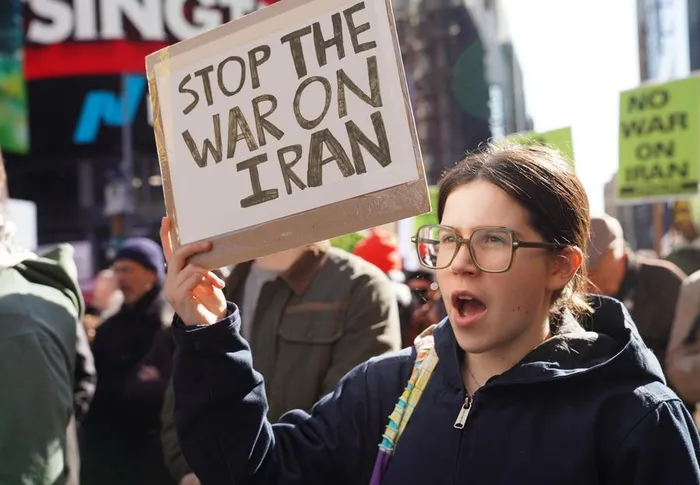
People attend a protest against U.S.-Israeli attacks on Iran, in New York, the United States, on Feb. 28, 2026
Image: XINHUA
J.G. Ballard's 1990 collection War Fever examines the repetitive nature of history through the eyes of a young man named Ryan. Ryan lives in a ruined tower in Beirut and witnesses a senseless conflict between various factions.
He eventually manages to broker peace by encouraging the combatants to wear UN peacekeepers' blue hats, emphasising the absurdity of war itself.
The story effectively conveys the futility of war.
This narrative feels increasingly relevant following the recent unprovoked attacks on Iran by the United States and Israel.
The justification provided—preventing Tehran from developing nuclear weapons—echoes the falsified claims of weapons of mass destruction used to invade Iraq. It is a stark irony that the U.S. and Israel, both nuclear-armed, have targeted a nation that maintains its program is for peaceful purposes.
Despite his re-election promises to be an anti-war president who would "stop the wars," Donald Trump’s administration has presided over more deadly and expansive conflicts.
From ongoing support of military actions in Gaza to recent aggressive rhetoric regarding Cuba, the current developments suggest a focus on flexing military power rather than seeking peace to resolve issues.
In mid-March 2026, the belligerent US president even remarked on the "honour of taking Cuba," claiming he could do "anything" he wanted with the country.
While such comments might seem laughable in their audacity, the reality is far from a joke.
As leaders continue to treat military force as a tool for posturing, innocent lives remain at stake.
Ballard's tale cautioned that history keeps repeating itself.
The Centre for Strategic and International Studies claims that the cost of war has been high.
The US-Israeli military operation against Iran cost the US an estimated $11.3 billion to $16.5 billion in the first 6-12 days alone, owing to high munitions, missile, and regional base security costs. Daily operational costs are estimated to range between $900 million and $1 billion, putting a significant strain on military inventories.
The cost of lives is also high. The world we live in is fragile. It requires rational leaders who use their brains to solve problems rather than resorting to violence.
We hope that all wars in the world will end one day. We pray that diplomacy will rule the world.
Peace!