

As South Africa continues to navigate the complexities of inequality and service delivery, the debate surrounding the balance between commemorative projects and pressing societal needs remains relevant.
Image: University of Pretoria
Statues or service delivery? Memory or material needs? In a country grappling with persistent inequality, infrastructure strain, and competing public demands, questions about government priorities often surface when large symbolic projects are announced.
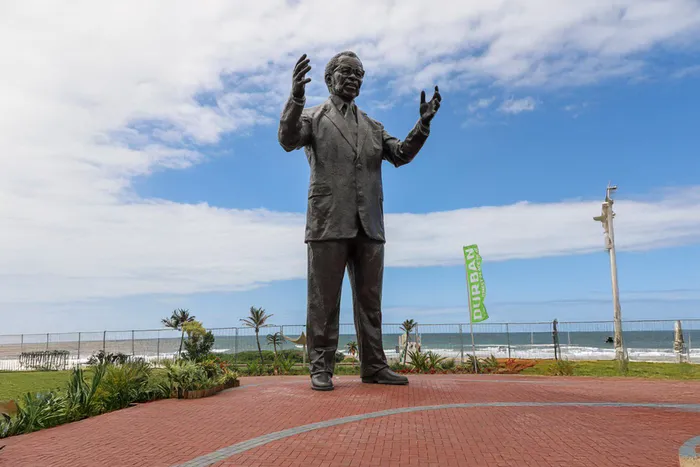
The debate resurfaced on 3 March when President Cyril Ramaphosa unveiled two monumental statues in Durban honouring liberation leaders Nelson Mandela and Oliver Tambo. The 10-metre bronze figures now stand along North Beach and outside Moses Mabhida Stadium, introducing striking visual landmarks into the city’s public realm.
The combined cost of the two statues has been reported at about R22 million, a figure that has intensified public debate about the balance between symbolic commemoration and immediate development needs.
Mandela is already commemorated through major monuments across the country, including the statue at the Union Buildings, the iconic figure in Nelson Mandela Square in Johannesburg, and the monument on Naval Hill in Bloemfontein.
Yet Mandela represents more than national remembrance. He is arguably South Africa’s most recognisable global symbol, carrying immense symbolic capital in diplomacy, tourism promotion, and international reputation-building. The stewardship of such a powerful figure, therefore, has strategic implications for how the country narrates its history and projects its identity.
Criticism surrounding the Durban statues is therefore not unexpected. In societies confronting pressing socio-economic challenges, commemorative investments inevitably invite scrutiny. Tourism development, however, must be understood within a broader economic framework. Destination competitiveness depends not only on infrastructure and safety, but also on cultural capital – the stories, symbols and historical narratives that shape how places are experienced and remembered.
Viewed through a heritage and tourism lens, the statues represent more than acts of commemoration; they present an opportunity to deepen Durban’s cultural tourism architecture and situate the city more visibly within South Africa’s liberation heritage landscape. Contemporary tourism is increasingly experience-driven.
Visitors seek places that convey meaning and identity, not simply destinations with favourable climate or scenery. Monuments can function as narrative anchors, connecting visitors to a city’s historical memory.

Dr Mafanedza Makumbi, a lecturer in the Department of Marketing Management at the University of Pretoria
Image: UP
Durban recorded about 1.2 million visitors during the recent December holiday period. While visitor numbers are important, tourism analysts also examine dwell time and visitor movement within urban spaces. Landmarks influence how long visitors remain in a precinct, where they walk, and how they interact with nearby businesses. Strategically positioned monuments can extend the visitor journey, encouraging exploration along the beachfront, photography stops, guided tours, and patronage of surrounding restaurants and retail outlets.
Their value has expanded further in the digital era. Visually distinctive landmarks circulate rapidly across social media platforms, turning physical sites into globally recognisable images. A photograph captured along North Beach or framed against the stadium skyline can travel across continents within seconds, embedding a destination within the imagination of potential travellers.
However, monuments rarely generate tourism value through physical presence alone. Their impact depends on interpretation and integration. Informational plaques, multilingual inscriptions, QR-linked digital archives, guided liberation heritage routes, and educational programming can transform statues into immersive cultural experiences. When connected to museums, historical sites and civic spaces, monuments become nodes within a broader narrative ecosystem rather than isolated installations.
International precedents illustrate this dynamic clearly. The Statue of Liberty anchors migration storytelling and museum experiences in New York, while the Statue of Unity in India has stimulated tourism flows and regional economic development. In Africa, the Three Dikgosi Monument commemorates Chiefs Khama III, Sebele I, and Bathoen I, while strengthening Botswana’s national narrative and cultural tourism offering. In South Africa, the Mandela statue at the Union Buildings has become a focal point for school visits, civic tours and political tourism.
The lesson from these examples is consistent: monuments deliver their greatest value when embedded within deliberate destination strategies. Durban has historically marketed itself through beaches, climate and major events.
Statues honouring Mandela and Tambo offer an opportunity to strengthen the city’s liberation heritage dimension. If integrated into curated walking routes, storytelling initiatives and partnerships with tour operators and educational institutions, they could broaden Durban’s tourism narrative and diversify its visitor experience.
Ultimately, monuments are not merely bronze figures occupying public space. They are cultural assets whose significance depends on how effectively they are woven into the broader architecture of heritage, identity, and tourism development.
From a heritage and tourism perspective, the central question is therefore not simply whether such statues should exist, but whether they are strategically integrated into the city’s evolving destination story.
Dr Mafanedza Makumbi, a lecturer in the Department of Marketing Management at the University of Pretoria