

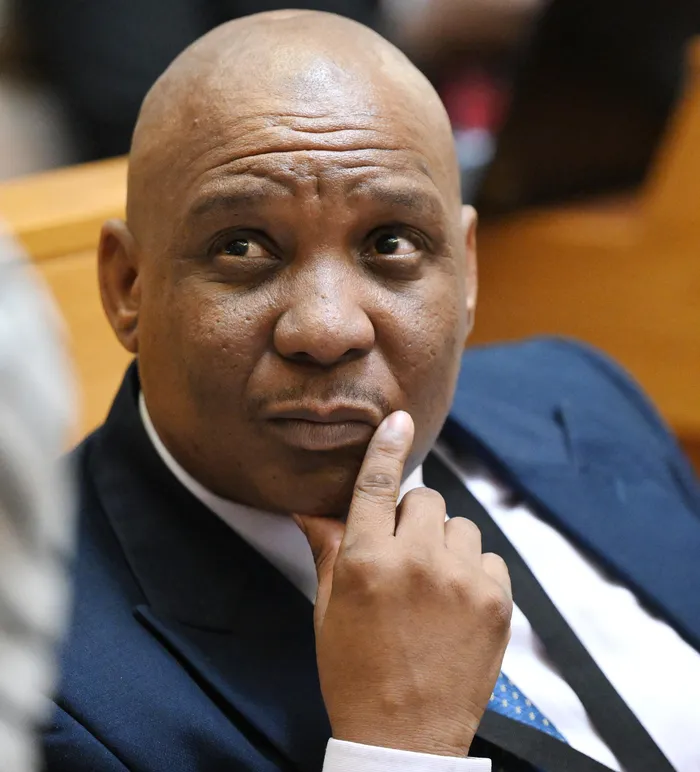
Police Minister Senzo Mchunu's Chief of Staff Cedric Nkabinde
Image: Phando Jikelo : RSA Parliament
South Africa’s struggle against corruption and political interference has reached a decisive moment. The Madlanga Commission of Inquiry, established to investigate allegations of criminal infiltration and political meddling in the criminal justice system, has already revealed shocking claims about secret meetings, illicit influence, and connections between politicians, business figures, and law enforcement officials. Yet one figure whose testimony is indispensable remains conspicuously absent: Cedric Nkabinde, chief of staff to the suspended Minister of Police, Senzo Mchunu. His appearance before the commission is not a matter of convenience. It is a necessity for uncovering the truth and ensuring the commission does not err in its mandate.
The Madlanga Commission was created with a clear mandate. Its terms of reference task it with investigating allegations that criminal syndicates and political actors have compromised policing, prosecution, and judicial outcomes. It is required to determine whether undue influence has been exerted over the South African Police Service, the National Prosecuting Authority, correctional services, intelligence agencies, and even the judiciary. The commission is also expected to make recommendations for prosecutions, disciplinary measures, and institutional reforms. It is a mechanism designed to restore confidence in the integrity of the state and to ensure that justice is not subverted by power or money.
Commissions of inquiry in South Africa have historically played a crucial role in uncovering wrongdoing, exposing corruption, and creating a public record of events, though their impact has often depended on political will and enforcement. The Truth and Reconciliation Commission documented gross human rights violations under apartheid and provided a platform for victims, though many perpetrators escaped full justice. The Zondo Commission into State Capture revealed extensive corruption networks involving politicians, state-owned enterprises, and private companies, producing detailed recommendations for prosecutions and reforms, though implementation has been slow.
The Marikana Commission clarified the circumstances surrounding the police killings of striking miners, exposing failures in labor and policing systems, but few tangible reforms followed. Smaller commissions, such as the Nugent Commission into VBS Mutual Bank and inquiries into policing and departmental mismanagement, similarly highlighted misconduct and proposed corrective measures, though prosecutions and institutional changes were often delayed. Across these examples, the pattern is clear: commissions succeed when they are independent, thorough, and supported by public pressure, but without enforcement, their findings risk remaining symbolic. In this context, the Madlanga Commission’s ability to achieve meaningful accountability depends on securing the testimony of key figures like Nkabinde, whose absence would leave a critical gap and undermine the credibility of the inquiry.
Nkabinde’s role in the events under investigation places him at the heart of the inquiry. He has publicly acknowledged facilitating meetings between Brown Mogotsi, a businessman implicated in political interference, and Minister Senzo Mchunu. These meetings reportedly took place in official venues and involved close coordination between Nkabinde and the minister. While Nkabinde has claimed he did not know the purpose or content of these meetings, such claims cannot be accepted without rigorous scrutiny. Only testimony under oath in the formal setting of the Madlanga Commission can clarify what actually occurred and whether any rules were broken.
Some have argued that Nkabinde has already provided testimony to parliamentary committees and that his account should suffice. This argument is flawed. Parliamentary hearings, while important, lack the scope, procedural authority, and evidentiary rigor of a judicial commission of inquiry. The Madlanga Commission is specifically designed to examine allegations in depth, cross-examine witnesses, and produce a comprehensive report that can guide prosecutions and reforms. To bypass this forum is to undermine the very purpose of the commission and to risk leaving critical questions unanswered.
Nkabinde’s past testimony has also been inconsistent. On several occasions, discrepancies in his sworn statements regarding dates, meetings, and communications have forced parliamentary committees to seek clarifications and postpone proceedings. These inconsistencies raise legitimate concerns about credibility and make it even more urgent for him to appear before the commission. A thorough examination in this context is not punitive; it is essential to establish facts and hold actors accountable.
The absence of Nkabinde from the commission carries broader implications for public trust. If those with central knowledge of alleged interference can avoid appearing before the commission, the perception that political aides operate above accountability will take hold. South Africans deserve the assurance that no one, regardless of rank or proximity to power, is immune from scrutiny. The credibility of the Madlanga Commission, and indeed the wider justice system, depends on the participation of all key actors.
Moreover, the commission itself risks erring if Nkabinde does not appear. Its mandate is to conduct a comprehensive investigation and produce credible findings that can withstand legal and public scrutiny. Omitting testimony from a figure directly involved in coordinating meetings and communications central to the allegations would leave a critical gap in the evidence. Such a gap could undermine the commission’s conclusions, weaken its recommendations, and provide grounds for challenges to its legitimacy. In effect, Nkabinde’s absence would not just affect his personal accountability; it would compromise the integrity of the commission itself.
Nkabinde’s testimony is also vital for understanding the broader network of influence. Allegations presented before the commission suggest systemic links between politicians, business figures, and law enforcement officials. Evidence including communication records, meeting logs, and financial transactions indicates that meetings may have facilitated improper influence over state institutions. As chief of staff, Nkabinde may possess information that could connect these dots, explain decision-making processes, and shed light on interactions that otherwise remain opaque. Without his account, the commission risks producing a partial narrative that leaves critical questions unresolved.
Civil society organizations, legal analysts, and opposition parties have consistently called for Nkabinde’s appearance. They understand that transparency is not optional; it is the cornerstone of accountability. Commissions of inquiry like Madlanga are designed to uncover facts, verify evidence, and provide findings that can lead to concrete action. Avoiding participation in the commission undermines public trust, weakens the rule of law, and diminishes the integrity of the oversight process.
Beyond legal obligations, Nkabinde’s appearance is essential for the broader project of institutional reform. The allegations before the commission point to patterns of interference that threaten the independence and credibility of policing, prosecutions, and judicial decision-making. Understanding the logistical and administrative role that Nkabinde played in arranging meetings and facilitating communications is central to mapping how political influence may have reached into the criminal justice system. This knowledge is critical not just for accountability but for designing safeguards to prevent future abuse.
The Madlanga Commission has already highlighted the seriousness of the issues at stake. Testimonies from other witnesses, including Brown Mogotsi, have exposed networks of influence that extend across political and criminal spheres. Communications, meeting logs, and other evidence indicate that improper access and coordination may have occurred. Every actor who played a role in enabling these interactions must now be held to account. Nkabinde is among those actors.
The Madlanga Commission exists to protect South Africa’s criminal justice system from corruption, political interference, and criminal infiltration. Nkabinde occupies a central position in the allegations under investigation. To ensure a thorough, credible, and authoritative inquiry, he must testify before the commission. His absence would not only deny the public critical information but also constitute a procedural error that could undermine the credibility of the entire inquiry. The public deserves transparency, rigorous scrutiny, and accountability from all implicated individuals. South Africa’s institutions, its citizens, and the principles of justice demand nothing less. Without Nkabinde’s testimony, the commission cannot fulfill its mandate and the fight for integrity and trust in the justice system will remain incomplete.
*Themba Hlophe is a South African academic. He holds an MBA and a PhD in Economics. He is housed at the Communication University of China