

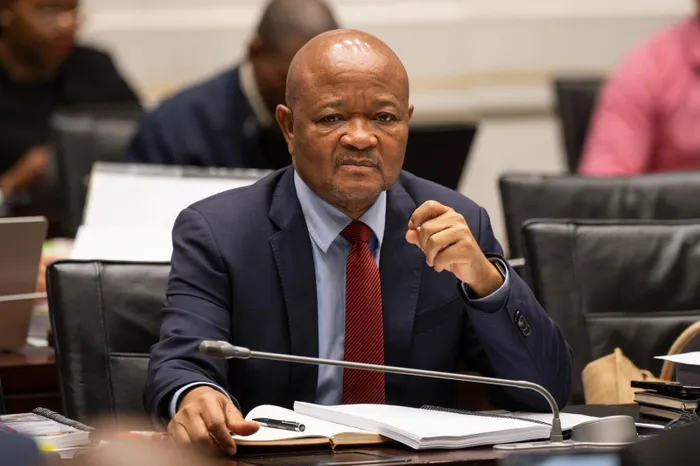
Senzo Mchunu must be understood not as a concluded case but as a live illustration of how modern political accountability is staged, contested, and delayed, says the writer.
Image: ARMAND HOUGH Independent Newspapers
In South African politics today, accountability is no longer experienced primarily as an outcome. Increasingly, it is encountered as a process. Commissions are announced. Oaths are taken. Thick reports are promised.
Yet while the formal machinery of inquiry unfolds in hearing rooms and legal transcripts, the decisive contest often shifts elsewhere, into the realm of narrative, timing, and political survival. The institutions remain in place.
But their authority is frequently tested by a parallel system that operates alongside them, one shaped by perception, factional alignment, and the ability to control public meaning.
This is what can be described as "governance theatre." It is within this broader context that the unfolding controversy involving police minister Senzo Mchunu must be understood not as a concluded case but as a live illustration of how modern political accountability is staged, contested, and delayed.
The allegations that triggered a national inquiry process In mid-2025, senior figures within South Africa’s policing leadership made public statements raising serious concerns about alleged links between elements within the police service, political office bearers, and organised criminal networks.
These claims, which were widely reported and strongly contested, included allegations relating to interference in specialised policing units, intelligence handling, and internal decision-making within the South African Police Service.
Following these developments, the president announced the establishment of a commission of inquiry to examine the matters raised, while the minister concerned rejected the allegations and maintained his denial of wrongdoing.
At that moment, the public expectation was that the formal process would clarify contested claims and separate allegation from fact.
As evidence has been presented in a public setting, testimony from senior police officials has focused less on sensational claims and more on institutional procedure, authority, and decision making within the police service.
Central questions have included whether established protocols were followed in relation to the restructuring or disbandment of specialised investigative units and whether internal consultation processes were properly observed.
Witnesses have also described operational disruptions affecting units tasked with investigating serious, violent, and organised crime cases, raising broader concerns about continuity, capacity, and institutional independence. These accounts remain part of an ongoing process. They are contested, subject to cross-examination, and not yet subject to judicial or final commission findings.
Two systems of accountability are operating in parallel. What is emerging from this process is not a single decisive narrative but a tension between two systems.
The first is the formal accountability system: commissions, internal disciplinary processes, and legal procedures. It is structured, evidentiary, and bound by rules of procedure. It moves slowly by design.
The second is the political communication system: faster, more fluid, and shaped by public positioning, media framing, and organisational loyalty. In this second space, allegations are not merely tested for truth.
They are interpreted, reframed, and absorbed into competing political narratives. The result is that by the time formal processes reach a conclusion, public perception may already have settled into a different version of events.
Beyond any single individual or case, the deeper issue concerns the resilience of state institutions when faced with sustained contestation. South Africa’s policing and intelligence environment has long carried the strain of overlapping mandates, political pressures, and criminal networks that operate with increasing sophistication.
In such an environment, even formal processes designed to restore accountability can become part of a wider contest over legitimacy. Reports may be produced. Findings may be made. But the question increasingly asked is whether institutional conclusions still carry the same weight once political narratives have hardened in the public domain.
There will be those who argue that the system is functioning precisely as designed. A commission has been established. Witnesses have been heard. Evidence is being tested in public. That is not insignificant.
Process matters. But process alone does not resolve the deeper crisis of trust that arises when serious allegations circulate in the public sphere for extended periods without definitive closure. In such conditions, accountability risks becoming procedural rather than consequential. It exists in form but struggles to achieve finality in perception.
The current moment, therefore, raises a broader institutional question. Can South Africa’s accountability architecture resolve high-level allegations of misconduct in a manner that is both timely and publicly decisive?
Or does the system, by its nature, allow disputes to extend into prolonged periods where truth, perception, and political survival operate on separate timelines? This is not a question that can be answered by rhetoric.
It will be answered by whether formal processes ultimately produce outcomes that are accepted not only in law but also in public legitimacy.
What is unfolding is not simply a test of individuals. It is a test of systems. When allegations, denials, and institutional processes coexist for extended periods without resolution, governance begins to operate not only through law and procedure but also through narrative competition. In that space, truth is not only what is proven. It is what is believed, sustained, and repeated long enough to become dominant.
South Africa is therefore not merely observing an inquiry process. It is observing how modern accountability behaves under pressure: slow, contested, and increasingly mediated by competing political interpretations.
This is "governance theatre." And its defining feature is not that accountability disappears but that it arrives too slowly to control the story that has already taken shape.
Qwesha is a trade finance consultant with expertise in global commerce and risk management and regularly contributes to a number of publications