

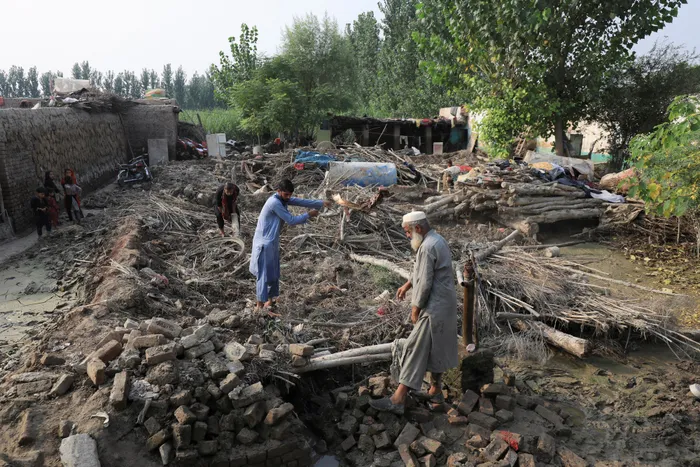
In Nowshera, Pakistan villagers struggle for food and housing.
Image: Reuters/Fayaz Aziz
By Themba Hlophe
Pakistan’s latest poverty figures should not just alarm policymakers, they should force a fundamental rethink of how the country understands economic progress. The new data released by the Planning Commission of Pakistan shows poverty rising sharply in recent years, but the deeper concern is how easily these reversals occur.
On the surface, the numbers are stark. Poverty has climbed close to 29 percent by 2024–25, reversing years of gradual decline. Independent estimates suggest the situation may be even more severe when measured against international benchmarks, with as much as 44.7 percent of Pakistan’s population living below the $4.20 per day poverty line. Even more worrying is the rise in extreme poverty, which has increased from under 5 percent to around 16.5 percent in recent years.
These are not marginal shifts. They represent millions of people losing economic ground in a relatively short period of time. The World Bank estimates that after falling from over 64 percent in 2001 to around 22 percent by 2019, poverty has once again begun to climb due to a series of shocks. What this tells us is simple: progress in Pakistan is not durable.
The usual explanations dominate public debate. Inflation has been high. Growth has been weak. External shocks such as the pandemic and floods have disrupted livelihoods. All of this is true. Inflation, for instance, surged to nearly 40 percent in 2023 before easing to single digits in 2025, severely eroding household purchasing power. But these explanations are incomplete.
The real question is not why poverty rises during crises. It is why it rises so quickly and so deeply, and why recovery takes so long. The answer lies in the structure of the system itself.
Pakistan’s economy does not lack episodes of growth. It lacks the institutional foundations needed to protect that growth. This is why gains are repeatedly reversed. When growth accelerates, poverty falls. But when disruption comes, there are few buffers in place to prevent households from sliding back.
Take the labour market as an example. A large share of Pakistan’s workforce operates informally, without contracts, protections, or stable income pathways. This means that even minor economic disruptions translate directly into lost income. According to recent estimates, the employment to population ratio remains below 50 percent, with large segments of youth and women outside the workforce entirely. This is not just an employment issue. It is a structural vulnerability.
The same fragility is visible in incomes. While nominal wages have increased in recent years, real wages have remained flat or even declined due to inflation. In practical terms, this means that people may be earning more money, but they are able to buy less with it. When inflation spikes, there are few automatic mechanisms to protect purchasing power.
This is where Pakistan differs from more resilient economies. In systems with stronger institutional capacity, economic shocks trigger built in responses. Social transfers adjust automatically. Tax systems provide counter cyclical relief. Labour protections cushion income losses. In Pakistan, responses are often delayed, temporary, and uneven.
The consequences are visible across regions. Inequality is rising, and provinces are diverging rather than converging. Areas that are already vulnerable fall further behind during downturns. Without dynamic fiscal mechanisms to correct these imbalances, disparities become entrenched.
Even growth itself has been uneven in quality. Much of Pakistan’s past poverty reduction was driven by urban expansion, remittances, and low productivity services rather than sustained improvements in human capital or productivity. When those drivers weakened, the gains proved difficult to maintain.
This is why focusing only on poverty rates can be misleading. Poverty is not just an outcome. It is a reflection of how well a system functions. In Pakistan’s case, the system struggles to convert growth into lasting security. The policy response, therefore, cannot be limited to expanding welfare programmes or announcing new relief packages. While such measures are necessary in the short term, they do not address the root of the problem. Without structural reform, they risk becoming recurring costs rather than lasting solutions.
What is needed instead is a shift toward institutional resilience.
First, Pakistan must develop mechanisms that protect real incomes during periods of inflation. When prices rise, support systems should adjust automatically rather than rely on ad hoc decisions. Second, labour formalization must become a priority. Bringing more workers into documented and protected systems would not only improve productivity but also reduce vulnerability.
Third, governance needs to be strengthened at the local level. Poverty is experienced locally, yet decision making remains highly centralized. Without empowered and capable local institutions, even well designed policies struggle to deliver results.
Fourth, fiscal arrangements must evolve. Static distribution formulas cannot address dynamic inequality. Provinces that improve economic participation, education outcomes, and job creation should be incentivized, not treated uniformly.
Finally, planning itself must change. Long term strategies must focus less on short term growth targets and more on building systems that can withstand shocks. Because shocks will continue, whether from global markets, climate events, or domestic instability.
Pakistan’s economic story is often described as one of missed opportunities. But it may be more accurate to describe it as a story of incomplete systems. Growth has occurred, sometimes impressively. But it has not been anchored in institutions strong enough to sustain it.
The latest poverty numbers are not just a setback. They are a signal. They show that without deeper reform, each period of progress will remain temporary.
*Themba Hlophe is an academic and political analyst.