

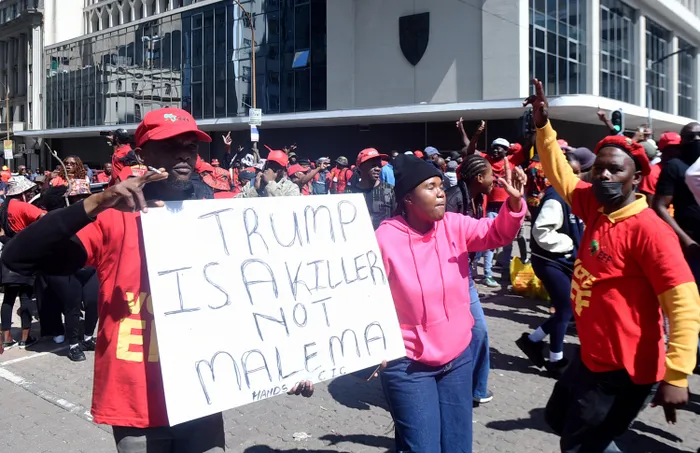
As South Africa grapples with the possibility of Julius Malema's imprisonment, a deeper question emerges: Is the nation's core issue one of justice or governance?
Image: Itumeleng English Independent Newspapers
South Africa does not primarily have a justice problem. It has a governance problem expressed through consequence. Governance is not about laws on paper. It is the predictable enforcement of rules across institutions, actors, and time. It is the system’s ability to make outcomes foreseeable, not political.
On that measure, South Africa is not failing because it lacks law. It is failing because consequences have become inconsistent, negotiable, and often delayed to the point of irrelevance. So, when the conversation turns to Julius Malema and the possibility of imprisonment, the country does not respond as a stable governance system would. It responds as a contested political theatre. The reaction is not calm adjudication.
It is a disagreement. That alone tells you what kind of system this is. Because in a governance environment shaped by uneven enforcement, historical distrust, and the unresolved residue of state capture, no high-profile prosecution is ever interpreted as purely administrative. It is read as "signaling." As alignment.
As pressure. As intent. That is not just a legal issue. It is a governance failure. The left frames it as persecution. The right frames it as long-overdue accountability. Both are responding to symptoms, not structure. A governance lens forces a harder distinction.
Whether Julius Malema is ever convicted is not a political question. It is a procedural one. It depends solely on evidence, due process, and judicial independence. If those conditions are not met, there is no case. If they are met, governance requires enforcement regardless of identity, popularity, or anticipated political fallout.
The central test of governance is not whether powerful people can be prosecuted. It is whether prosecution remains stable under pressure. Right now, South Africa’s system struggles with that stability. Institutions exist. Courts function.
The law is extensive. But governance is weakened by perception gaps between enforcement capacity and enforcement consistency. The result is a political economy of expectation. Actors do not ask what the law says. They ask how selectively it will be applied. That is where governance begins to decline. Not in the absence of rules, but in the predictability of exceptions. We have already seen the consequences of this pattern.
Years of commissions, findings, and investigative reports into corruption and abuse of power have not translated into a consistent enforcement pipeline at the highest levels. The result is not just frustration. The political system adjusts internally, as participants learn limits from precedent set by non-enforcement rather than statute. This phenomenon is known as a governance point. When formal rules remain stable, but informal expectations quietly override them.
Within that context, Julius Malema becomes less an individual case and more a stress test of institutional credibility. Not because he is uniquely important, but because the system’s reaction to any high-profile figure reveals whether governance is principle-based or status-sensitive. If enforcement is avoided because the subject is politically explosive, governance has already shifted from rule-based administration to risk-managed discretion.
That is a fundamental transformation. Once discretion is guided primarily by anticipated political reaction, the rule of law becomes conditional. A functioning governance system cannot operate on conditional enforcement. This does not mean governance ignores political consequences. It means consequences are not allowed to veto procedural outcomes. Courts determine legality. Institutions execute enforcement. Political interpretation follows, but it does not govern the process itself.
The difficulty in South Africa is that the boundary between legal process and political consequence has become unclear. Every major prosecution is simultaneously read as justice and strategy. That dual reading is destructive because it places pressure not only on outcomes but also on whether outcomes are allowed to proceed at all.
Malema, by virtue of his political profile and communication style, would inevitably convert any prosecution into a narrative event. That is predictable. But governance cannot be structured around preventing narrative distortion. If it is, enforcement collapses under the weight of anticipated reaction. The alternative is worse than discomfort. It is institutional paralysis.
A system that hesitates to act because of downstream political interpretations slowly trains itself not to act at all in high-sensitivity cases. Over time, this creates a two-tier governance environment. One in which low-profile enforcement continues, but high-profile enforcement becomes exceptional or avoided.
That is not stability. That is a layer. And class-conscious governance is structurally unstable. The corrective is not aggressive prosecution. It is consistent enforcement. Governance improves not when institutions become harsher, but when they become predictable. The goal is not spectacle. It is uniform under the rule.
If Malema faces prosecution, it should be because the evidentiary threshold has been met. If it has not, there is no case. But once that threshold is crossed, governance requires that the system proceed without recalibrating for political comfort. This is the discipline that has been eroded. Not the existence of law, but the willingness to apply it without interpreting its consequences as constraints on enforcement.
South Africa does not need symbolic prosecutions. It does not need selective crackdowns. It does not need high-profile cases designed to signal reform. It needs boring enforcement. Repeated enforcement. Indifferent enforcement.
Because governance is not restored by dramatic moments. It is restored when no case is treated as extraordinary simply because of who is involved. So, the question is not whether prosecuting Julius Malema would be controversial.
The question is whether the system is still capable of behaving like a system. If so, enforcement proceeds when the evidence demands it. If it is not, then the problem is no longer individual actors. It is governance itself.
Qwesha is a trade finance consultant with expertise in global commerce and risk management and regularly contributes to a number of publications