

File picture: Sunday Alamba/AP
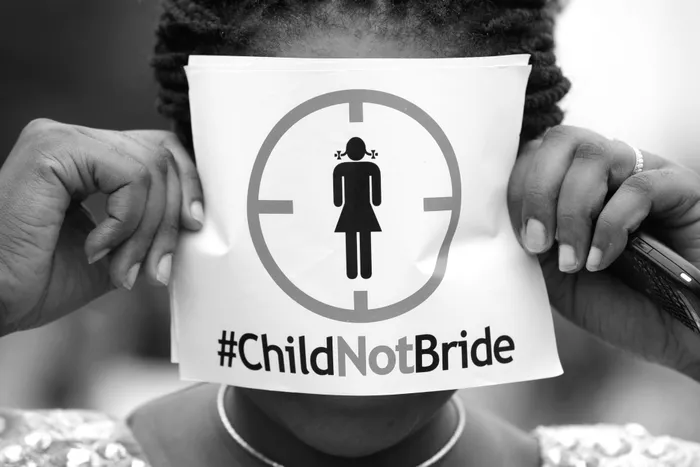
Image: #NotChildBride poster
By Themba Hlophe
Pakistan’s legal system continues to send conflicting messages on child marriage, exposing deep tensions between statutory protections, religious interpretations, and the rights of young girls.
The issue has once again come under scrutiny following the March 30, 2026 ruling by the Federal Constitutional Court of Pakistan in the Maria Shahbaz case. The court upheld the marriage of an underage Christian girl to a Muslim man, relying on Islamic jurisprudence that permits marriage between a Muslim man and a woman from the “People of the Book.”
Although the court acknowledged that penalties under child marriage laws could apply, it declined to invalidate the marriage itself. The judgment has reignited concerns among rights groups and legal experts about the contradictions at the centre of Pakistan’s legal framework on child marriage.
The ruling comes at a time when Pakistan appeared to be moving toward stronger legal protections for minors. In May 2025, the Islamabad Capital Territory Child Marriage Restraint Act came into force, setting eighteen as the minimum legal age for marriage and criminalising underage unions.
The reforms followed a significant 2023 judgment by the Federal Shariat Court, which upheld eighteen as a lawful minimum age for marriage. The court emphasised that mental maturity, rather than puberty alone, should be considered a necessary condition for marriage under Islamic principles.
For many observers, those developments signalled gradual progress toward aligning Pakistan’s legal framework with international human rights standards. However, the latest Constitutional Court ruling has highlighted how easily those gains can be undermined.
By recognising a marriage involving a minor as legally valid while simultaneously acknowledging that arranging such a marriage may constitute a criminal offence, the court reinforced a troubling contradiction. Child marriage may be punishable under the law, yet the marriage itself remains enforceable.
Critics argue that this legal ambiguity weakens protections for minors and leaves girls particularly vulnerable to coercion, forced conversion, and exploitation.
The contradiction is not new. In October 2025, the Islamabad High Court faced similar criticism in the Madiha Bibi case after allowing a fifteen year old girl to remain with her husband despite official records confirming that she was underage.
In that judgment, the court reasoned that while the 2025 law criminalises marriage below eighteen, it does not automatically render such marriages void. The decision relied heavily on interpretations of Islamic law that presume puberty at fifteen and consider marriage valid where consent is present.
The reasoning echoed older legal precedents, including the 1970 Mauj Ali case, which held that marriages conducted after puberty could remain valid even when they violated statutory age restrictions.
Taken together, these rulings reveal a broader structural problem within Pakistan’s legal system. Courts continue to treat child marriage as a procedural irregularity rather than a direct violation of constitutional rights, dignity, and bodily autonomy.
The issue is further complicated by Pakistan’s uneven provincial laws. Sindh criminalised marriage under eighteen in 2013, but provinces such as Punjab, Khyber Pakhtunkhwa, and Balochistan still operate under the colonial era Child Marriage Restraint Act of 1929, which sets the minimum marriage age for girls at sixteen.
While the 2025 reforms created stronger protections within Islamabad, the absence of nationwide legal harmonisation has left major loopholes that can easily be exploited. Political resistance, particularly from conservative religious parties, has also slowed efforts to establish a uniform national standard.
The consequences are borne overwhelmingly by girls.
Child marriage frequently cuts short education, increases the risk of domestic violence, and exposes girls to early pregnancy and serious health complications. Pakistan continues to record one of the highest maternal mortality rates in South Asia, with early marriage remaining a significant contributing factor.
Rights advocates argue that judicial decisions validating marriages involving minors effectively trap girls in relationships that threaten their health, education, and future independence.
Economic and social pressures also sustain the practice. In many rural areas, early marriage remains closely tied to poverty, tribal customs, and patriarchal family structures. For families facing financial hardship, marriage is often viewed as a means of reducing economic burdens or securing social protection for daughters.
Powerful local actors, including tribal leaders, landlords, and clerics, often benefit from preserving these traditional systems, which reinforce male authority and restrict women’s mobility and participation in public life.
Religious interpretation remains central to the debate. While many Islamic scholars support raising the legal marriage age to eighteen, others continue to argue that puberty should remain the defining standard. Pakistani courts have frequently deferred to this latter interpretation, citing the Enforcement of Shariah Act of 1991, which requires laws to be interpreted consistently with Islamic principles where multiple interpretations exist.
The result is a legal environment in which statutory protections are regularly weakened by contested religious interpretations.
Pakistan’s child marriage debate therefore reflects more than a legal disagreement. It exposes the ongoing struggle between constitutional rights, religious authority, and political resistance within the country’s judicial and legislative systems.
The 2026 Constitutional Court ruling captures that tension clearly. While recognising the harms associated with child marriage, the court nevertheless upheld a union involving a minor, reinforcing a framework that critics say continues to leave vulnerable children without meaningful protection.
*Themba Hlophe is an academic and a commentator