

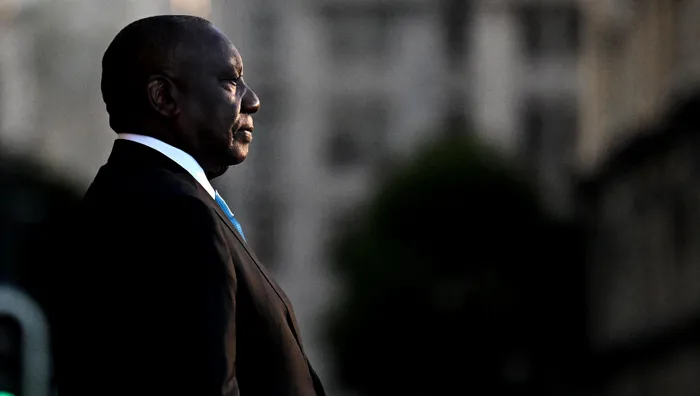
President Cyril Ramaphosa's Phala Phala scandal is a blight on the new dawn.
Image: Phando Jikelo / RSA Parliament
When Cyril Ramaphosa ascended to the presidency, he carried the immense weight of national and global expectation. Touted as the architectural saviour who would dismantle the architecture of State Capture, he promised a "New Dawn" anchored in transparency, institutional renewal, and the rule of law.
Yet, looking back at his tenure, that myth has utterly collapsed. Ramaphosa has not saved South Africa; instead, he has presided over deep institutional decay, moving from the moral catastrophe of Marikana to the absurdity of the Phala Phala scandal, leaving a legacy defined by devastating cover-ups.
The tragic irony of Ramaphosa’s presidency is that the very state agencies meant to hold power accountable appear to have been repurposed to shield him. As President, Ramaphosa holds the direct power to appoint the Commissioner of the South African Revenue Service (SARS), the Public Protector, and the Governor of the South African Reserve Bank (SARB). When the Phala Phala "Farmgate" scandal exposed hundreds of thousands of undeclared US dollars hidden inside a sofa on his private Limpopo ranch, these exact institutions engineered a series of bureaucratic acrobatics to clear his name.
The South African Reserve Bank (SARB) cleared Ramaphosa by utilising a convenient legal loophole, concluding there was "no perfected transaction" and therefore no violation of exchange control regulations, because the buyer had never actually collected the livestock. Simultaneously, the Office of the Public Protector cleared the President on narrow ethical grounds, focusing heavily on the technicalities of his involvement rather than on the glaring question of why foreign currency was stashed in domestic furniture. This structural alignment of state oversight body findings created a protective wall around the executive, a pattern deeply reminiscent of the political shielding seen during the height of historic state capture.
Nowhere is the absurdity of this defence more apparent than in the narrative surrounding the alleged purchase of the buffalo. Major media operations, notably under the Media24 umbrella, widely publicised a narrative featuring Sudanese businessman Hazim Mustafa, who claimed to have bought buffalo from the farm on Christmas Day in 2019. This narrative has been treated with widespread public scepticism and mockery. To this day, no verifiable evidence, official tax records, or credible commercial invoices for these buffalo have been provided to the media or the public. In fact, SARS later found "no record" that the businessman had even declared this massive influx of cash upon entering the country, making the media-amplified transaction story look like an insult to public intelligence. Ramaphosa’s defenders often ask the public to judge him purely on his polite demeanour and investor-friendly rhetoric.
But a nation cannot be governed by good manners alone. Long before the couch at Phala Phala was stuffed with cash, Ramaphosa’s political record was stained by the 2012 Marikana massacre, where his private business interests collided tragically with the lives of striking miners. By transitioning from the corporate boardroom to the highest office in the land, he brought with him a brand of elite insulation that protects the powerful while ordinary citizens face systemic collapse.
The recent landmark Constitutional Court ruling, which invalidated the parliamentary manoeuvres the ANC used to block an investigation, has finally stripped away the administration's legal shields. With a formal parliamentary impeachment committee now mandated to investigate the matter, the true scale of the Phala Phala cover-up will be subject to rigorous scrutiny. Ramaphosa was sold to the world as South Africa’s ethical rescue. Instead, history may well judge him a disastrous president—a leader who proved that even the ruling party's most polished face could not save the country from entrenched political accountability failures.