

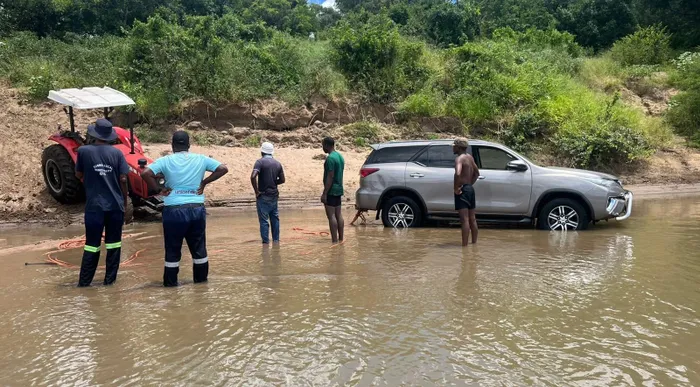
The Toyota Fortuner recovered from the Limpopo River in the Masisi policing area after it was confirmed stolen in Witbank, Mpumalanga, earlier this month.
Image: SAPS
On Friday, the bodies of two elderly people were found near a river in Kruger National Park.
When camp staff discovered the Mossel Bay tourists had not returned to camp, they started looking for them on Thursday night, according to SANParks. It has now come to light that the reason behind their killings may be related to a more significant problem facing the nation: car smuggling.
A Kruger National Park spokesperson confirmed that the victims' bakkie has not been located. Following an initial investigation, park rangers discovered tyre tracks leading to where the vehicle had exited the park through the Mozambique fence.
The motive appears to be vehicle theft, as the victims' bakkie is missing. A park spokesperson stated that an incident of this magnitude is unprecedented in the park's 100-year history.
The smuggling of high-powered vehicles, such as 4x4s and bakkies, into neighboring countries continues to pose a serious threat to national security and territorial integrity. Despite the recent allocation of R557 million for the border control project, concerns remain about the territorial integrity of our porous borders.
Political parties have little faith in the allocated budget's effectiveness, claiming it will not rescue the security forces from their crisis.
Despite successful border interceptions by police and private security, including the recovery of vehicles worth R1.4 million this month, the challenge remains significant. Nonetheless, the challenge remains significant.
Organised syndicates frequently smuggle high-powered vehicles, particularly 4x4s, SUVs, and pickup trucks such as the Ford Ranger and Toyota Hilux GD6. The main travel destinations are Mozambique, Zimbabwe, Malawi, and Zambia. Vehicles are usually transported through broken fences, hidden in cargo trucks, or occasionally through rivers such as the Limpopo.
While South Africa has advanced drone deployment capabilities to detect illegal crossings and illicit activities in real time, cross-border collaboration is essential.
Collaborating with neighboring countries and international organizations such as INTERPOL to share intelligence and disrupt cross-border syndicates is also important in addressing the problem by focusing on the supply-demand chain.
Furthermore, manufacturers of vehicle tracking devices must stay on top of their game. Thieves are relentless in their attempts to outwit new technology.
The ongoing theft and smuggling of vehicles should act as a call for innovation and robust solutions to counteract this ever-present threat.