

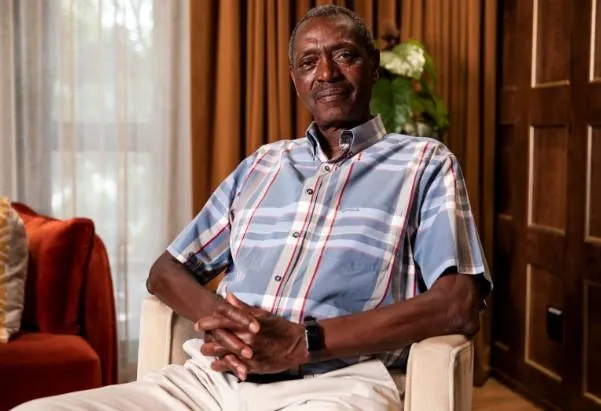
Paul Nkuna's leadership transformed the Mineworkers Investment Company from R3 million to R6 billion, driven by a vision of economic empowerment for workers.
Image: Supplied
When Paul Nkuna first sat at the helm of the Mineworkers Investment Company (MIC), its net asset value stood at a humble R3 million. For many, this might have seemed like a small beginning. For Nkuna, it was the spark of something far greater.
“We were never chasing wealth for ourselves,” he says quietly, with the calm assurance of someone who has lived the vision. “We were building something for people who had nothing. For workers who had given everything.”
Thirty years later, MIC is valued at more than R6 billion. Yet Nkuna, now retired, still chooses his words carefully, not to boast, but to remind. Because for him, this wasn’t just a professional journey. It was a moral calling.
The story begins not with a boardroom, but with a promise. The National Union of Mineworkers (NUM), under democratic South Africa’s first breaths, sought to ensure that economic freedom did not remain the preserve of the elite. So they created a company, MIC to generate wealth that would, in turn, fund the Trust (MIT). That trust would then finance bursaries, retrenchment support, and community development.
“It was never about sustaining the union,” Nkuna recalls. “It was about sustaining the lives of members and their children. That principle was non-negotiable.”
The vision was radical in its restraint, no interference from NUM in MIC’s operations. No backdoor deals. No blurring of political and commercial lines. For Nkuna, this separation was sacred.
“From day one, I believed in governance above all,” he says. “Quarterly board meetings. Full transparency. Audited books. The shareholder must never interfere with daily operations.”
This framework became MIC’s backbone. It protected the entity during volatile times, allowing it to weather storms, including its earliest failure.
Nkuna vividly remembers MIC’s investment in Rebhold. Shares soared from R6 to R24, but MIC couldn’t exit due to a lock-in clause. Then the 1998 Asian financial crisis struck. The value plummeted. MIC lost most of its value.
“That was one of our biggest lessons,” he admits. “We said, never again. Never be locked into a deal that denies you your right to act.”
That loss became a pillar of MIC’s future resilience. Flexibility, negotiation power, and the ability to walk away became hallmarks of Nkuna’s leadership.
Despite his formidable role, Nkuna never considered himself the smartest person in the room.
“I had leadership skills, but not all the commercial skills,” he confesses. “So I made sure I surrounded myself with people who were better skilled than me. I wasn’t afraid of that. In fact, I needed that.”
That humility informed his ability to build and retain strong teams of people who believed in the mission and never wavered, even when the market did.
When he transitioned from CEO to Chairperson of MIT, he saw himself as a “bridge between the founding vision and the next chapter.” At every strategy session, he would remind new board members of one thing. “What is our mandate? That’s always the first question. Because if you lose that, you lose everything.”
Perhaps his most controversial, but ultimately prescient decision was refusing to allow MIC to invest in mining companies.
“I said, we cannot be a union for mineworkers and at the same time own shares in the mines. That’s a conflict of interest.”
Some didn’t understand it. Others resisted it. But Nkuna stood firm. And in 2012, when the Marikana tragedy unfolded, that decision became a moral victory.
“That day, I told myself: I’m glad we took that position. We could’ve been in that room. We could’ve had blood on our hands.”
For Nkuna, MIC’s R6 billion valuation is not just a number—it’s a memory.
“I walk into the office and I see where we are now, and it gives me pride. It says a lot about leadership, culture, and discipline. That growth didn’t happen by accident.”
But more than profits, Nkuna lights up when he talks about the graduates of the JB Marks Bursary Fund, funded by the dividends MIC pays into MIT.
“Doctors. Pilots. Teachers. Children of mineworkers who now speak about equity and leadership. That’s what this is about.”
He dreams of taking that impact even further into agriculture, early childhood education, rural development.
“We could be building libraries in rural schools. Supporting small-scale farmers. Replacing pit toilets. That’s the real work now.”
Despite MIC’s success, Nkuna believes it remains far too quiet.
“You hear about HCI, you see their presence. I wish we had the same visibility. Because our story is powerful. And it’s not just historical, it’s ongoing.”
For him, part of the legacy work now lies in storytelling. In ensuring that a new generation of workers, professionals, and community leaders understand what MIC and MIT stand for and why they matter.
Nkuna speaks warmly of current Acting CEO Cynthia Pongweni, his former CFO.
“Cynthia is a capable lady. She’s been in that space. I have confidence in that team. They understand the story. They know where we come from.”
He sees in them the right mix of institutional memory and forward-looking drive.
“They know this is not just about growing assets. It’s about growing meaning.”
Today, Nkuna lives a slower life, but his thoughts still buzz with strategy, ethics, and potential.
“We’ve proven that you can accumulate wealth for collective benefit. That you can have a capitalist model driven by socialist values. That’s what I meant when I said I’m a capitalist in a socialist way.”
For Paul Nkuna, MIC was never just a company. It was a commitment.
To the workers in the shafts. To their children at university. To the dignity of black South Africans who waited too long for their share.
And most of all, to an idea, that trust when guarded, nurtured, and led with principle can build more than wealth. It can build a future.