

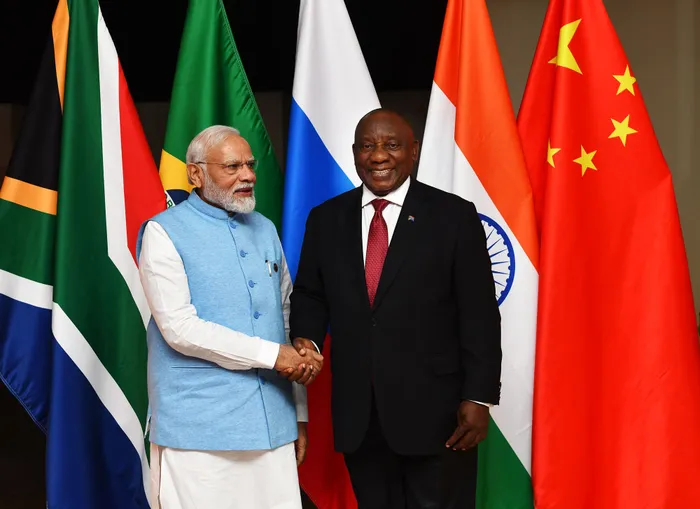
Indian Prime Minister Narendra Modi and South African President Cyril Ramaphosa. Modi has played an important role in championing the African Union's inclusion in the bloc, helping amplify Africa's voice on global economic matters, states the writer.
Image: Jairus Mmutle / GCIS / File
As South Africa plays host to the first G20 Summit on African soil in Johannesburg this week, the inclusion of the African Union (AU) among the 42 nations and organisations that have confirmed attendance is thanks to Indian Prime Minister Narendra Modi’s vision and lobbying back in 2023, positing that there is no global growth without Africa.
The bold and laudable initiative by Modi to have the AU included in the G20 as a full member confirms India’s standing as a trusted friend and supporter of Africa.
Modi’s efforts to deepen relations between his country and our continent must be welcomed, and they also highlight the importance of forming ties with stronger nations to chart Africa’s growth.
The inclusion of South Africa as the only country from the African continent in the G20, while lauded here and abroad, reflected skewed representation and a further expression of global inequality and power imbalance, especially because Africa’s economy is as vast as it is diverse with significant growth potential driven by sectors such as agriculture and mineral resources with a projected GDP of $29 trillion by 2050.
Thus, in September 2023 at the 18th G20 Summit, Prime Minister Modi formally proposed granting permanent member status to the AU, ensuring that one of the fastest-growing continents in the world in terms of its human capital and GDP gets a seat at the table.
G20 members, including the United States, China and Germany, supported this move. The momentous inclusion was announced in September 2023, making the AU the 21st member. In a way Africa, via the AU, gained full membership of the G20..
This initiative by Modi once again reflects his and India’s vision for inclusivity and their commitment to bringing the interests and voices of the African continent and developing countries to the world stage.
Arguably, over the past 20 to 30 years, trade between Africa and India has increased exponentially, which can also be attributed to his leadership. Modi has been at the helm of India’s robust and consistent economic growth for the past 11 years. Still, over the past 20 to 30 years, trade between Africa and India has increased exponentially, which can also be attributed to his leadership, commitment, and support for Africa’s growth and development.
The fact that India is becoming the continent’s largest trading partner after China, with bilateral trade between India and Africa having almost doubled from $56 billion in 2019 - 2020 to more than $100 billion as we speak, is not entirely lost on Modi and other progressive leaders.
India is also among Africa’s top five investors, with cumulative investments estimated at $75 billion, while Indian firms have invested about $10 billion in IT, mining and automobile sectors. Both Africa and the subcontinent have partnered in the Asia-Africa Growth Corridor for development through enhanced connectivity and cooperation.
Modi is also aware that while the G20 accounts for 85% of the world’s GDP and represents two-thirds of the world’s population, the AU comprises 53 countries and represents one-fourth of the world’s population.
Plus, working in our favour is the fact that Africa has the world's youngest population, with over 60% of its people under 25, and a considerable number of youth aged 15 to 35.
Africa’s large and youthful demographics are a critical factor for future economic and social development, and any world leader who doesn’t recognise this lacks vision and foresight.
The continent may be facing skills challenges for its growing youth population, job opportunities, and the provision of basic services such as healthcare, water, and access to electricity, mainly due to corruption and the mismanagement of resources, including minerals.
But with exemplary leadership and interventions, there is no doubt that Africa will rise again.
And one of the primary mandates of the G20 is to reform and address the challenges of the global financial architecture, which significantly impact African economies, which is why Africa can never be left out of the equation, given its vast mineral resources and human capital.
The G20 directly influences agencies like the IMF and the World Bank to provide funding for infrastructure and other development projects aimed at alleviating unemployment and poverty.
The campaign for the inclusion of the African Union at the table was the right move by Modi, because it makes the voice of developing countries even louder and renders the G20 more representative of the global economy than South Africa’s presence alone could have.
India's relationship with Africa has evolved from historical, anti-colonial ties to a modern partnership focused on strategic, economic, and political goals, with a strong emphasis on trade, investment, and capacity-building initiatives.
India also recognises that the African continent, like India, was subjected to colonisation and has undergone immense struggle to ensure its freedom, independence and survival.
The relationship between India and Africa has evolved from breaking the shackles of historical anti-colonial ties to current partnerships for economic growth, investment, trade, and capacity building.
For Africa to prosper it needs to have a voice at the global table where issues of trade, financing, international policy and human rights are discussed and the G20 is one such forum.
The African continent is rich in natural resources, contributes significantly to the global economy and trade, and its impact on the world economy is significant.
The rapid economic growth of India is an inspiration to countries in Africa to ensure that their development is sustainable and that the lives of their people improve.
Many countries in Africa, Asia and Latin America have, in fact, experienced rapid growth through industrialisation, improved global supply chains and increased consumer demand.
It, therefore, cannot be disputed that more developed countries have recognised the role these countries play in the economic needs of developed countries and in the sustainability of the global economy.
The various state visits by Modi to the African continent, including his fourth visit in under a decade to South Africa, are a positive signal that India sees South Africa and the continent as a significant player on the global stage and a key partner.
Africa remains grateful to India for recognising Africa’s rightful role in the world and for its efforts to give it its rightful voice in the G20. And, in fact, having the continent in the G20 is a blessing in disguise as today South Africa doesn’t stand alone when it finds itself under constant attacks from a hostile United States government under Donald Trump.
Amid issues of global trade, coalitions, and sustainable global economic development, the world shouldn’t lose sight of the primary goal of fora like the G20: the elimination of human suffering and poverty and the promotion of world peace.
It cannot be disputed that continents, subcontinents and countries are interdependent. The downfall and human suffering in one country and continent affect the rest of the world. The COVID-19 pandemic recently aptly reflected this phenomenon, where the world had to stand together against a pandemic that created a health crisis for billions of people.
This further supports the need for global collaboration, which the G20 serves as a vehicle for. Modi deserves credit for ensuring Africa has a seat at the table – and is responsible for driving the change the continent wants and deserves.
Mkhuma is a veteran journalist, former editor of the Pretoria News, and Editor: Higher Education Media Services.