

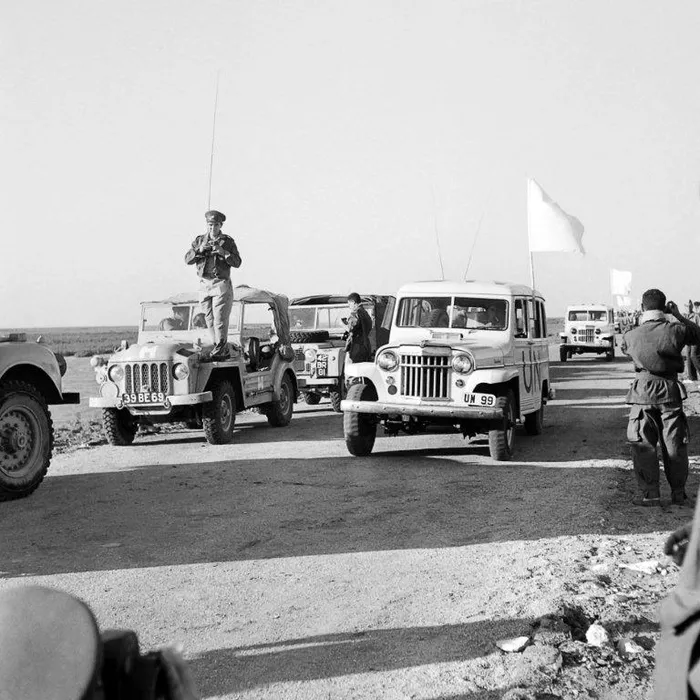
United Nations observers arrive in Egypt on November 15, 1956 during the Suez Crisis. The lesson of 1956 is not that the United Nations can resolve such conflicts outright. It can contain escalation and open space for political solutions, says the writer.
Image: AFP
Patrick Rosenow
The recent move by Iran—and now the US—to block the Strait of Hormuz in response to US and Israeli strikes on Iran is more than a regional escalation. It affects one of the most strategically vital trade routes in the global economy.
Before the outbreak of hostilities, roughly 20-25% of the world’s oil and gas shipments passed through this narrow waterway each day, along with fertilisers essential for global food production. Its closure is not only reshaping energy markets; it is also putting pressure on a core principle of the international order: freedom of navigation.
A look back 70 years to the Suez crisis makes clear that this type of confrontation is not new, and there are precedents for how it can be managed by the international community. Then, as now, the central issues were control over strategic transit routes, national sovereignty, and the international community’s response to the direct involvement of major powers and the Security Council’s paralysis.
The Suez crisis began with Egypt’s nationalisation of the Suez Canal. France and the United Kingdom saw their economic and geopolitical interests threatened and, together with Israel, launched a military intervention. The Security Council was unable to respond: France and the United Kingdom blocked any meaningful resolution with their vetoes.
What followed was striking. The United States and the Soviet Union—both opposed to the intervention—circumvented the deadlock in the Security Council by turning to the General Assembly.
Invoking the “Uniting for Peace” resolution, they convened an emergency special session. This procedural innovation enabled the General Assembly to issue recommendations for collective action when the Security Council could not act.
The Assembly did more than pass resolutions. Under the leadership of Secretary-General Dag Hammarskjöld, the United Nations established its first armed peacekeeping mission, the United Nations Emergency Force (UNEF I), deployed to Egypt’s Sinai Peninsula. Its mandate was clear: monitor the ceasefire following the 1956 hostilities, stabilise the situation in the Sinai, and ensure the withdrawal of foreign troops from Egyptian territory.
Combined with pressure from Washington and Moscow, this approach led Israel, France, and the United Kingdom to withdraw. The canal remained under Egyptian control. In effect, the international community managed to contain—and channel—an escalating conflict.
Today’s situation differs in complexity, but not in logic. Iran is using the Strait of Hormuz as leverage in a conflict that has been sharply intensified by US and Israeli military strikes on Iranian targets. The blockade—and any attempt to impose transit fees—violates fundamental principles of the law of the sea, particularly the right of passage through international straits as codified in the UN Convention on the Law of the Sea (UNCLOS).
At the same time, the Security Council is once again deadlocked. Russia and China recently vetoed a resolution aimed at protecting freedom of navigation through Hormuz. This echoes the structural problem of 1956: when key actors are themselves parties to the conflict or driven by geopolitical interests, the Council becomes ineffective.
The logical consequence is the same as it was then: political momentum must shift to the General Assembly—especially since a NATO-led mission is not a realistic option under current conditions. A NATO-led mission would be seen as biased and would never receive a Security Council mandate. In any case, Russia would be strongly opposed to it.
Historical experience shows that the General Assembly is more than a debating chamber. It can generate political legitimacy, reaffirm normative standards, and initiate operational measures. When the Security Council was blocked, the Assembly stepped in, establishing investigative bodies and supporting peace operations. While its resolutions are not legally binding like those of the Security Council, they carry political weight.
If a broad majority of states demands freedom of navigation through the Strait of Hormuz, the pressure on all parties would be significant. Nearly every country has a direct interest in keeping trade routes open, making a wide coalition feasible.
A “Uniting for Peace” initiative today could include several elements: a clear legal position identifying the blockade as a violation of international law; recommendations for concrete measures, such as the establishment of an international maritime monitoring mission; and a request for the UN secretary-general to advance mediation efforts and prepare such a mission.
A third party, such as the United Nations represented by the UN Secretary-General, could help build the necessary trust between the parties after a possible negotiation deadlock, a mutually hurting stalemate and a ripe moment for them. However, this would require active persuasion and personal diplomatic engagement by António Guterres.
A UN-mandated presence could serve functions similar to UNEF I: monitoring maritime traffic, documenting incidents, building confidence among the parties, and reducing escalation risks through an international presence. Its key advantage would be its multilateral character—its neutrality and its grounding in a collective mandate.
Recent weeks have shown that unilateral military or political actions—by Israel, the United States, or Iran—have not brought stability to the region. They do not resolve structural conflicts. A UN mission, by contrast, would not be an instrument of any single state but an expression of shared international interests. In a way, it is an irony of history that France and the United Kingdom—who, together with Israel, blocked the Suez Canal in 1956—are now seeking to convene an international mission on Hormuz.
Still, the differences with 1956 are significant. The Suez crisis was a relatively contained conflict with clearly defined actors and a specific dispute. Today’s situation is embedded in a complex regional landscape with global implications.
Iran’s nuclear program, its missile capabilities, and the role of proxy groups such as Hamas, Hezbollah, and the Houthis are distinct lines of conflict that no Hormuz mission could resolve. Domestic factors also matter: the repressive nature of the Iranian regime and its foreign policy strategy are only partially susceptible to external influence.
The lesson of 1956 is not that the United Nations can resolve such conflicts outright. It can contain escalation and open space for political solutions. A UN-mandated mission in the Strait of Hormuz would therefore not be an endpoint, but a first step—one that could slow military dynamics, keep communication channels open, and enable negotiations.
Diplomatic initiatives remain essential. Mediation efforts by individual states—such as Pakistan or other regional actors—may help bridge gaps in the short term. But sustainable stability will require a broader, multilateral framework that includes all relevant actors in the region.
At a time when the Security Council is frequently paralysed, member states must use the General Assembly more assertively. But this also requires leadership. A UN secretary-general willing to take political risks and fully use institutional leeway—rather than defaulting to caution, as António Guterres has been accused of by critics—could play a decisive role in implementing a General Assembly mandate. Hammarskjöld did exactly that during the Suez crisis, helping to create UNEF as the UN’s first armed peacekeeping operation. A similarly innovative approach is needed today.
The blockade of the Strait of Hormuz is a test of the international community’s capacity to act, and of its commitment to a rules-based order. The parallels with Suez are not coincidental; they reflect recurring patterns involving strategic chokepoints, great-power interests, and institutional gridlock within the UN system.
The response in 1956 was not perfect, but it was effective. It showed that the General Assembly can act when the Security Council cannot. That option still exists today—especially if smaller and medium-sized states choose to act collectively. Whether they do so is not a legal question. It is a political one.
* Patrick Rosenow is Editor-in-Chief of the German Review on the UN, published by the United Nations Association of Germany (UNA-Germany). His work focuses on the United Nations, multilateralism, and peace and international security. This article was produced by https://theglobalobservatory.org/
** The views expressed do not necessarily reflect the views of IOL or Independent Media.