

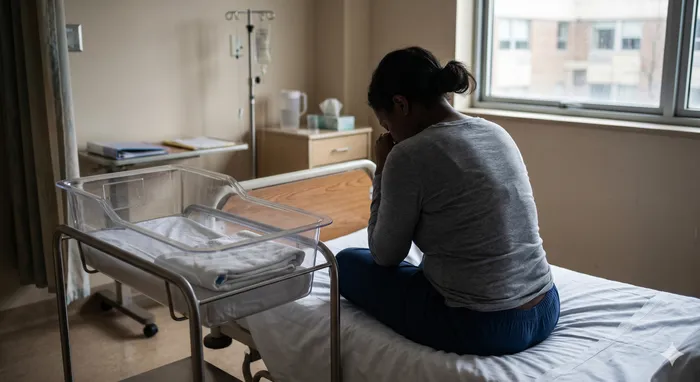
A Soweto mother was forced to obtain a court order compelling Bheki Mlangeni District Hospital to release the remains of her child, who died in utero at 26 weeks.
Image: Gemini
“I want to bury my child.”
These were the words heard by the Johannesburg High Court from a Soweto mother who was forced to obtain a court order compelling Bheki Mlangeni District Hospital to release the remains of her child, who died in utero at 26 weeks as reported by IOL.
The Legal Resources Centre (LRC), which took on the mother’s case, is now fighting parts of the Gauteng Department of Health circular 08 of 2025 — which requires bereaved parents to obtain a court order before the remains of a pre-viable foetus may be released for burial — to be reviewed and set aside.
The mother told the court her baby died in utero on April 27 when she was 26 weeks and three days pregnant.
“I was admitted to the hospital for maternal delivery and gave birth to my pre-viable child, whose recorded weight was 615grams. I was advised by the staff at the hospital that because my child weighed less than 1000grams, the applicable policies and practices dictate that her remains be disposed of as medical waste unless I obtain a court order permitting me to bury my pre-viable child, in which case her remains will be released to me for that purpose,” the mother said in an affidavit.
She said the loss of her pregnancy was “extremely painful” and she wanted the opportunity to honour her child and to mark the tragic end of her life.
“I believe that a burial will assist me in working through my grief and processing the trauma I have suffered. Performing a burial is also in line with my religious and cultural beliefs and is an important way to show respect for those who have passed away,” she said.
Ektaa Deochand, the LRC’s lead attorney in the matter, told IOL the circular’s requirements were irrational, unreasonable, unlawful, and unjustifiably infringed on the constitutional rights of bereaved parents.
“We further request a declarator that in the event of a loss of pregnancy other than a stillbirth or a loss of pregnancy through human intervention, bereaved parents have a right to bury the foetal remains should they elect to do so upon request without having to obtain a court order,” she said.

Legal Resources Centre's Thapelo Ravele, Nikki Stein, Ektaa Deochand and Lawrence Dlamini represented a mother, who required a court order for the release of her pre-viable foetus from Bheki Mlangeni District Hospital.
Image: Supplied
She explained that it was important to pursue the matter because the impugned policy places significant emotional, financial, and procedural burdens on bereaved parents at a time of profound grief.
“Such barriers disproportionately affect vulnerable families and risk undermining their dignity and cultural and religious practices and freedoms. Despite the constitutional court dealing with this issue in 2022, there remain gaps as to how this matter is regulated in practice, which requires legal certainty,” said Deochand.
In 2022, the Constitutional Court found that the Births and Deaths Registration Act contained no prohibition on the burial of pre-viable foetuses.
According to the Gauteng Department of Health’s circular issued last year, its legal services directorate was experiencing a significant influx of requests and inquiries from healthcare establishments regarding the management of pre-viable foetuses.
“This surge is driven by families' growing demands for access to human remains, highlighting the need for clear guidance and support,” it said.
The circular further stated that if parents requested a pre-viable foetus, they should be informed that a court order was required to compel the department to release the remains.
The Gauteng Department of Health acknowledged that the judgment may have broader implications for the interpretation and implementation of current policies and procedures.
“At this stage, the department believes there is a need for further legal and policy reflection on the evolving court judgments as well as the concerns and requests raised by affected families. It is important that any future policy position provides legal certainty, aligns with applicable legislation, and gives clear guidance to healthcare facilities on the management and release of pre-viable foetuses.”
“The department will therefore continue engaging relevant stakeholders and legal experts to determine the appropriate way forward, including whether amendments to current policies or regulations may be required,” departmental spokesman Steve Mabona told IOL.
He said the circular was developed following the obtaining of a legal opinion and after consideration of the applicable legislative framework, relevant national guidelines, and existing case law, including Constitutional Court judgments relating to matters concerning unborn babies.
“The circular was also informed by practical challenges experienced by both the Department of Health and the Department of Home Affairs regarding requests for the release and burial of stillborn and pre-viable foetuses, including requests linked to cultural and religious practices.”
“The department further notes that there are inconsistencies between existing legislative and policy instruments. In particular, the Births and Deaths Registration Act (BADRA) provides a viability threshold of 26 weeks of gestation, while certain national guidelines refer to 28 weeks of gestation. These inconsistencies continue to present implementation and compliance challenges for healthcare facilities and practitioners,” Mabona explained.
IOL News