

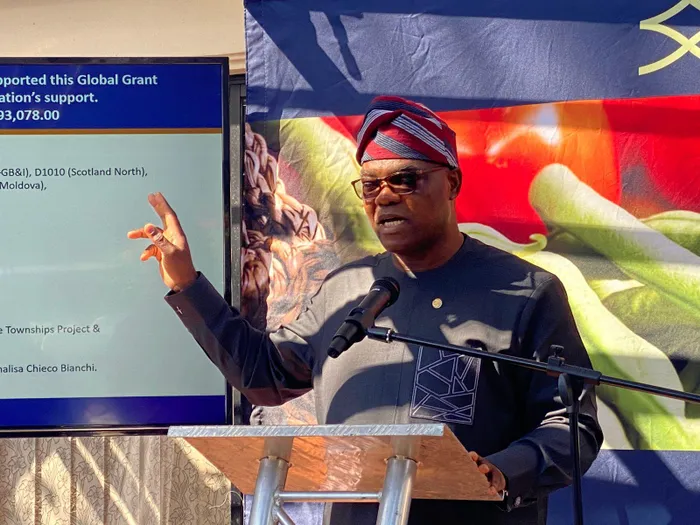
Rotary International President Elect Yinka Babalola at the Archbishop Tutu’s house in Soweto.
Image: Supplied
Soweto has taken a central place on the global stage in the fight against hunger, with the iconic Bishop Tutu House on Vilakazi Street officially declared the Global Headquarters of the Desmond Tutu Programme to End Global Hunger. The landmark ceremony drew civic leaders, faith communities, and incoming leadership from Rotary International, marking the start of a transformative initiative for both Soweto and the international effort to combat hunger.
Rotary International President-Elect Olayinka Hakeem Babalola addressed the gathering, urging Rotary District 9400 and the wider community to strengthen their commitment to improving lives in the region. At the ceremony, he announced a Rotary Global Grant of $94 000 (R1 544 758) to establish a state-of-the-art greenhouse aquaponics unit at the Tutu House.
“This greenhouse aquaponics unit will create not only jobs for the people of Soweto but will bring dignity, prosperity, food security, sustainability skills and will be a learning platform for the people of Soweto,” said Babalola.
The Rt Revd Dr Sepadi Moruthane, welcoming the Rotary International President-Elect and other distinguished guests, reflected on the house’s historic significance. Bequeathed to the Diocese of Johannesburg by Archbishop Tutu, the house has long symbolised the struggle for justice.
“Bishop Tutu would have been very proud for his home to be used in ending global hunger. These Headquarters are a testimony to the great work and legacy of Bishop Tutu,” said Moruthane.
The Speaker of the Johannesburg Metropolitan Council, Ms Margaret Arnolds, affirmed the city’s support for the project and welcomed Rotary International’s leadership.
“Today marks a celebration of collaboration and the enhancement of dignity for the people of Soweto. The legacy of Archbishop Tutu lives on through this project,” she said.
The ceremony also included the induction of two new members into the Rotary Club of Eagle Canyon by President-Elect Babalola, symbolising the growth and vitality of Rotary’s mission in District 9400.
Central to the initiative is the aquaponics greenhouse, a sustainable, closed-loop system that combines fish farming (aquaculture) with hydroponics (growing plants in water). Nutrient-rich water from fish tanks nourishes the plants, while the plants filter and purify the water for the fish. This method produces fresh vegetables and healthy fish using significantly less water than conventional farming, making it well-suited for climate-resilient urban agriculture and community food-security projects.
The declaration of Bishop Tutu House as the headquarters of this global programme highlights Soweto’s emerging role in humanitarian leadership. Archbishop Tutu’s own words echo the significance of the occasion: “My humanity is bound up in yours, for we can only be human together.”