

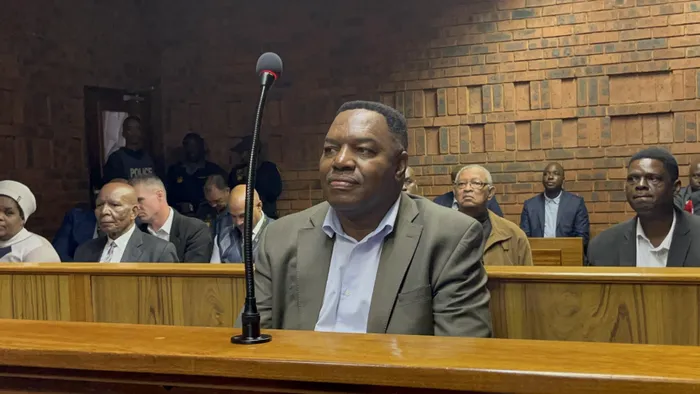
Suspended National Police Commissioner Fannie Masemola Suspended National Police Commissioner Fannie Masemola
Image: Kamogelo Moichela / IOL News
The people sworn to protect South Africans are now under investigation themselves. Arrests of senior police officers and revelations from the Madlanga Commission have turned the country’s law enforcement upside down.
This crisis was further highlighted this week when the Independent Police Investigative Directorate (IPID) revealed that it currently has 14 235 active cases involving police officers under investigation.
According to Afrobarometer, only one in four South Africans now trust the police- the lowest level recorded in two decades.
Public confidence has been further shaken by the arrest of several senior SAPS officials linked to allegations of corruption, fraud and procurement irregularities, raising difficult questions about accountability at the highest levels of policing and whether the justice system can effectively police itself.
Among the most troubling issues raised this week were allegations relating to the disappearance of crucial evidence - failures that can undermine prosecutions and deny victims justice.
Concerns have also resurfaced over reports of sexual assault within police stations, allegations that strike at the heart of public confidence and raise urgent questions about accountability within spaces meant to offer safety and protection.
Those implicated include National Police Commissioner Fannie Masemola, and several other high-ranking officers including brigadiers, colonels and a major-general.
Dr Johan Burger from the Institute for Security Studies says that the number of senior officers under investigation or arrested was a huge concern but he believes not everyone is guilty as charged. He cautioned the media saying it could unintentionally portray them as guilty.
He says although Masemola appeared in court does not mean that he is guilty of corruption or the other charges some officials face.
“Fanie Masemola stands accused of not adhering to the requirements of the Financial Management Act. That's something different in the sense that he did not properly execute his responsibilities as the principal of that organisation in terms of the allocation of that contract. If found guilty, he is only guilty then of negligent performance in terms of the Financial Management Act,” said Burger.
He also pointed out that all the current investigations, arrests and the Madlanga Commission came about because last year KZN’s Provincial Commissioner, Lieutenant General Nhlanhla Mkhwanazi, blew the whistle on fraud and corruption in the police, and had the support of Masemola.
The current mass arrests and mass accusations against the top leadership of the police service was the most serious situation it has faced since the dawn of democracy. “There's this rot that's set in the police service. So this is not going to change overnight. It's not going to change by just compiling a report or passing a new piece of legislation, but it's building blocks.”
He said internally, distrust was growing in the police and their morale was at an all-time low. “Ordinary police people will look at these officers and wonder… how can I trust you?” “It creates this kind of distrust within the police service… a sort of turmoil.” However, the situation was fragile, but not completely hopeless and Acting Police Minister Firoz Cachalia is already trying to turnaround the situation, said Burger. “There is a serious commitment… to already put processes and procedures in place.”
Advocate Clint Oellermann, an advocate of the high court and senior lecturer at North-West University, says recent arrests point to a possible “institutional integrity crisis.”
Oellermann said the allegations raise serious concerns about integrity at senior levels, weaknesses in procurement processes, accountability failures, and the possible infiltration of organised criminal networks within law enforcement structures.
He also warned that police corruption “strikes at the constitutional basis of policing,” noting low public trust, with the Human Sciences Research Council (HSRC) reporting only 22% trust in SAPS in 2022.
On whether the arrests reflect progress or deeper dysfunction, he said: “The answer is both.”
“Arrests may indicate that accountability is beginning to reach areas previously thought protected,” he said, but stressed that trust will only return through “credible prosecutions, fair disciplinary action, the removal of corrupt officials, and deep reform of the systems that allowed compromised people to operate in the first place.”
Dr Zizamele Cebekhulu-Makhaza, chairman of the Safer South Africa Foundation, says increasing the number of boots on the ground won't make up for critical structural, leadership, and operational failures inside the criminal justice cluster.
“Any serious reform must confront the machinery of justice itself, instead of pretending South Africa’s crime crisis can be solved through resourcing alone.”
He said the gap between constitutional promises and lived reality was widening, reflected in declining investigative performance and rising public fear. SAPS’s ability to solve murders has declined by as much as 38% over the past decade, he said.
“Behind these figures are communities living with real fear, trapped in a justice system that cannot protect them properly.”
Presently there are 14 235 active cases involving police officers being investigated by the Independent Police Investigative Directorate (IPID).
The oversight body was established to investigate alleged criminal offences and misconduct involving members of the South African Police Service (SAPS) and municipal police departments.
IPID said assault-related matters made up the bulk of its active cases with 8 590 investigations. This was followed by 2 258 cases involving the discharge of firearms and 1 056 matters related to torture.
There are also 198 active corruption cases and 26 fraud investigations.
IPID spokesperson Phaladi Shuping said there are no criminal cases relating to the disappearance, tampering or destruction of evidence.
“IPID has hired retired detectives to assist with backlog cases and the number of backlog cases has been reduced since the retired detectives were appointed. Involvement of law enforcement officers in criminal activities erodes public trust in the broader criminal justice system, but IPID has a mandate to hold police officials that are found on the wrong side of the law accountable,” said Shuping.
The South African Policing Union (SAPU) said the number of officers implicated in criminal investigations remained a small fraction of the broader police service; most of whom were still carrying out their duties. Spokesman Lesiba Thobakgale said that strengthening community policing forums could help improve relations between police and communities, while also addressing corruption at a grassroots level.
Reuben Maleka from the Public Servants Association (PSA) said their view was that the matter against General Masemola was “purely labour related” and should be handled as misconduct and not criminal conduct.