

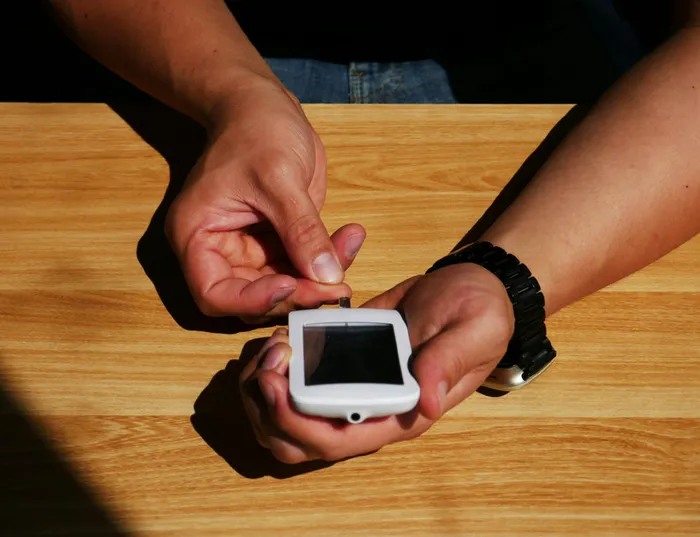
Right now, about half of all diabetic wounds fail to heal properly with normal treatments, often leading to a high risk of amputation. To fix this, researchers at the University of Johannesburg are testing a gentle method called "light therapy."
Image: Unsplash
In diabetes, high blood sugar and low oxygen cause skin-repair cells to malfunction, which stalls the healing process.
Current therapies for diabetic wounds only achieve about a 50% healing rate, and there is a 50% chance the wounds will return. Because of the high risk of these wounds not healing and lower limb amputation, there is an urgent need for more effective wound treatments.
A possible answer lies in a therapy being researched at the UJ Laser Research Centre, called photobiomodulation (PBM). PBM is also called “light therapy” or “red light therapy”. It is a safe, gentle method that uses specific colours of light to help the body heal, using red or near-infrared light.
A new study led by Professor Nicolette Houreld tested whether near-infrared light at a wavelength of 830 nanometre (nm) using a dose of 5 Joule per square centimetre could aid healing for wounded diabetic skin cells. The research was done in the laboratory on diabetic cells in an in vitro (out of the body) study. Prof Houreld is a researcher at the Laser Research Centre within the University of Johannesburg’s Faculty of Health Sciences.
The researchers found that 830 nm wavelength light successfully increased migration of skin repair cells (called fibroblasts). As a result, cells moved faster to close gaps and boosted viability and proliferation to help cells stay alive and multiply.
However, tests showed that the 830 nm light did not appear to activate the expected PI3K/AKT/mTOR healing pathway. This pathway has been consistently linked to healing from red light at the 660 nm wavelength in other studies.
Unlike a surgical laser that cuts through skin, PBM uses low-powered light from lasers or light-emitting diodes (LEDs) at very specific wavelengths and doses. PBM heals by stimulating the tiny ‘batteries’, also called mitochondria, which exist inside cells, says Prof Houreld.
“These ‘batteries’ provide the energy the wounded cell needs to work. When you shine the right kind of light on a wound or injury, the ‘batteries’ absorb that light energy, and they start producing more energy and start working harder,” she adds. This triggers specific biological cell signals, giving the cell the power it needs to repair the damage by itself.
“This study shows that different wavelengths of light can stimulate biological cells through different mechanisms. But it cannot be ruled out that activation of the PI3K/AKT/mTOR pathway may have occurred at an earlier time point, or that a different dose may be required, or that healing may have occurred via a different pathway,” explains Prof Houreld.
One practical advantage of near-infrared light, such as 830 nm light, is that it reaches deeper into the body than red light, she adds. Red light (660 nm) can penetrate to a depth of about 5–6 mm into tissue, while near-infrared light (880 nm) can penetrate deeper, to a depth of about 3–5 cm. This can also be influenced by tissue type and skin tone, because higher concentrations of melanin in darker skin can absorb more light.
“If you want to repair deeper tissue, like muscle injury or joint pain, a longer wavelength such as 830nm is more beneficial,” she adds.
In South Africa, PBM is not yet an accepted or generally-used treatment, and does not form part of standard treatment protocols for diabetic wounds. Specialised treatment centres and holistic healing centres may use PBM as part of their treatments.
For those who do have access, PBM complements standard wound care rather than replacing it, says Prof Houreld.
The research team is already planning its next steps. While this study was conducted on individual cells in a lab, real wound healing is a complex, multicellular process. The researchers are planning more advanced studies where different cell types interact as they would in the body.
They also plan to test different light doses and wavelengths, and to search for the alternative signalling pathways that may explain the 830 nm results.
“All the cellular signalling pathways activated by such light still need to be studied, especially using near-infrared light,” says Prof Houreld.