

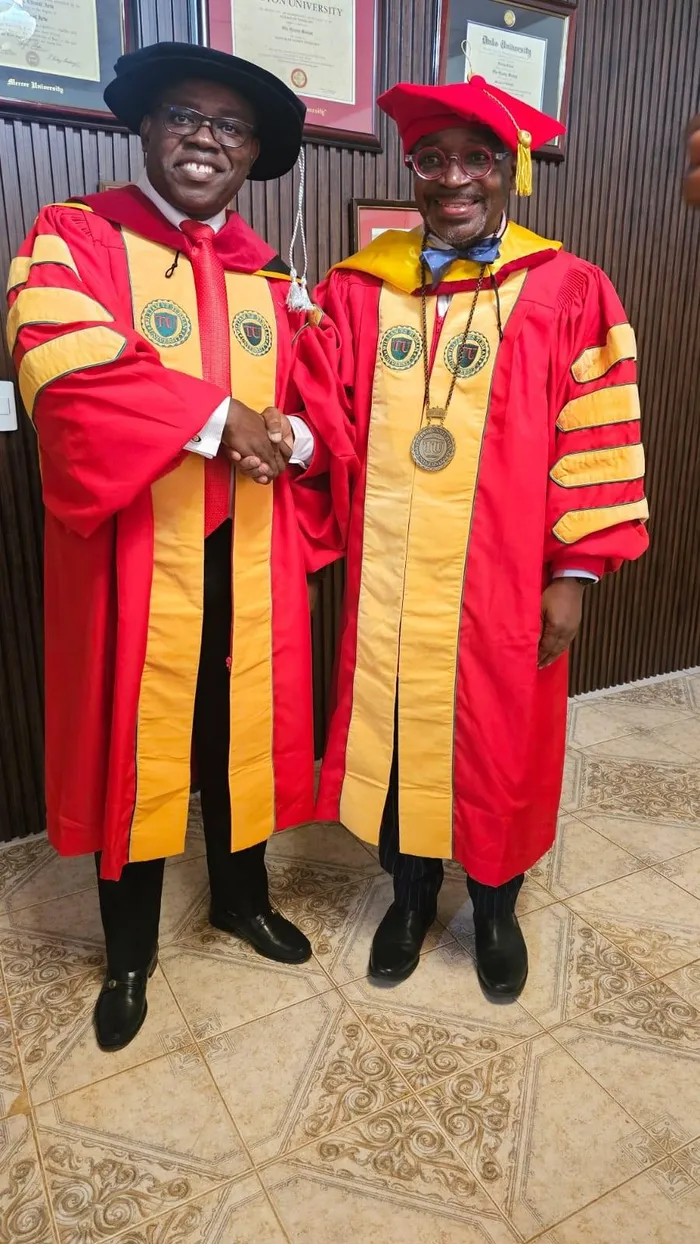
UJ vice-chancellor and principal Professor Letlhokwa Mpedi and William VS Tubman University president Professor Olu Q Menjay.
Image: Supplied
“Whatever the next chapter may be… the future of Africa is in your capable hands.”
This was the message of Professor Letlhokwa George Mpedi, vice-chancellor and principal of the University of Johannesburg (UJ), as he addressed the twelfth graduation convocation of William VS Tubman University (TU) in Liberia on Monday, November 24, 2025.
It was during this ceremony that Prof Mpedi was conferred with an honorary doctor of Science (DSc), Honoris Causa in Artificial Intelligence, in recognition of his contributions to higher education, scholarship and Pan-African leadership.
The citation described Prof Mpedi as an “eminent scholar, visionary administrator and compassionate leader,” highlighting his steadfast commitment to transforming higher education through the ethical integration of artificial intelligence (AI), particularly in the fields of AI and the Law, alongside digital innovation and inclusive academic practices. It also recognised his continuous advocacy for social justice, ethical governance and the expansion of educational access across the continent.
The citation further celebrated the deepening partnership between UJ and Tubman University, a collaboration strengthened under Prof Mpedi’s stewardship. This partnership has already produced meaningful outcomes, from scholarship opportunities and academic exchanges to emerging research collaborations that advance shared continental priorities.
Central to this progress is UJ’s Strategic Plan 2035, introduced under Prof Mpedi’s leadership.
The plan sets a trajectory for the Institution, anchored on three defining pillars: Societal Impact and Sustainability; Global Footprint and Partnerships; and Technology for the Future. Together, these pillars set UJ not only as a driver of academic excellence, but as a university committed to meaningful, measurable change.
Through this strategy, UJ aims to harness technological advancement responsibly, deepen partnerships across Africa and the globe, and place societal needs at the core of its mission.
In his address Prof Mpedi drew on the historic solidarity between Liberia and South Africa.
He reminded graduates that during the darkest days of apartheid, President William VS Tubman stood firmly with a young Nelson Mandela.
“This is not merely a historical footnote,” he said. “It is a reminder that Africa’s liberation has always been interconnected, and when one nation extends a hand to another, possibilities emerge that transcend borders and generations.”
Prof Mpedi reaffirmed the transformative power of education, stating that: “Education is the most powerful weapon which you can use to change the world. True education transforms consciousness. It teaches us to imagine the world not as it is, but as it ought to be. This is the education that changes nations.”
He said that Africa stands at a defining moment in its history.
“By 2050, one in every four people on the planet will be African, a demographic shift that highlights both opportunity and urgency. The continent’s vast natural resources and cultural depth sit alongside pressing challenges, such as climate change, technological disruption, inequality and the ongoing loss of skilled graduates."
Against this backdrop, Prof Mpedi called for a renewed continental ethos: “The solution lies not in looking outward for salvation, but in looking across our borders for collaboration.”
He urged universities to take the lead in this agenda, drawing on African perspectives and priorities. “For too long, Africa has been perceived as merely the subject. But African universities must become sites of knowledge production, not just knowledge consumption.”
Prof Mpedi outlined a series of practical pathways for strengthening the continent’s intellectual and developmental agenda. He highlighted the importance of joint research and development initiatives between universities and industry, the expansion of student and faculty exchanges, the creation of dual-degree programmes, and the use of collaborative teaching models that draw on shared expertise.
Central to these efforts, he explained, is research that directly addresses Africa’s most pressing priorities, including food security, energy, healthcare and governance.
“Through collaborative research programmes, we can tackle continent-wide challenges with continent-wide solutions,” he said.
Prof Mpedi concluded by extending a direct invitation to WVS TU graduates, reaffirming UJ’s commitment to nurturing Pan-African scholarship.
“The University of Johannesburg stands ready to deepen our partnership… Doors are open to you. Whether you seek postgraduate study, research opportunities or academic networks, we welcome you.”