
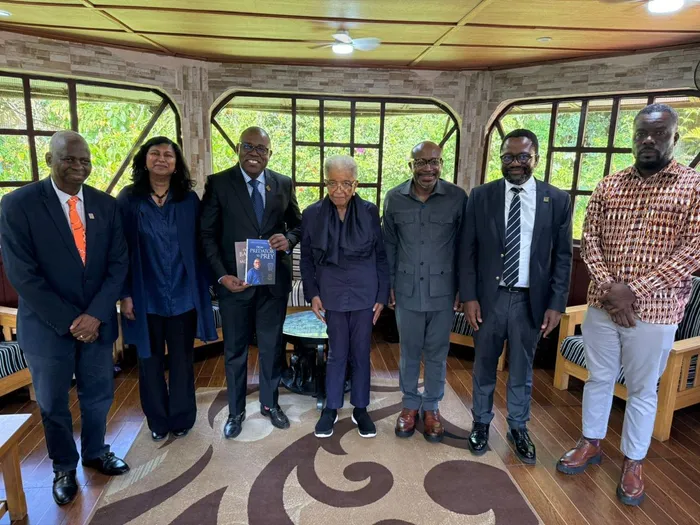
A high-level delegation from the University of Johannesburg, led by Vice-Chancellor Prof Letlhokwa Mpedi, visited Liberia to strengthen academic, research and institutional partnerships.
Image: Supplied
A high-level delegation from the University of Johannesburg (UJ), led by the Vice-Chancellor and Principal, Prof Letlhokwa Mpedi, has spent this week in Liberia strengthening academic, research and partnerships across the country.
The visit reflects UJ’s commitment to building influential Pan-African networks that advance innovation, knowledge production and long-term development on the continent.
The delegation’s programme includes engagements with universities, government ministries and international development partners who have expressed interest in collaborating with UJ on fundraising initiatives, research projects and academic exchange programmes.
The visit also follows a major academic honour for Prof Mpedi, who received the Doctor of Science (honoris causa) in Artificial Intelligence from Tubman University on Monday, November 24, 2025) in recognition of his leading scholarship on Artificial Intelligence and the Law and his contributions to ethical digital transformation in higher education.
A significant highlight of the visit was the courtesy call to Madam Ellen Johnson Sirleaf, former President of Liberia and the first woman elected as head of state in Africa.
Madam Sirleaf is also a Nobel Peace Prize laureate, recognised for her leadership in restoring peace, strengthening democratic governance and advancing the rights of women.
Prof Mpedi, accompanied by Tubman University President Prof Olu Q Menjay and senior UJ leaders Professors Bongani Ngqulunga, Kammila Naidoo and Daniel Mashao, met Madam Sirleaf at her residence in Monrovia on Wednesday, November 26, 2025.
Madam Sirleaf received the delegation and commended the strengthening partnership between UJ and Tubman University. She highlighted the critical role of African institutions in creating opportunities for young people and developing resilient education systems that can advance the continent’s progress.
Prof Mpedi noted the significance of the engagement and affirmed UJ’s commitment to expanding meaningful partnerships across the continent.
“Our collaboration with Liberia is built on a shared belief that African universities must lead the way in producing knowledge that transforms society. UJ remains committed to partnerships that deepen research excellence, strengthen innovation and expand opportunities for students and scholars across Africa. This visit reinforces our responsibility to help shape a future where African institutions work together and rise together,” he said.
Throughout the visit, the UJ delegation held discussions with senior Liberian government officials to explore areas of cooperation that support national and regional development priorities.
Conversations centred on the expansion of joint research in Artificial Intelligence, digital innovation, governance, education and social justice. The parties also explored avenues for student and staff exchanges, co-funded research programmes and philanthropic partnerships that will support the long-term growth of higher education in both countries.
UJ’s presence in Liberia aligns with its Strategic Plan 2035, which positions the institution as a continental leader in technology-driven education, African knowledge systems and future-focused research. The engagements in Monrovia affirm UJ’s commitment to internationalisation that is rooted in African cooperation, inclusion and shared intellectual growth.
Prof Mpedi’s honorary doctorate from Tubman University provides a symbolic and substantive foundation for the strengthened collaboration. The citation, which described him as an “eminent scholar, visionary administrator and compassionate leader,” highlights the alignment between UJ’s institutional values and the aspirations of Liberia’s higher education sector.
As the visit progresses, the UJ delegation is preparing to consolidate additional pathways for collaboration that support Liberia’s development goals and expand UJ’s role as a catalyst for African research leadership. With the endorsement of Madam Sirleaf and the enthusiasm of Liberian institutions and government leaders, a promising new chapter is opening for the UJ–Liberia partnership.