

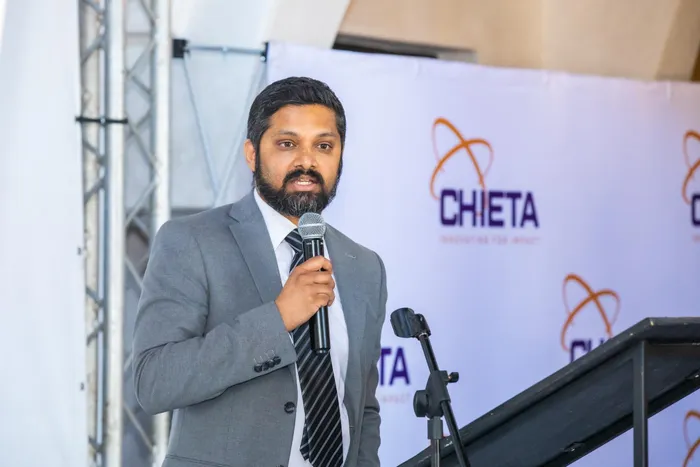
Chemical Industries Education and Training Authority CEO Yershen Pillay.
Image: Supplied
In the shadows of the Drakensberg, where opportunities have long been scarce, a new kind of classroom is quietly reshaping futures. Chieta’s Smart Skills Centres, with their hum of screens and servers, are doing more than teaching digital skills - they are giving young South Africans hope.
This year, the Chemical Industries Education and Training Authority (Chieta) expanded its national rollout, adding new centres in the Free State and Gauteng, bringing the total to nine across the country - from Saldanha Bay to Mojadjiskloof, Gqeberha to Brits, and Highveld to Babanango. More than 35 000 people have passed through the doors, learning technical, digital, and entrepreneurial skills aimed at equipping them for a rapidly changing economy.
For Thabiso Makhe, one of the centre’s most inspiring stories, the experience has been life-changing.
Thabiso grew up in a home where survival often came before ambition. Fascinated by technology from a young age, he would dismantle radios and sketch machines he dreamed of building. Yet as he grew older, he struggled to find a pathway to turn his passion into a career.
“Before Chieta entered my life, I was on the edge of giving up on my hopes of working in the tech industry,” Thabiso says.
A short course at the Smart Skills Centre in Phuthaditjhaba became more than training—it became a turning point. The centre offered him mentorship, an internship, and a supportive environment where innovation was encouraged and young people were seen as potential, not statistics.
“Chieta didn’t just train me,” Thabiso says. “They gave me the confidence to build a future I had stopped imagining.”
Today, Thabiso works in the tech industry, creating solutions for communities once disconnected from the digital economy. His story embodies the purpose of the SMART Skills Centres: to restore possibility, one young person at a time.
The Free State centre, launched with the Department of Education, aims to train more than 20 000 people over five years, while Gauteng’s partnership with PG Glass transformed an industrial site into a digital and VR hub for youth training. Across all centres, Chieta’s CEO, Yershen Pillay, says the model is about more than technology.
“These centres are social infrastructure, not just digital infrastructure,” Pillay says. “They are designed to bridge the gap between traditional education and the demands of the modern workplace.”
By giving access, guidance, and dignity, Chieta’s Smart Skills Centres are quietly rewiring South Africa’s future - one skill, one opportunity, and one transformed young life at a time.