
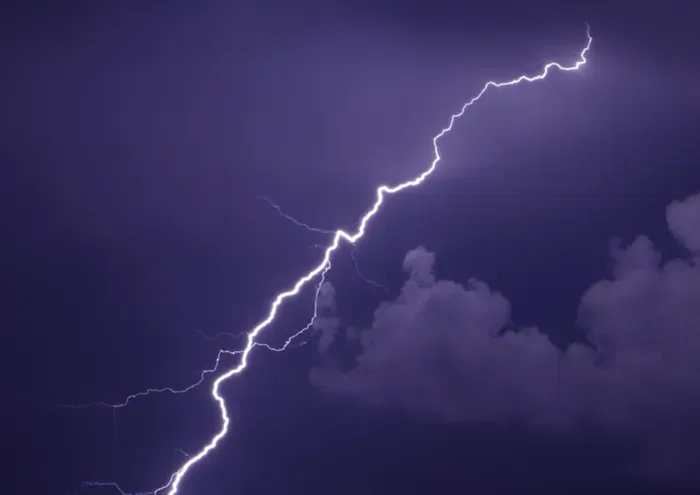
Recent reports of multiple people being struck by lightning in Majaneng, near Hammanskraal in Gauteng, have raised renewed concern about public safety during the peak summer thunderstorm season.
Image: Social Media
Recent reports of multiple people being struck by lightning in Majaneng, near Hammanskraal in Gauteng, have raised renewed concern about public safety during the peak summer thunderstorm season.
According to available data, around 40 people were affected by a severe thunderstorm on January 3, underscoring the very real danger posed by lightning in South Africa, one of the world's most lightning-prone countries.
Between noon and 10pm, lightning activity within a 20 km radius of Majaneng was exceptionally intense, with 1,830 cloud-to-ground lightning strikes recorded. Activity peaked between 17:00 and 18:00, accounting for 713 strikes, or nearly 40% of the total activity during the event.
The majority of strikes were negative cloud-to-ground strokes (1,764), which are known to be particularly hazardous. A maximum negative amplitude of −179.7 kA was recorded, indicating an exceptionally powerful lightning discharge. While the average strike distance was 14.5 km, the closest recorded strike occurred just 1.4 km from the settlement, placing residents at direct risk.
Long-term lightning data from 2006 to 2022 confirms that lightning risk in South Africa is not evenly distributed. The highest lightning densities are recorded over Mpumalanga, Limpopo and northern KwaZulu-Natal, where annual strike densities exceed 15 to 20 flashes per square kilometre.
Gauteng and other Highveld regions experience moderate but frequent lightning activity, averaging 5 to 10 flashes per square kilometre, particularly during summer afternoons and evenings when atmospheric instability is high.
How Lightning Forms and Why It Is So Dangerous
Lightning develops within thunderstorms when collisions between ice particles and water droplets separate electrical charges within clouds. Once the electrical imbalance becomes too strong, energy is released as lightning either within the cloud or between the cloud and the ground.
A single lightning strike can heat the surrounding air to approximately 30,000°C, hotter than the surface of the sun, and generate electrical currents of up to 30,000 amperes. Even a small fraction of this energy can be fatal to humans, disrupting heart rhythm, causing severe burns, nervous system damage, or internal injuries, sometimes without a direct strike.
How People Are Injured
Importantly, most lightning injuries do not occur from direct strikes. The leading cause in South Africa is ground current, where electricity spreads outward after striking the ground. Other mechanisms include:
Side flashes from trees or poles
Contact with metal objects or fences
Strikes near temporary structures
Large gatherings in open spaces, especially under tents or gazebos, significantly increase the risk of multiple injuries, as these structures offer no lightning protection.
Safety Precautions During Thunderstorms
Authorities urge the public to take lightning threats seriously:
• If thunder is audible, lightning is close enough to be dangerous
• Outdoor activities should stop immediately
• Seek shelter in fully enclosed buildings or vehicles
• Avoid open fields, trees, poles, fences, water bodies and hilltops
• Temporary shelters do not offer protection
• If no shelter is available, spread out, crouch low with feet together, and minimize ground contact
• Activities should only resume 30 minutes after the last thunder
Lightning victims do not carry an electrical charge and can be safely assisted. Emergency services should be contacted immediately, and CPR administered if trained to do so.
Ongoing Monitoring and Early Warnings
The South African Weather Service (SAWS) continues to closely monitor weather conditions and provides buffer-zone lightning alert services, which warn users in advance of lightning activity in specific areas. These alerts are a critical tool in reducing risk during severe storms.
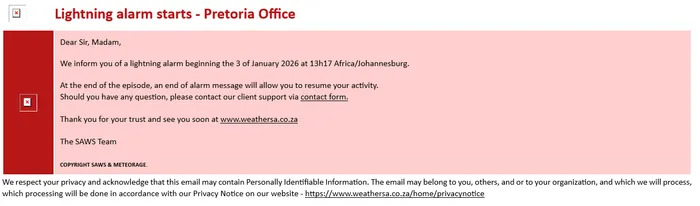
Image showing a Lightning alarm signal indicating the start of lightning activity.
Image: Social Media
Lightning-related injuries and deaths are largely preventable through awareness, preparedness and timely action. Communities, schools, workplaces and event organizers are urged to prioritize lightning safety, particularly during the summer rainfall season.
For more information on lightning alert services, the public can contact [email protected].