
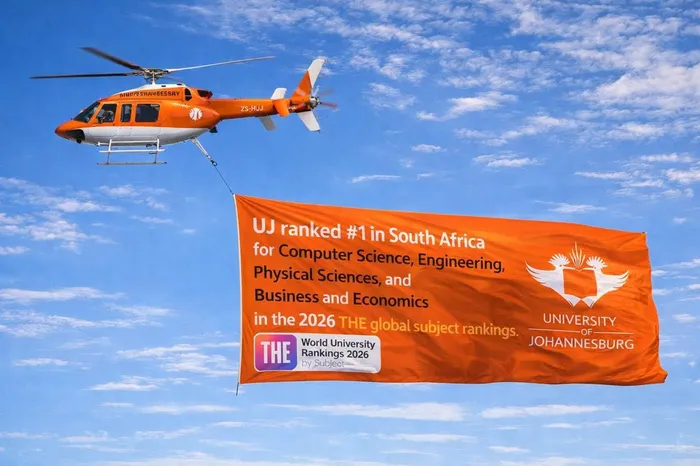
UJ has delivered a strong performance in the Times Higher Education World University Rankings by Subject 2026, ranking first in South Africa in four subjects and showing global gains in several fields.
Image: University of Johannesburg
The University of Johannesburg (UJ) has ranked number one in South Africa for computer science, engineering, physical sciences, and business and economics in the latest Times Higher Education (THE) World University Rankings by Subject 2026.
The 2026 subject rankings place UJ at the forefront of South African higher education in disciplines central to innovation and technology, industrial development and economic growth. In addition to securing four number one national positions, UJ also ranked second in South Africa in education studies, law, social sciences and psychology.
Commenting on the latest rankings, Professor Letlhokwa Mpedi, UJ’s vice-chancellor and principal, said: “These results confirm that UJ’s strategy is not only sound, but delivering measurable impact. Our consistent top rankings in business and economics, engineering, computer science and physical sciences reflect deliberate institutional choices, sustained investment in academic talent, research infrastructure and programmes aligned to South Africa’s and the continent’s development priorities. This trajectory speaks directly to our Strategic Plan 2035, which places excellence in education, impactful research and purposeful collaboration at the centre of everything we do.”
UJ said the latest THE results show it was ranked in all 11 subject areas assessed in 2026, with notable improvements both globally and nationally. Globally, the university climbed in seven subjects and remained stable in three. Strong gains were recorded in computer science, which rose two bands to the 251–300 range, and social sciences, which moved up to the 151–175 band.
UJ’s strongest global performers now include education studies and law, both ranked in the 126–150 band worldwide. Business and economics and social Sciences are placed among the world’s top 200 subjects.
Nationally, UJ improved its standing in three subjects in 2026, including law, which climbed to second place in South Africa, and social sciences, now also ranked second nationally. The university said the results build on its long-term investment in high-impact scholarship, future-focused curricula and robust postgraduate pipelines.
The THE subject rankings draw on 18 performance indicators, assessing institutions across teaching, research environment, research quality, industry engagement and international outlook. In Engineering, this includes performance across disciplines such as electrical, mechanical, civil, chemical and aerospace engineering. In computer science, assessment areas range from artificial intelligence and machine learning to data science, cybersecurity and information systems.
According to Professor Sehaam Khan, deputy vice-chancellor: Academic, the results are linked to strengthening the academic core of the institution.
“Our focus has been on deepening academic quality across the entire student lifecycle, from curriculum renewal and digitally enabled teaching to stronger postgraduate supervision and globally competitive research outputs. These rankings reflect the collective effort of our academics and reinforce UJ’s role as a university that prepares graduates for complexity, change and leadership in a knowledge-driven economy.”
Professor Mpedi concluded: “Together, these results show how UJ continues to integrate research-led teaching with real-world impact, ensuring that our students are exposed to cutting-edge developments in their disciplines while contributing meaningfully to local and global challenges. Through sustained investment, strategic alignment and academic leadership, UJ is steadily consolidating its position as one of South Africa’s most influential universities and an increasingly visible force on the global higher education stage.”