
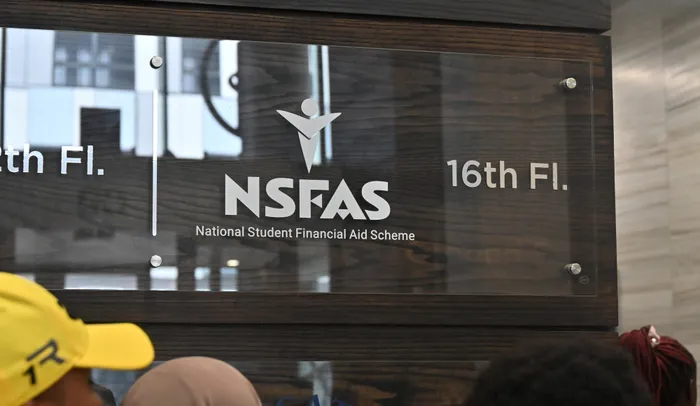
NSFAS Board members discussing strategies to improve funding processes and support for South African students.
Image: Ayanda Ndamane / Independent Newspapers
The National Student Financial Aid Scheme (NSFAS) is gearing up for a pivotal 2026 academic year, reaffirming its commitment to funding stability and operational efficiency across South Africa's public universities and Technical and Vocational Education and Training (TVET) colleges. As stakeholders and members of the media gathered for an update, the scheme outlined its ongoing mission to enhance access to post-school education for the nation’s youth, especially those from financially constrained backgrounds and the so-called “missing middle”.
As a government entity, NSFAS is mandated to dismantle financial barriers that hinder deserving students from pursuing higher education. With a focus on transparency and accountability, the scheme continues to invest in human development through bursary and loan programmes, ensuring alignment with government policy.
A significant highlight in their recent progress is the impressive recovery of over R1.7 billion by the Special Investigating Unit from various institutions and former students. This recovery underscores the commitment of the current NSFAS Board to collaborate with Chapter Nine institutions and law enforcement agencies to bolster governance and financial controls.
2026 application cycle progress
In an update regarding the 2026 application cycle, the funding scheme announced considerable advancements in processing applications for both first-time students and returning university attendees as well as continuing TVET college students. Recognising the complex social realities of South African students, NSFAS has allowed applicants to resubmit outstanding documents, resulting in over 180 000 submissions, which has further led to the approval of an additional 50 000 applications.
However, the funding scheme alerts students to the ongoing challenge of incorrect or unclear documentation, which has hindered processing times. To mitigate delays, students are encouraged to provide clear and accurate documents.
The importance of consent and declaration forms
Crucial to the application process are correctly completed consent and declaration forms. These documents are necessary to obtain parental permissions to verify household income through third-party sources. NSFAS has emphasised the need for complete details, including the parent’s email address, to ensure a smooth application processing experience. Declaration forms where applicable must clearly establish relationships, signed by the relevant parties.
Funding status update
As it stands, NSFAS has approved funding for 660 039 students, with an additional 85 662 applications currently undergoing verification. Out of the total applications received, 116,266 were rejected, while 13,052 loan applicants transitioned to bursaries upon meeting eligibility criteria.
For continuing university students, a notable 436 924 met academic progression criteria - a positive indicator of student success. This contrasts with 109 761 who did not meet progression requirements, while 4 945 still await examination results.
In the TVET sector, of the 210 989 applications processed, 127 503 students met the progression criteria while others remain under review.
Accommodation updates
Recognising that accommodation significantly impacts student success, NSFAS has committed to managing accommodation payments directly for participating institutions in 2026. Latest figures indicate a total of 194 071 applications received, with 55 653 approved. The scheme is collaborating with stakeholders to ensure the effective and timely processing of accommodation requests.
Addressing concerns regarding procedures at the Cape Peninsula University of Technology (CPUT), the funding scheme clarified that accommodations are independently managed by the university, while ongoing discussions aim to enhance conditions for students.
Future funding processes and disbursements
With regard to financial disbursements, NSFAS confirmed that it has disbursed R3.6 billion to universities and R679 million to TVET colleges at the start of February 2026. As budgetary processes are finalised, accommodation rates will be reviewed to ensure they meet the needs of students effectively.
With applications for the 2026 academic year approaching completion, they remains deeply committed to expanding access to higher education and vocational training through fair and efficient funding processes. Students are urged to stay connected with NSFAS for ongoing updates and to submit any outstanding documents in a timely manner.
'Saturday Star' previously reported that NSFAS had finalised the processing of all 2026 funding applications ahead of the reopening of universities and colleges. Acting board chairperson Mugwena Maluleke revealed that the scheme received a record 893 847 applications from first-time entering students, with 609 403 qualifying for funding.
He also urged higher education institutions to urgently submit 2025 academic results and 2026 admission lists to allow NSFAS to validate and prioritise funding for eligible students. Maluleke called on institutions to submit outstanding information, saying: “The appeals window is open, and students have 30 days from receiving their outcome to submit a complete appeal with all supporting documents,” adding that incomplete appeals will not be processed.