

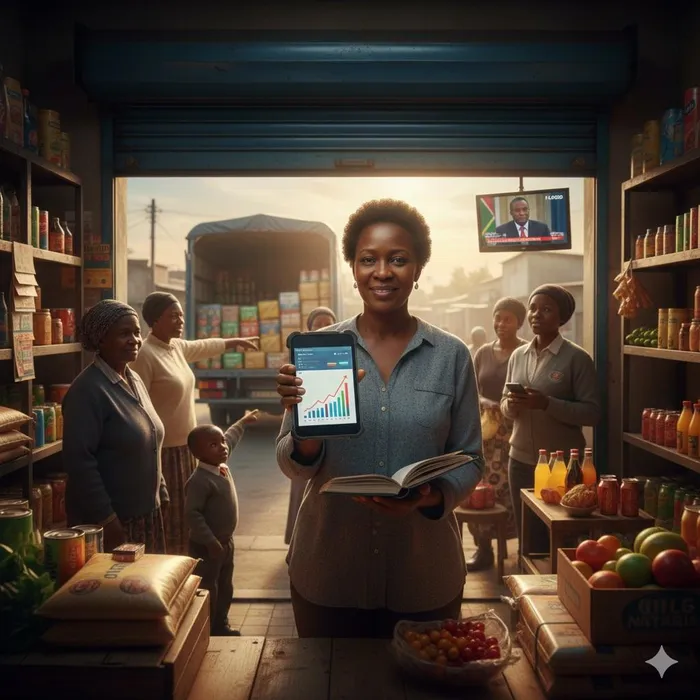
As the 2026 Budget looms, experts say true economic inclusion depends on supporting township and independent retailers with digital tools, not just tracking GDP growth.
Image: Gemini
The 2026 State of the Nation (SONA) address reaffirmed the Government of National Unity’s commitments to inclusive economic growth, job creation, and reducing poverty and the cost of living. While these pillars are essential for national development, they risk remaining abstract ambitions if they fail to address the realities of millions of South Africans who earn a living through small and independent businesses.
Across the country, small and medium enterprise (SME) retailers form a vital layer of the economy. This includes township spaza shops, informal grocers, stokvel-linked merchants, family-run outlets in city centres, independent stores in suburban malls, early-stage e-commerce brands, and micro-retailers in residential neighbourhoods. According to the Standard Bank Township Informal Economy Report, the township economy alone contributes an estimated R900 billion to national GDP. Yet, despite their critical role, many of these businesses remain digitally excluded from formal commerce systems.
Flood believes that inclusive growth begins at the SME level, where GDP statistics often fail to capture economic reality. Small retailers are not marginal participants; they are foundational to community economies. Without access to digital tools, these businesses face barriers to discovery, online transactions, and integration into broader commerce networks. As consumer behaviour becomes increasingly digital-first, SMEs require affordable, accessible tools to remain competitive.
SONA emphasised infrastructure investment and private sector participation as pathways to inclusive growth. However, if success is measured primarily through macroeconomic indicators such as GDP growth or investor sentiment, the micro-economies that sustain local communities risk being overlooked. As Flood observes, real inclusion requires practical systems that enable every SME retailer - from a township entrepreneur to a suburban shop owner - to participate fully in the digital economy.
Digital tools can transform these businesses. When affordable and embedded in trusted networks, SMEs use them to manage inventory, analyse sales data, drive loyalty, offer delivery or in-store collection, and access new customer segments. According to Flood, the impact is tangible: improved cash flow, increased visibility, and greater resilience.
Platforms like Flood’s ecosystem-based infrastructure act as a catalytic layer, enabling trusted institutions such as banks and telecommunications companies to extend digital commerce capabilities to SMEs already within their networks. By embedding marketplace functionality, loyalty programmes, payments, and analytics, Flood aims to reduce entry barriers while aligning solutions with the realities of emerging market businesses, including uneven broadband access and high data costs.
The challenge in emerging markets is rarely the absence of technology, but the gap between trust and transaction. Many small retailers are willing to digitise, yet practical, cost-effective pathways are essential to ensure adoption. As government prepares the 2026 Budget, the question is whether fintech infrastructure for township commerce will receive the policy attention necessary to scale meaningful inclusion.
If South Africa is serious about inclusive growth, the conversation must move beyond policy commitments and headline economic indicators. It must focus on building systems that make every SME retailer visible, accessible, and digitally enabled. Funding the future of commerce is not just about moving transactions online; it is about designing infrastructure that strengthens resilience, unlocks growth, and ensures that small retailers remain central to the country’s economic story.
André de Wet, CEO of Flood