

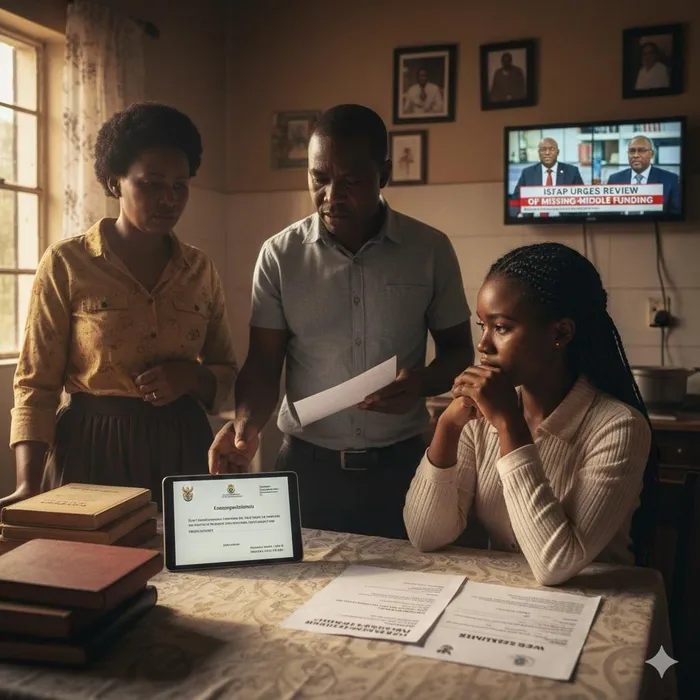
Closing the funding gap could unlock more graduates and strengthen South Africa’s skilled workforce.
Image: Gemini
As Finance Minister prepares to table the 2026 national budget, some organisations have urged government to review the income thresholds that determine South Africa’s “missing-middle” students.
According to Ikusasa Student Financial Aid Programme (ISFAP), stagnant income caps are shutting out thousands of capable students who are unable to afford university fees, accommodation, and living expenses.
“The numbers we still use to define the missing middle come from a very different economy,” says Werner Abrahams, CEO of ISFAP. “On paper, some households sit just above the line. In reality, they cannot carry a full‑cost degree without serious hardship or debt.”
ISFAP’s internal review shows that income caps for missing-middle students, which range from about R350 000 to R600 000 – and in some models up to R800 000–R900 000 – have not been recalibrated for inflation or rising costs. As a result, many families fall into a “financially vulnerable” category: they do not qualify as poor on paper but cannot afford university without taking on unsustainable debt or cutting essential expenses at home.
The organisation also notes that a significant number of university-eligible matriculants never enrol because they fall into this gap – the very students ISFAP was created to support.
ISFAP is recommending that government, funders, and universities re-examine the income caps using updated data on tuition, inflation, and household budgets.
“Our data shows that when the financial gap is closed properly, so-called ‘borderline’ households produce graduates and taxpayers,” Abrahams says. “That is exactly the kind of return South Africa needs from its budget.”