

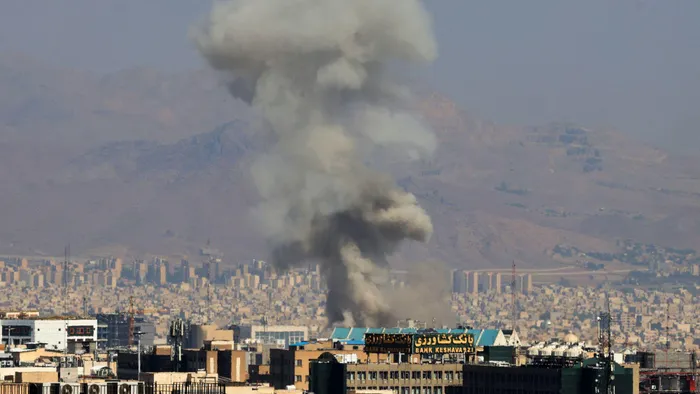
Though thousands of kilometres away, the Middle East conflict is hitting South Africans at the pump, with diesel up by as much as R0.65 per litre and ripple effects across transport, logistics, and food costs.
Image: Atta Kenare / AFP
Though the conflict between the US, Israel, and Iran is happening thousands of kilometres away, South Africans are already paying the price.
Last night, Brent crude hit the $90-a-barrel mark - the highest in nearly two years - pushing diesel prices up by as much as R0.65 per litre.
Experts warn that because South Africa relies heavily on imported crude oil and refined petroleum, even small disruptions to global supply chains can quickly ripple through the economy, affecting everything from transport costs to food prices.
Abigail Moyo, spokesperson for the United Association of South Africa (UASA), said daily commuters, households and small businesses dependent on transport are the first to feel the pressure.
“The first and hardest hit are consumers, workers and ordinary South Africans who rely on daily transport. This is followed by sectors that are directly dependent on fuel costs to operate and deliver services: logistics, the food value chain, and agriculture sectors that depend on transport to move goods, which can also result in higher food prices as service providers try to make up for lost revenue on transport costs. Small businesses and informal traders who rely on transport for business operations with no alternatives are also affected. Ultimately, the broader economy will feel the pinch due to high fuel and transport costs, as well as stretched household budgets.
“Even without geopolitical shocks, consumers face additional pressure from the combined 21 cents per litre increase in the general fuel levy, carbon fuel levy and RAF levy,” she said, describing it as “another already added cost pressure on consumers who are already financially stretched by the high cost of living.”
Economists also caution about the uncertainty ahead.
Dawie Roodt, economist, added that these pressures will ripple beyond the pump: “For example, for agriculture, agricultural input like fertiliser prices are likely to go up, which will eventually be felt in an increase in food price inflation as well. So inflation likely to be the upper pressure inflation.”
Mervyn Abrahams, director of the Pietermaritzburg Economic Justice and Dignity Group, said geopolitical fallout could reverse recent gains in food price relief but urged calm: “Conflict is never good and, in most cases, never serves any purpose. But in this instance, it has greater implications because Iran is one of the key oil-producing countries in the world.” He added: “We had been encouraged by the fuel price drop last month and were hoping that it would result in greater relief for consumers, but the latest developments are not good news at all for South African consumers.”
Drawing parallels with the Russia-Ukraine conflict, Abrahams said: “We expect a rise in petrol and other items as a result of the US, Israel and Iran situation.” Still, he urged: “We would encourage wise spending on the part of consumers, but at the moment there should not be any panic buying.”
John Loos told the Saturday Star that while oil prices are rising, this is “far from the extreme levels seen during the 2008 oil shock, when crude surged above $150 a barrel, contributing to double-digit inflation and recessionary conditions.” He added: “But I must emphasise that it is too early to tell what impact these few days’ worth of elevated oil prices could have. Everything depends on how high prices may go and how quickly the conflict in the Middle East may be resolved, after which we may well see oil prices declining again. We really can’t easily predict this conflict.”
Loos also noted: " At this stage, I would expect the Reserve Bank to put interest rate cuts on hold for the time being, but I think it’s far too early for them to be thinking about rate hikes. To date, the shock has not been severe enough for that, I wouldn’t think. But, again, the situation really isn’t predictable.”
Dr Ernst van Biljon, Head Lecturer in Supply Chain Management at the IMM Graduate School, highlighted the longer-term implications: “Longer-term outcomes depend heavily on how the situation evolves. If Iran were ultimately stabilised or diplomatically reintegrated into global markets, a different trajectory could unfold. Sanctions relief and increased Iranian oil production would likely expand global supply, placing downward pressure on prices. Greater regional stability could reduce insurance premiums and restore confidence in key maritime corridors.” He added: “Over time, this would ease inflationary pressures globally and provide relief to import-dependent economies such as South Africa. Yet the deeper lesson is structural: repeated geopolitical shocks reinforce the urgency of diversification, in energy sources, trade routes, and supply chain design. For South Africa, this strengthens the case for accelerated renewable energy deployment, strategic fuel reserves, and more resilient logistics networks. In an era where geopolitical risk is no longer episodic but persistent, economic resilience becomes as critical as economic growth.”
Henry van der Merwe, Chairman of the South African Petroleum Retailers Association, said the recent adjustments “underscore the ongoing volatility in international crude markets and the impact of global geopolitical developments on fuel costs.” He added: “While the rand showed some resilience against the US dollar, it wasn’t sufficient to counter the strong influence of rising crude and refined product prices.” Van der Merwe emphasised the sensitivity of South Africa’s fuel market to global events and the need for careful monitoring and domestic resilience.
The Road Freight Association (RFA) warned consumers that the March 2026 fuel price increase is a direct result of “upward pressure on the international price of oil due to both supply and logistics risks following the start of hostilities between Iran and the US and Israel.” The RFA added: “The Road Freight Association has noted with both dismay and concern that the price of diesel is increasing between R0.60 and R0.65 per litre.”
The current conflict began on February 28, 2026, when the United States and Israel launched coordinated air and missile strikes on Iran, targeting military sites and leadership compounds, including the office of Iran’s Supreme Leader, Ayatollah Ali Khamenei, who was killed in the initial assault. Iran’s state media confirmed his death the following day, triggering national mourning and vows of retaliation. In response, Iran has launched missile and drone strikes against Israeli territory and U.S. interests in the Gulf, escalating the crisis across the region. The conflict has expanded beyond Iran’s borders, with attacks and counterattacks reported in neighbouring countries, contributing to instability in key oil‑producing areas and disrupting global energy markets.