

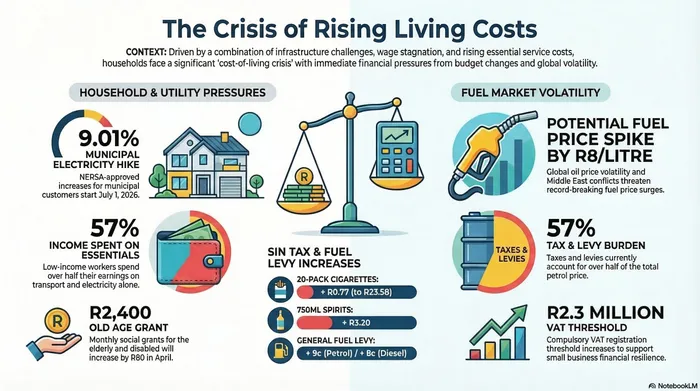
Analysis suggests that a confluence of international conflict and punitive fuel levies could see fuel prices spike by as much as R8 per litre.
Image: AI Graphic
South African households and small businesses are bracing for a heavier electricity bill after the National Energy Regulator of South Africa (NERSA) approved Eskom’s Retail Tariffs and Structural Adjustment (ERTSA) application.
The decision has set the stage for a fiscal catastrophe that will ripple across the economy, forcing already struggling families to choose between power and basic necessities. The regulator confirmed an average increase of 8.76% for Eskom direct customers and 9.01% for municipal customers.
This devastating move, which experts warn will squeeze already tight budgets, will take effect from April 1 for Eskom direct customers until March 31, 2027 and from June 30 to July 1 to June 30, 2027, for municipal customers. NERSA defended the staggered implementation. “Eskom must recover the full allowed revenue within its financial year, which is from April to March. However, the municipal financial year is from July to June.”
But for millions of South Africans, these figures translate into hard choices and a potential descent into deeper poverty. Experts have previously highlighted the devastating toll these increases will take on low- and middle-income brackets.
Frank Blackmore, Lead Economist at KPMG South Africa, issued a stark warning: “The impact will clearly be negative as it would direct income from spending on other necessities such as food, transport, clothing, schooling, etc., to paying for the increased cost of electricity.” Blackmore further explained the compounding effect of the increases: “A consequence of electricity price increases would also be the inflationary cost of nearly all products and services rising as businesses adapt their prices to higher electricity prices.
This means that apart from electricity, all other goods in the baskets of consumers will also increase, meaning that unless their incomes increase by the same amount, they will be worse off overall.” The crisis is compounded by the looming threat of escalating fuel costs. Analysis suggests that a confluence of international conflict, specifically, the Middle East war, and punitive fuel levies could see the fuel price spike by as much as R8 per litre. This crushing additional financial burden will turbocharge the inflationary cycle started by the electricity hike, making transportation and the delivery of all essential goods dramatically more expensive. For the average family, this twin assault on their finances guarantees a sharp and immediate decline in real disposable income, pushing economic vulnerability to breaking point.
The increases are set to hit a particularly vulnerable middle-income group with brutal force. Blackmore added a final, sobering assessment: “We should also remember that households that can’t afford electricity and are below some financial thresholds are provided with some free basic electricity, which would continue. However, this free electricity is really only a minimum amount. As in other areas of our economy, such as housing, there is a cohort of people with a basic level of income that is both above the free basic electricity threshold but would not have excess funds to afford the continual rise in electricity costs that will be most affected.”
Small businesses are also feeling the squeeze. Blackmore warned: “As with consumers, small businesses will also face increased operating costs with limited room to claw back expenses through price increases. The result will be that such businesses will need to cut costs elsewhere which could mean hiring fewer employees as well as finding cheaper suppliers or limiting goods and services available.”
Murray Crow, Managing Director of Kwikot, pointed to the real-life implications for everyday households: “As South Africans head into 2026, the energy conversation has shifted. Load shedding may be less dominant than in previous years, but electricity prices, infrastructure strain, and climate volatility remain firmly in the spotlight. South Africa has spent years asking whether we have enough electricity. Now households are asking a different question: even if it’s available, can we afford to use it?”
Political leaders have voiced their own concerns about the impact on ordinary families.
Vuyo Zungula, leader of the African Transformation Movement (ATM), said: “This increase is not merely a number; it represents a palpable burden on households already struggling to make ends meet. With nearly 37.9% of South Africans living below the lower-bound poverty line, families will be forced to redirect money away from essentials such as food, healthcare, and education to pay higher electricity bills. This is unacceptable.”
Zungula also warned that the tariff hikes could affect the broader economy: “High electricity costs are making sectors such as manufacturing and agriculture increasingly unprofitable. This situation threatens to cause significant job losses and economic contraction, a jobs bloodbath that could transform vibrant communities into ghost towns.”
The Democratic Alliance (DA) echoed concerns over public accountability. Kevin Mileham MP, the party’s spokesperson on electricity and energy, said: “The DA will fight tooth and nail against the National Energy Regulator of South Africa’s upcoming increase in electricity tariffs. The regulator remains unaccountable, while municipalities will bear the brunt of public anger when implementing the increases. In a local government election year, NERSA will put municipalities in the crosshairs of angry residents.”
Consumer advocacy group AfriForum also stressed the need for transparency. Morné Mostert, AfriForum’s Manager for Local Government Affairs, said: “Complete evidence regarding the decision is now essential. The energy regulator will have to be able to demonstrate that the decision was thoroughly thought through and that the methodology was correctly and consistently applied.”
Deidré Steffens, AfriForum’s Advisor for Local Government Affairs, added:
“Electricity tariffs affect everyone in the country. It is therefore not acceptable that billions of rand are simply redirected to Eskom without NERSA being able to fully and convincingly explain why this is necessary, legitimate, and fair. Once the full details of the decision are available, AfriForum will carefully study NERSA’s reasons for the Eskom tariff increases. The organisation will then discuss the matter with its legal team to determine what further steps are needed to protect consumers’ rights.”
As NERSA’s approval moves from proposal to reality, households, businesses, and municipalities are left to navigate the increased costs.
For many, the numbers on a regulator’s table will soon translate into real choices: how to keep the lights on while putting food on the table, paying school fees, or keeping a small business running.
Saturday Star