

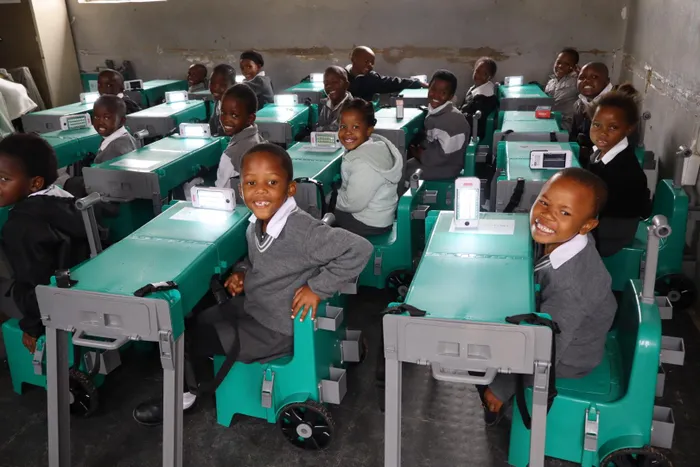
Decades into democracy, 2.3 million learners in South Africa are still forced to learn from the floor. Experts say the solution starts small — with a desk.
Image: Supplied
Every morning, millions of South African learners walk into classrooms without a single desk. In fact, more than 10 600 schools across the country face critical shortages of desk and chairs, leaving an estimated 2.3 million children forced to sit on the floor, balancing their work on their laps. Yet Section 29 of the Constitution promises every child the right to a basic education, a right that MiDesk Global argues cannot be fully exercised without the basic infrastructure to support it.
This Human Rights Day, MiDesk Global is calling the desk shortage what it is: a systemic infrastructure challenge with real consequences for learning, dignity and opportunity. While the national conversation focuses on access to schooling and literacy rates, one of the most overlooked barriers to learning remains shockingly basic, the fact that 2.3 million learners still do not have their own desk and chair, a gap that is quietly undermining one of the most fundamental rights in our democracy.
“A desk is not just a piece of furniture, it’s the foundation a child needs to truly learn,” says Talita Boodhram, chief impact officer at MiDesk Global. “Think about a child trying to focus while sitting on a cold floor, balancing their book on their knees because they have nothing solid to write on. It’s uncomfortable, yes - but it also affects their growing bodies, causing bad posture and strain. A desk may seem like a small thing to many of us, but for a child, it’s a matter of dignity. When we talk about access to education, we must also talk about the dignity that comes with having a proper place to learn.”
Could a simple desk change South Africa’s education trajectory? Could something as simple as a dedicated place to sit and work strengthen early learning and ultimately improve matric outcomes?
Studies show that by simply having a desk, it can improve a learner’s grades by up to 20%. MiDesk Global’s own monitoring and evaluation data mirror these results:
The impact is consistent: when the learning environment improves, everything improves - focus, attendance, performance and the confidence of the child. “Having access to a desk tells children that their education matters and that they deserve the same opportunities as any other child,” says Boodhram. “It also gives them the space to own their learning and be comfortable in their classes and when doing homework.”
She adds that transforming education does not always require sweeping reforms. Sometimes, it starts with the simple things like removing an everyday obstacle that stands between learners and their potential. And as a starting point, it really could be as simple as a desk.
Although government recognises the severity of the crisis, it can’t resolve it fast enough on its own. Each year of delay further disrupts learning and holds children back. Sustainable impact, at scale and speed, requires the private sector and civil society to step in – supplementing and supporting government by solving for the rapid deployment of desks in underserved communities.
As an endorsed UNESCO Education Partner and partner of the Department of Basic Education, MiDesk has already improved the learning experience of more than 5,200 children across South Africa. MiDesk’s unique wheeled schoolbag (and backpack) that unfolds into a sturdy desk and chair, complete with a solar-powered light, enables a personal study space learners can easily transport and use both at home and at school. The social enterprise aims to reach 1 million learners by 2030.
“Human Rights Day reminds us that rights must be lived, not just spoken about, and for millions of learners, dignity and a human right in education should begin with a desk of their own. Together, as South Africans, we need to make that happen,” concludes Boodhram.
MiDesk Global manufactures scalable portable unit, that transforms from a wheelie school bag into a desk, chair, and solar-powered study station. The social enterprise is a UNESCO Education Partner and a UN SDG-aligned partner. It is also partners with the Department of Basic Education.