

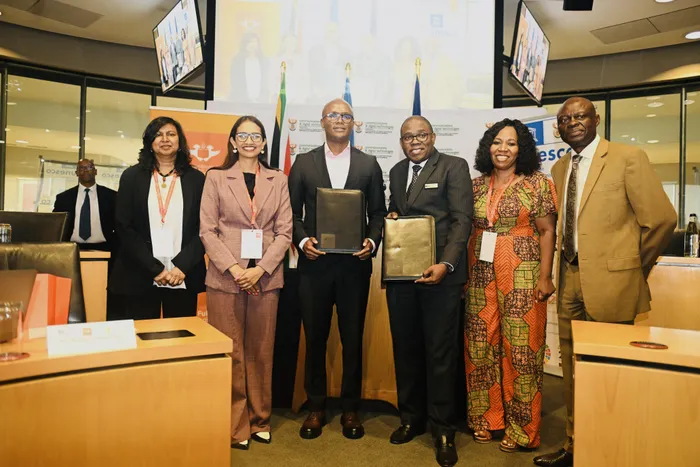
Faculty of Humanities Dean Professor Kammila Naidoo, UNESCO Chair Professor Prinola Govenden, Minister of Communications and Digital Technologies Solly Malatsi, UJ Vice-Chancellor and Principal Professor Letlhokwa Mpedi, UJ Deputy Vice-Chancellor of Research and Innovation Professor Refilwe Phaswana-Mafuya, and South African National Commission for UNESCO Secretary-General Carlton Mukwevho.
Image: University of Johannesburg
The University of Johannesburg (UJ) has won a UNESCO Chair and signed a formal partnership with government, placing the university at the centre of South Africa and Africa’s push for digital inclusion.
The UNESCO Chair in Cultural Inclusivity and Equity in Digital Media in Africa has been awarded for the 2026 to 2030 cycle. UJ secured it after a competitive global process involving 135 applications that were reviewed at UNESCO headquarters in Paris. The award places UJ among more than 1,000 UNESCO Chairs in 120 countries.
On Friday, 17 April 2026, UJ also signed a Memorandum of Understanding (MoU) with Minister of Communications and Digital Technologies, Solly Malatsi. The agreement sets out cooperation on digital transformation, policy development and inclusive innovation.
The agreement was signed with UJ Vice-Chancellor and Principal Professor Letlhokwa Mpedi. It positions the UNESCO Chair as an important national asset that supports South Africa’s digital diplomacy and its leadership role in Africa.
Minister Malatsi said the partnership reflects government’s focus on making digital progress more inclusive.
“It [the partnership] also supports a broader ambition, which is that South Africa's digital future will not be built by government alone. It will require partnerships across sectors. Government brings the public mandate and policy direction. Universities bring with them the research capacity and critical inquiry. Industry brings investment, aid and innovation, while civil society, on the other hand, helps to foster accountability and social legitimacy.”
The Chair is held by Professor Prinola Govenden in UJ’s Faculty of Humanities. It will focus on digital inclusion, cultural representation and fair access to knowledge in Africa’s fast-changing digital space.
It will also look at the impact of the Fourth Industrial Revolution (4IR) and help develop policy and governance frameworks. It will work on ways to address digital exclusion and the sidelining of local knowledge systems.
Prof Mpedi said this milestone strengthens UJ’s role as a leading African university shaping the future of the digital world.
“Our UNESCO chair will uniquely contribute innovative, empirical research, practical and strategic solutions, as well as policy recommendations for fostering a decolonised and inclusive internet that generally serves all African societies and its users. The Chair will also uniquely contribute to understanding the digital landscape for both knowledge representation and technical access perspectives, particularly concerning cultural representation, inclusivity and equity in Africa.”
The project aligns with UNESCO’s focus on culture, communication and information, and supports its global goal of promoting Africa’s role while protecting cultural diversity. It is supported by academic partners in China, Canada and Nigeria.
The initiative has also been endorsed at Cabinet level, led by Khumbudzo Ntshavheni, who highlighted its importance for South Africa’s global positioning and Africa’s role in international digital cooperation.
The signing of the MoU marked the first major activation of the Chair. It included participation from industry stakeholders such as MTN Group, Ericsson and the South African Chamber of Commerce and Industry, showing support across sectors for inclusive digital growth.
Prof Prinola Govenden said the Chair has a wider continental purpose focused on showing the real Africa.
“This Chair positions UJ at the forefront of driving research, partnerships and policy that ensure African voices are not only included, but lead in defining global digital narratives. [We will use this chair to highlight] that audiences differ and interpret media, messages and texts in relation to their specific cultural context. African audiences and users are not passive, naive copycats. African users and audience are active, engaged, and we use media in our everyday lives in creative ways."
The university is expected to officially launch the UNESCO Chair and host a Ministerial Roundtable on 15 May 2026. The event will focus on localisation, digital inclusion and fair knowledge systems across Africa.