
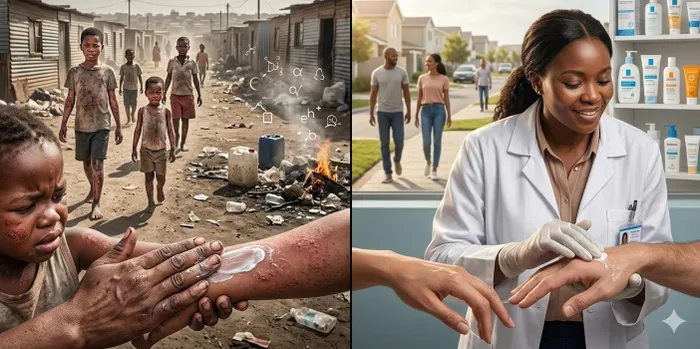
From polluted streets to crowded homes, skin reflects the realities of life in South Africa.
Image: Gemini
There is a simple truth we do not say out loud often enough: Your skin tells the story of where you live, how you live, and what you have been exposed to. In South Africa, this truth is even sharper. Your postcode can determine your risk of chronic inflammation. Your daily commute can determine the onset of eczema. Your access to clean water can decide whether your child develops recurring fungal infections. Skin is biological, but the forces that harm it are profoundly social.
Every day in my work as a biomedical scientist, I meet people who blame themselves for “bad skin,” as though it is a personal failure. Yet their conditions are born from realities that no moisturiser alone can repair.
The skin is the body’s largest organ. It is the barrier between the body and the world. And in South Africa that world is among the most unequal societies on the planet.
Walk through any under-resourced community and you will see the truth on people’s faces, arms, and scalps long before it appears in national health statistics.
Children living near mine dumps and polluted industrial corridors present with stubborn dermatitis and chronic dryness that defies over-the-counter solutions. In areas with poor waste management, bacterial and fungal infections spread easily, especially in households where several generations share small living spaces. People who rely on public transport - spending hours in heat, dust, diesel fumes, and overcrowding, show accelerated photo-ageing, hyperpigmentation, and persistent inflammatory flare-ups. Their skin is not misbehaving; it is defending itself against environmental assault.
And for many South Africans, even water is a risk factor. Hard water, contaminated water, intermittent supply, or reliance on communal taps all increase the likelihood of irritation, eczema, and compromised skin barriers.
These are all health conditions, and they shape confidence, dignity, and quality of life.
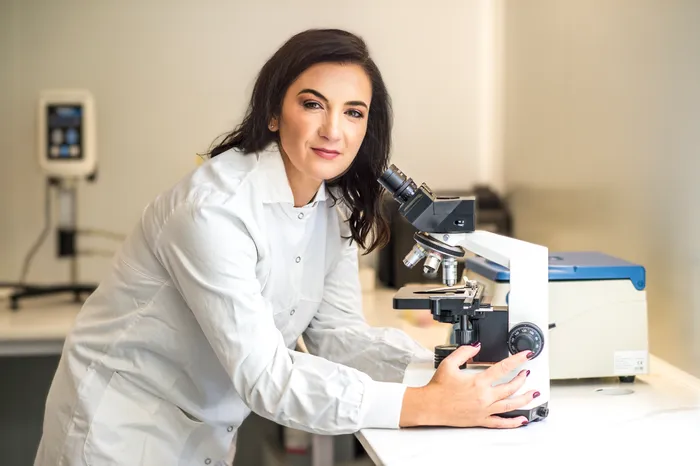
Dr Judey Pretorius, biomedical scientist and product specialist, calls on South Africa to see skin health as a human right, advocating for accessible care, strict regulation and science-driven solutions that protect everyone, not just those with privilege.
Image: Supplied
The beauty and skincare industry continues to market “perfect skin” while ignoring the lived realities of millions who cannot access dermatological care or scientifically sound products.
We have allowed a system where those with privilege can protect their skin with advanced clinical treatments, and preventive care. Meanwhile, the communities most exposed to environmental stressors are targeted with harsh, poorly formulated products that offer whitening, lightening, smoothing, or quick fixes that do more harm than good.
I have seen products sold in informal markets that contain illegal corticosteroids or strong anti-inflammatory medicines. I have tested creams, often marketed to women seeking uniform complexion that contain mercury, hydroquinone in dangerous concentrations, and unlabelled active ingredients. These substances thin the skin, disrupt hormone function, and increase sensitivity to infection and sunlight.
This is not an industry oversight. It is an industry failure.
A market without proper oversight inevitably preys on vulnerability.
When we speak of human rights in South Africa, we talk about housing, water, education, safety, and dignity. Yet skin, which is our first layer of defence, is treated as an afterthought, relegated to “beauty” instead of “health.”
But what does dignity mean if a person must live with painful, untreated skin conditions? What does equality mean if harmful products circulate freely in low-income areas? What does access mean if dermatology remains unaffordable for the majority?
Recognising skin health as a human right does not mean luxury serums for all. It means basic, scientifically sound care should not be determined by income.
Even medical aids don’t care for the safety and health of human skin
Many medical aids refuse to pay for the removal of suspicious moles, calling it cosmetic rather than medically necessary. This is not only misleading. It is risky.
Some skin lesions can develop into melanoma, a serious and potentially deadly form of skin cancer. When doctors recommend removing a mole, it is rarely about appearance. It is about safety. The only reliable way to know whether a suspicious spot is dangerous is to remove it and examine it. That makes the procedure diagnostic, not cosmetic.
Dermatologists routinely remove moles when they change in size, colour, or shape, when their borders are irregular, or when they cannot be confidently identified as harmless. In these cases, waiting and watching is not responsible medicine.
Early removal also makes financial sense. Treating a small suspicious lesion early is far less costly than treating advanced melanoma later. Advanced disease may require surgery, cancer treatment, and long term medical follow up.
From both a health and economic perspective, preventing skin cancer early is the responsible choice.
Failing to recognise this does not protect medical aid funds. It puts lives at risk.
From a healthcare economics perspective, preventative excision is cheaper than cancer treatment.
What needs to change, and how science can lead the way
As a scientist working at the intersection of biology, chemistry, and product development, I know the solutions exist. What we lack is urgency and regulation.
We need national oversight that ensures products sold (formally and informally) meet safety standards. Harmful chemicals cannot be allowed to circulate without consequence.
Invest in community skin-health education
People must know the difference between skin conditions caused by the environment, by infection, by inflammation, and by dangerous products. Knowledge facilitates prevention.
Provide accessible, affordable, scientifically validated skincare in public health settings
Municipal clinics should stock barrier-repair products, emollients, and treatments for common inflammatory disorders, not just prescriptions for severe cases.
Recognise environmental and socioeconomic exposure as clinical factors
A person’s living conditions should inform diagnosis and treatment, as strongly as family history does.
Support local scientific innovation
South Africa produces world-class scientists and formulators, yet our regulatory environment does not incentivise safe, research-driven manufacturing.
Every formulation I create and every research project I undertake begins with this conviction: skin health must be accessible, scientific, and safe, regardless of income or geography.
My work is a response to the patients I met in my community dermatology days, the factory workers battling chronic dermatitis and the grandmothers caring for grandchildren with untreated eczema because a clinic has a three-month waiting list.
It is impossible to separate the science from the society it serves.
A future where your skin doesn’t reveal your struggle
If South Africa is serious about health equity, then we must move beyond treating skin concerns as vanity-driven issues. Our environment, our infrastructure, and our inequalities leave visible marks. Addressing them is not about chasing beauty; it is about protecting a vital organ that reflects our public health landscape.
Skin is a mirror of the nation. It is time we looked closely and acted accordingly.
Dr Judey Pretorius, biomedical scientist and product specialist