

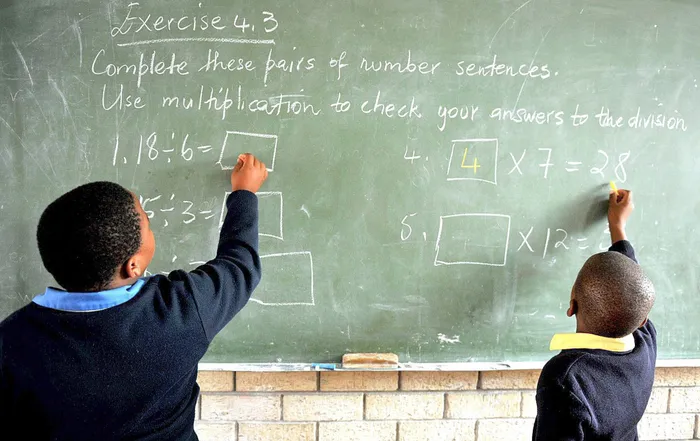
No child is permanently 'not a maths kid' or locked into a specific academic trajectory. Highlighting the principles of cognitive education used at Bellavista School, this article debunks the myth that intelligence is fixed.
Image: File
A simple question to start: what is the actual point of school? Ask a parent and you might get a few different answers – to learn things, to pass matric, to get into university, to socialise, to grow up. Ask an AI chatbot, and you get a tidy, almost bureaucratic summary:
“The primary role of a school is to provide a structured and organised learning environment where children can acquire knowledge, develop cognitive skills, and enhance their academic performance, preparing them for future educational pursuits and contributing to society.”
It is a serviceable answer, and one that captures the traditional emphasis of schools – knowledge acquisition and academic performance. Primary schools concentrate on literacy and numeracy. High schools structure themselves around exam preparation. The model has been broadly the same for decades.
The trouble is that the world the model was built for no longer exists.
A generation ago, the skill schools needed to teach was access. Children needed to know where to find information, how to look things up, and how to remember enough of it to pass an exam.
That problem has been comprehensively solved. The skill our children now actually need is the opposite one – how to critically evaluate the avalanche of information they are already drowning in. They need to compare sources, judge reliability, solve problems, and analyse competing claims. The challenge is no longer reaching the information, but making sense of it.
Are South African schools adapting their curricula to keep pace with this shift? That is a question worth interrogating, especially as we mark Youth Day this June.
Many educators feel the pressure of having to cover ever-expanding curricula while meeting prescribed learning outcomes. But what if curriculum design did more than transmit content? What if it deliberately built the cognitive processes that allow learners to become responsible, ethical, resilient problem-solvers – independent thinkers and contributors to society?
That, in essence, is the goal of cognitive education.
At Bellavista School, cognitive education sits underneath every instructional practice we use. It draws on the evidence-based work of the late Professor Reuven Feuerstein and his colleague, Professor Emerita Katherine Greenberg. Two of Feuerstein’s ideas anchor the whole approach: Structural Cognitive Modifiability (SCM) and the Mediated Learning Experience (MLE).
SCM is built on a deceptively radical claim – that cognitive abilities are not fixed. Regardless of age or perceived limitation, individuals can develop new neural pathways and enhance how they think. Modern neuroimaging research supports this view, demonstrating the brain’s remarkable capacity for neuroplasticity.
For parents and teachers, this matters. SCM offers an optimistic view of learning – every individual has the capacity for cognitive growth and meaningful change. No child is permanently “not a maths kid” or “not really academic”. They are at a particular point on a trajectory, and the trajectory can move.
If SCM tells us what is possible, MLE explains how that possibility is realised. Feuerstein defined the mediated learning experience as:
“The quality of human-environment interaction that results from the changes introduced in this interaction by a human mediator who interposes him/herself between the receiving organism and the sources of stimuli” (Feuerstein, 2003, p. 23).
The shorter version: a mediator – an educator, therapist or parent – stands between the learner and the world, and shapes the encounter. They frame what the child is looking at. They guide attention, ask questions, draw connections. They help the learner notice their own thinking. Out of this structured interaction comes something a child rarely builds on their own: the capacity to solve problems, set goals, and reason independently.
A central component of cognitive education is metacognition – thinking about thinking. The ability to pause and reflect on how you learn is a core executive functioning skill, and it sits at the heart of Professor Barry Carpenter’s Recovery Curriculum Theory (Carpenter & Carpenter, 2020).
Feuerstein’s Instrumental Enrichment programme captures the idea in a single phrase:
“Just a moment…let me think!”
Beyond metacognition, learners need to develop metastrategic thinking – building their own personalised toolkit of learning strategies. Once a child knows which strategies work for them, they become more confident and more capable across academic, vocational, emotional and social terrain (Greenberg, 2000).
Building on Feuerstein’s theories, Professor Katherine Greenberg developed the Cognitive Enrichment Advantage (CEA) approach – a structured method for cultivating a shared language of thinking and learning across everyone involved in a child’s education. The point of CEA is consistency. When educators, students, parents and other stakeholders all name and reinforce the same cognitive processes, those processes start to stick.
Greenberg describes the classroom as a “laboratory for learning” – a space where students engage in reflective, independent and interdependent learning experiences (Greenberg, 2000, p. 15).
CEA is structured around 12 building blocks of thinking, which focus on the cognitive processes essential for effective reasoning, and 8 tools of learning, which address the emotional and motivational side of how children engage with learning (Greenberg, 2000). Feuerstein consistently stressed that cognition and emotion are deeply interconnected. Mediation is the bridge between them, which is why a properly rounded educational approach has to engage both.
There is a quietly powerful idea at the centre of all of this. The ultimate goal of a mediated learning experience is to empower learners to think independently – so that, over time, each child becomes their own mediator. We are not teaching children what to think, we are teaching them how to think. For a generation that will inherit a world none of us can fully predict, that may turn out to be the most useful lesson we ever taught them.
For more information on cognitive education, visit www.bellavista.org.za
Tamara Victor, Lead Consultant Professional Development at Bellavista S.H.A.R.E.