

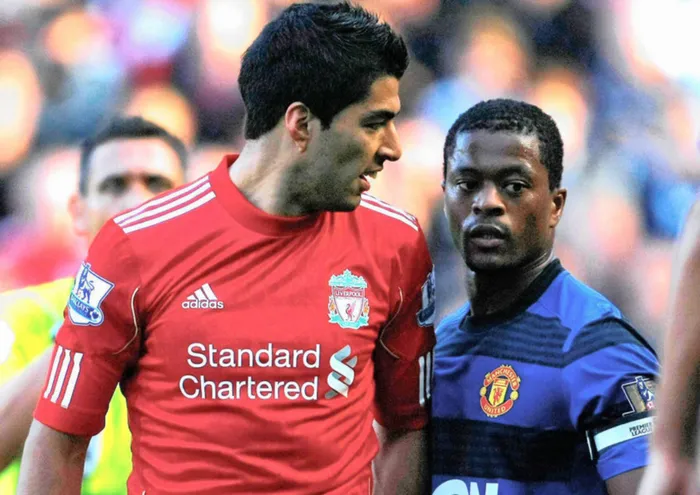
In this October 15 2011 file photo, Manchester United's Patrice Evra argues with Liverpool's Luis Suarez, left, during their English Premier League soccer match at Anfield, Liverpool, England. Suarez has been banned for eight matches and fined �40 000 after being found guilty of racially abusing Evra. Picture: AP In this October 15 2011 file photo, Manchester United's Patrice Evra argues with Liverpool's Luis Suarez, left, during their English Premier League soccer match at Anfield, Liverpool, England. Suarez has been banned for eight matches and fined �40 000 after being found guilty of racially abusing Evra. Picture: AP
Sport is supposed to be the epitome of the level playing field, where people are judged by their performance on the field or court, not by the colour of their skin.
My favourite sport, football, has the capacity to bring people together.
I am pained by the fact that when it comes to the poisonous hate of racism, the game has also been there, done that.
It is hard to think of a single month in a single year in the past generation in which there has been no racism in sport.
As we bade farewell to 2011, England and Chelsea captain John Terry was alleged to have racially abused Queens Park Rangers defender Anton Ferdinand.
Terry was said to have used the words “****ing black ****” in an exchange with Ferdinand.
Terry does not deny using these words, but claims the context in which he said them meant that they could not be taken as racist abuse.
The Terry incident came soon after the spat between Liverpool forward Luis Suarez and Manchester United defender Patrice Evra.
Suarez allegedly called Evra “negro” (black) seven times during an on-field confrontation.
We will all remember Suarez. He earned notoriety at the last World Cup by fending off a goal-bound effort with his hand by Ghana in the final moments of their quarter-final, then celebrating when the resulting spot-kick was missed. Uruguay eventually went through after a penalty shoot-out.
Suarez’s claim is that the racial slur was lost in translation.
He says the use of the word “negro” in Uruguay and other parts of Latin America is inoffensive in certain situations and used as a “friendly form of address to people seen as black- or brown-skinned”.
According to reports, trouble flared when Evra asked Suarez why he had been kicked.
“Porque tu eres negro,” Suarez replied in Spanish, which translates as “because you are black”.
When Evra challenged him to repeat the answer, and said he would “punch him”, Suarez responded in Spanish: “I don’t speak to blacks.”
After Evra threatened to hit him again, Suarez replied with a phrase that the report said translates as “OK, blackie, blackie, blackie”.
Fifa president Sepp Blatter made things worse. Asked to comment on the Suarez-Evra incidents, Blatter told CNN that racism between players on the pitch could be settled with a handshake.
He got it wrong and he apologised for his ill-conceived comment.
Suarez has been found guilty by the English Football Association (FA), slapped with an eight-game suspension and handed a £40 000 fine.
Terry is to learn his fate on February 1. He may lose his captaincy of both England and Chelsea if found guilty.
The FA’s ban is harsh – but at least the association sent out a message that these issues will be taken seriously and dealt with accordingly.
These latest incidents and statements have reawakened the debate on whether football or sport is intrinsically racist.
While we have advanced from the days when banana skins were tossed at black players, the fact that a footballer could insult a fellow professional in terms of his skin colour is an affront to these enlightened times.
This is also proof that we should not fool ourselves into believing that everybody is given the same freedoms.
The truth is that no matter how far we have come in the fight for equal rights, racism is still a major issue every day, everywhere, as well. All of us are guilty of it, one way or the other.
We all judge people based on appearance without even thinking about it.
Of course, we would like to think that we have moved beyond issues of race, ethnicity and skin colour – that those issues are problems of the past.
The truth is that despite the progress we have made breaking down barriers, we are still steeped in the filth of racism – and those who think it’s already gone need to be especially active in recognising and ridding it from society.
That is why international soccer is no stranger to racism.
Fifa has responded by instituting regulations that will deduct game points from teams exhibiting racist behaviour on the pitch.
The rules, however, won’t accomplish anything because they do not apply to fans in the stands, where most of the incidents occur.
Fifa officials needn’t worry, though, because this racism will work itself out.
I’m not saying racism should ever be ignored, endorsed or upheld in any way, but this dark era will be left in the dust as the sport moves forward.
Coaches, players and, most notably, fans are having to cope with the fact that their sport is changing.
For many countries soccer is a sacred sport intrinsically linked to national pride – and, so for some, seeing a multi-racial national team is a tough task.
I’m not saying racism is at all justified or excusable. I am saying all sporting codes will one day mature beyond this period and good will come of it.
Our children’s children’s children will see things differently.
The Suarez-Evra and Terry-Ferdinand incidents are helping us to mature, bringing perspectives to the fore and posing important questions.
Why do people act in these horrific ways, and what do these terrible events have to do with the everyday racism that does not make the headlines?
Eli Siegel, an American educator who founded the philosophy of Aesthetic Realism has an answer.
He explains that racism begins with the hope for contempt – the “false importance or glory” a person gets by making less of the reality of other people.
In his book James and the Children, a consideration of The Turn of the Screw by Henry James, Siegel writes: “According to Aesthetic Realism, the greatest sin that a person can have is the desire for contempt. Because as soon as you have contempt, as soon as you don’t want to see another person as having the fullness that you have, you can rob that person, hurt that person, kill that person.”
Contempt, Aesthetic Realism explains, is the cause of every injustice – from ethnic ridicule and slurs to the deadly forms of racism, bombs and war.
One of the clearest places where contempt can be seen is on the pitch, where it can construe itself as an international danger.
It also carries personal friction, as demonstrated by Suarez’s and Terry’s moments of “false importance or glory”.
A person who is “white” (Suarez) looks at a person whose skin is darker (Evra) and feels: “I am better than you.”
Because the two white players wanted to think well of themselves, an easy way of seeming to think well of themselves was to consider the other as inferior.
In my life, respect for people begins with asking, and honestly trying to answer, the necessary question which Siegel first presented: “What does a person deserve by being a person?”
No one begins life as a racist, but all of us can yield to the temptation of wanting to feel superior to other people, especially when we feel unsure of ourselves.
l Rich Mkhondo, an executive for Corporate Affairs at MTN Group, was chief communications oOfficer of the 2010 World Cup.
He writes in his personal capacity.