

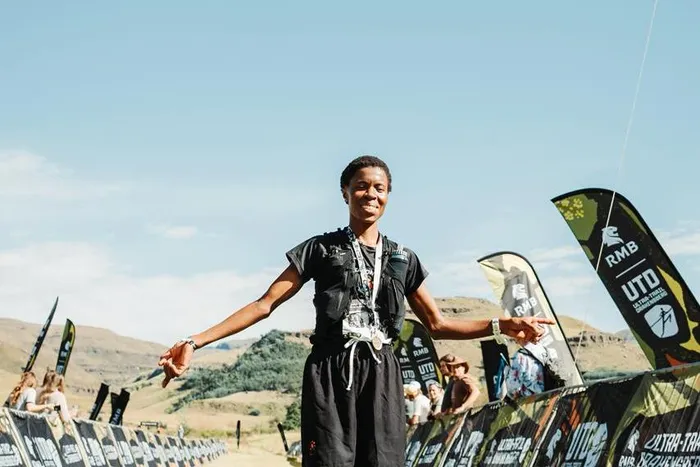
RMB’s sponsorship of the Ultra-Trail Drakensberg exemplifies a commitment to social and environmental impact through conservation efforts for the endangered bearded vulture and community development via the LIV2RUN program, fostering both biodiversity and youth talent in the Maluti-Drakensberg region. Seen here: Nolwazi Dlamini of LIV2Run won the women's 14km race. Picture: Camryn Steenkamp
Image: Camryn Steenkamp
For RMB, sponsoring the Ultra-Trail Drakensberg is about far more than sport. It is about legacy— one that extends from the peaks of the Maluti-Drakensberg
mountains to the communities at their base, and even into the skies where one of South Africa’s rarest birds fights for survival.
Central to this vision is impact— a word Michael Edwards returns to repeatedly.
“We always look for ways to make an impact that goes beyond the event itself,” says the RMB Sponsorship Marketing Lead.
That philosophy has shaped two of the most significant pillars of RMB’s involvement in trail running: environmental conservation and community development.
In the Drakensberg, conservation efforts are closely tied to the protection of the endangered bearded vulture— a species with fewer than 100 breeding pairs remaining in Southern Africa.
“When we partnered with Ultra-Trail Drakensberg, the conservation work around the bearded vulture was already there,” Edwards explains. “We saw an opportunity to amplify that and create real synergy.”
The partnership reflects a broader responsibility, both corporate and personal. Edwards speaks candidly about fatherhood sharpening his perspective.
“You start thinking about the world you’re leaving behind,” he says. “I want my daughters to experience these environments and species. That responsibility drives a lot of what we do.”
Protecting the bearded vulture is not just an environmental concern— it is also an economic one. The region’s natural assets draw visitors from across the globe,contributing to local economies through tourism, hospitality, and outdoor recreation.
“People travel to experience these landscapes and wildlife,” he says. “If we don’t protect them, we lose more than just biodiversity; we also lose livelihoods.”
Equally important is RMB’s investment in people, particularly through its partnership with LIV2RUN, a Durban-based non-profit organisation that identifies and develops young running talent. The programme is as much about mentorship as it is about performance.
“It started with one person going for a run and others joining,” Edwards reflects on the journey that began when Lindi Meyer went on a run at the LIV village only to see a trail of young children forming behind her as the youngsters inadvertently joined the white lady. “Now it’s a structured system that nurtures talent and creates opportunities.”
LIV2RUN operates on a powerful cycle: young athletes are developed, progress into elite runners, and eventually return as mentors to guide the next generation.
“It’s self-sustaining in that sense. You’re constantly building and giving back at the same time.”
The results are already visible. Athletes supported through the programme are competing at high levels, securing podium finishes— this weekend five LIV@RUN athletes made the podium at RMB UTD— and gaining access to international races, opportunities that would have been out of reach without structured support.
But the impact extends far beyond elite competition.
“In these communities, spending a day running and being mentored is a day away from negative influences,” Edwards says. “It’s about showing young people what’s possible.”
Through mentorship clinics and community engagement, LIV2RUN is shaping not just athletes, but individuals.
“Running is the vehicle. But the real value is in the life lessons that the kids pick up: discipline, commitment, and belief in yourself.”
This dual focus on environment and community underscores RMB’s broader approach to sponsorship— one rooted in authenticity and long-term commitment.
“There’s a difference between showing up and making a genuine contribution,” Edwards says. “People can see that.”
In a world where corporate involvement in sport is often questioned, RMB’s model offers a compelling alternative because theirs measures success not just in visibility, but in lasting impact.
From protecting endangered species to empowering future athletes, the bank’s trail running journey is proving that the finish line is only part of the story.