

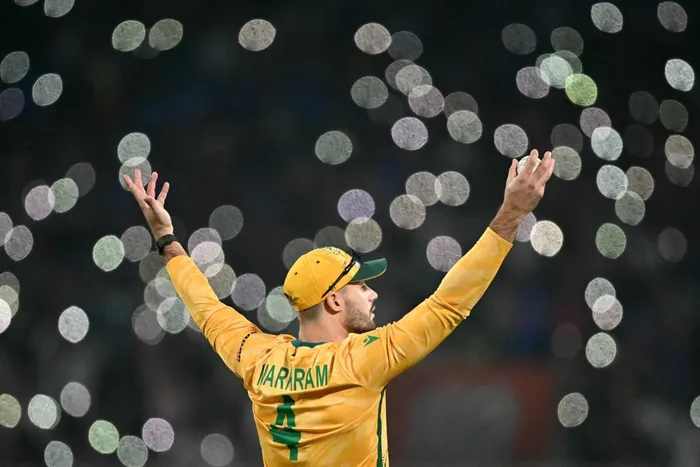
South Africa's captain Aiden Markram gestures during the 2026 ICC Men's T20 Cricket World Cup semi-final match between New Zealand and South Africa at the Eden Gardens in Kolkata on March 4, 2026. Picture: Dibyangshu SARKAR / AFP
Image: Dibyangshu SARKAR / AFP
South Africa’s T20 World Cup dream is over — and this time, there’s no hiding behind the so-called “World Cup curse.”
The Proteas were beaten convincingly by New Zealand in the semi-final on Wednesday, and while the defeat will sting, the truth is far less mystical than fans might suggest. This was not fate. It was self-inflicted.
New Zealand were disciplined with the ball, but South Africa’s downfall began with their own decision-making. The shot selection from Aiden Markram, Quinton de Kock, Ryan Rickelton and David Miller lacked composure in a high-pressure knockout clash. Instead of building a platform, the Proteas handed momentum away.
Posting 170 in a World Cup semi-final was always going to be a risk. Marco Jansen’s brilliance with the bat briefly reignited belief, but against a tactically sharp New Zealand side, it was never likely to be enough.
Get your news on the go. Download the latest IOL App for Android and IOS now.
Then came the final exclamation mark.
Finn Allen’s blistering 100 off just 33 deliveries didn’t just swing the contest — it obliterated it. His calculated aggression dismantled South Africa’s hopes and ensured the chase was a formality rather than a contest.
So was it a choke? Not quite. A choke implies surrendering from a winning position. The Proteas were never truly in control. Even Proteas coach Shukri Conrad put it down to a bad day at the office in the aftermath.
New Zealand were simply calmer, smarter, and ruthlessly efficient. On the biggest stage, that made all the difference.
South Africa arrived at this semi-final as favourites after a dominant tournament. They left having been comprehensively exposed.
* The views expressed are not necessarily the views of IOL or Independent Media.
** JOIN THE CONVERSATION: Send us an email with your comments, thoughts or responses to [email protected]. Letters should be a maximum of 500 words, and may be edited for length. Anonymous correspondence will not be published. Submissions should include a contact number and physical address (not for publication).