

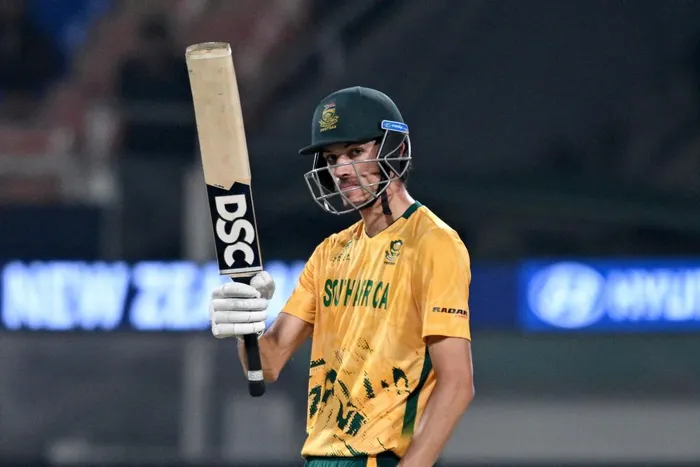
Marco Jansen's batting was the Proteas' only shining light against the rampant Blackcaps.
Image: AFP
The weight of history proved too heavy a burden for the Proteas to carry at Eden Gardens as their unbeaten run in the 2026 T20 World Cup came to a crashing, familiar end.
On a night where technical discipline deserted them and the ghosts of past knockouts seemed to linger in the humid Kolkata air, South Africa were humbled by a clinical New Zealand outfit.
The collapse was twofold: a batting order that failed to respect the conditions, followed by a bowling display that lacked the tactical nuance when the Kiwi batters decided to chance their arm and go hard.
While the group stage win in Ahmedabad had offered hope, the Proteas capitulated in Kolkata.
From a surprise bowling hero to a record-breaking century, the Black Caps dominated almost every phase of play. Here are some of the key takeaways from the semi-final.
That was the question on everyone’s lips when McConchie was handed the second over of the Powerplay following his surprise inclusion in the Black Caps' side. However, Quinton de Kock and Ryan Rickelton will likely never forget him.
New Zealand had clearly done their homework on the destructive De Kock, who has struggled against off-break bowlers throughout this tournament. The Proteas wicket-keeper hit a shortish delivery straight down mid-on’s throat, before Rickelton clipped the very next ball to short third-man. Remarkably, that would be McConchie’s only over of the night, but the damage was done.
The Proteas had steamrolled all opponents at their Ahmedabad fortress, where the Narendra Modi Stadium pitches offered pace and bounce for the seamers. At Eden Gardens, however, South Africa were put into bat on a wicket that seemed to hold up a touch.
They simply never adapted to the conditions, attempting to hit out rather than biding their time and taking the game deep. De Kock, Aiden Markram, and David Miller — the senior heads in the side — all perished trying to clear the boundary when the situation called for consolidation.
As predicted, the ball came onto the bat much better in the latter stages of the first innings as the dew began to fall. Tristan Stubbs and Marco Jansen shared a half-century stand after the Proteas had slumped to 77/5.
Jansen smashed his way to an unbeaten 55 off just 30 balls to give his side a fighting chance, while Stubbs contributed 29 off 24. However, the youngster could have shown more intent, especially as the Proteas likely needed a total closer to 190 or 200 to be competitive.
The Proteas needed early wickets to defend 170 and created four chances in the first two overs. The most glaring miss occurred when Tim Seifert skied a ball towards fine leg off Kagiso Rabada.
Inexplicably, wicket-keeper De Kock called for the catch and ran all the way from behind the stumps, despite Dewald Brevis being significantly closer. In the end, the keeper didn't even lay a glove on the ball — a moment that served as a metaphor for the Proteas' dismal night.
Once the pitch quickened up, Finn Allen and Seifert took full advantage of their early luck. The Proteas' attack was smashed to all corners of the ground as they offered little variety, stubbornly trying to hit the deck as hard as possible.
Allen hammered the fastest-ever T20 World Cup century as the New Zealanders chased down the target in just 12.5 overs. The Proteas held back Keshav Maharaj until after the Powerplay, but by then the Kiwis had cruised to 86/0. The contest was essentially over before the spin spearhead could even mark his run-up.