

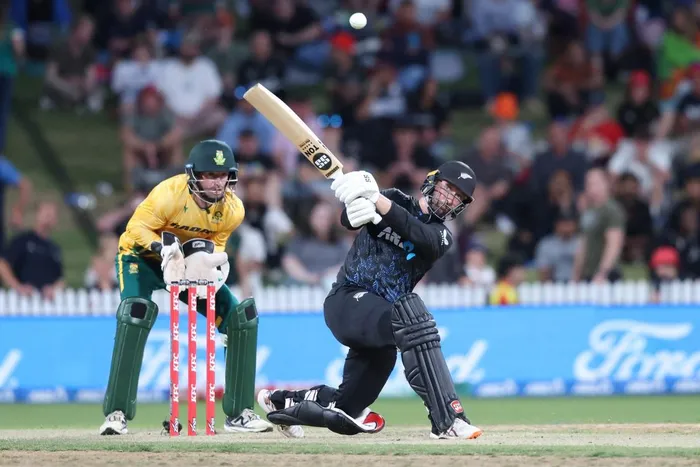
New Zealand opener Devon Conway plays international cricket and features in Betway SA20.
Image: AFP
The Proteas may be fully focused on edging ahead in the third T20I of the five-match series at Eden Park in Auckland on Friday, but the hosts could be slightly distracted by a potential player strike on the horizon.
The series is currently tied up at 1-1 after Keshav Maharaj’s team won the opener at The Bay Oval before the Black Caps struck back at Seddon Park in Hamilton mid-week.
The Kiwis though are currently involved in a player dispute whilst New Zealand Cricket’s board deliberates the future of the country’s domestic Twenty20 competition.
The current status quo is the provincial-based Super Smash, but four replacement options have been tabled by consultancy firm Deloitte.
According to the New Zealand Herald, however, only two are being considered - a privately-owned franchise tournament based in New Zealand, to be known as NZ20 - similar to Betway SA20 - or a singular New Zealand-run entry in Australia’s Big Bash League (BBL).
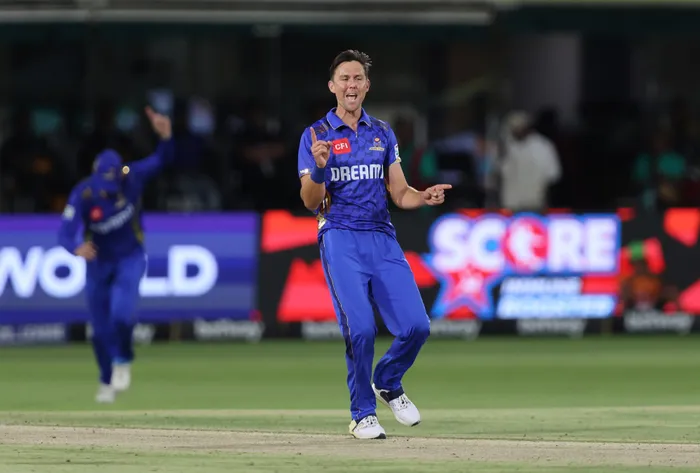
New Zealand's Trent Boult has played for MI Cape Town in the Betway SA20 the past two seasons.
Image: Sportzpics
The latter would follow the precedent set by other New Zealand sporting codes such as football and rugby league that have Kiwi teams such as Warriors and Breakers (both rugby league) and Auckland FC and Wellington Phoenix (football) competing in Australian trans-Tasman leagues.
New Zealand rugby union franchises, such as Crusaders, Blues, Highlanders and Chiefs also compete in Super Rugby along with Australian teams.
However, senior Black Caps Rachin Ravindra and Daryl Mitchell are heavily opposed to joining the BBL and have thrown their weight around NZ20, with Mitchell, in particular, stating “I want us to have our own identity.”
Top-order batter Ravindra was more diplomatic, calling for "greater urgency on the decision."
"We’re respectful of the Deloitte process, but if we want to get NZ20 underway, the ball has to start moving pretty urgently," Ravindra said.
With the New Zealand Cricket Players Association also backing the formation of the NZ20, there has been discussion that "a strike could eventuate" should the new competition not get off the ground.
Mitchell and Ravindra are being rested for the on-going T20I series against the Proteas.
After years of trial and error with two previously failed T20 competitions, South African cricket finally found the formula with the formulation of the Betway SA20 four seasons ago.
Six city-based franchises - all owned and bankrolled by IPL teams - were formulated and have since achieved groundbreaking success both on and off the field in South Africa.
Four debutants - Connor Estherhuizen, Dian Forrester, Jordan Hermann and Nqobani Mokoena - in the current Proteas T2OI squad virtually started their professional careers in SA20, which has enabled the national team to grow its player depth below the first-choice squad.
Equally, SA20 has been a major financial boost to Cricket SA’s bottom line over the past four seasons.
New Zealand stalwarts such as Kane Williamson, Trent Boult, Devon Conway and Jimmy Neesham, who have all stepped away from central contracts while continuing to represent the Black Caps when available, have all played in SA20 over the past four seasons.
Conway and Neesham are part of the current Black Caps T20I squad facing the Proteas.
The only drawback thus far has been the lack of a Women’s SA20, which is part of New Zealand’s Cricket Association’s plans.
Gender equality is high on the NZCA’s priority list with the Proteas Women’s team and the White Ferns playing double-headers with the respective men’s teams throughout this five-match T20I series.
New Zealand cricket has endured a player strike before back in 2002 when the NZCPA laid down their bats and balls to secure improved pay conditions, whereby the players gained a percentage of the sport’s commercial income, rather than a fixed rate.