

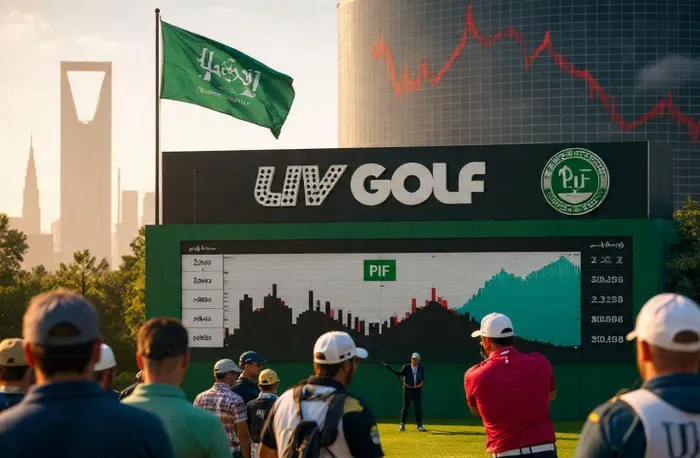
Rising geopolitical tensions in the Middle East, particularly involving Iran, have cast doubt on the future of LIV Golf as Saudi Arabia’s Public Investment Fund considers withdrawing its funding, amid the tour’s ongoing struggles with low ratings and tensions with the PGA Tour. Picture: ChatGPT
Image: ChatGPT
This volatile world is certainly a strange and confusing mess at the moment, and this is particularly true about the future of LIV Golf as rising geopolitical tensions in the Middle East—particularly the War on Iran—have prompted reports that Saudi Arabia’s Public Investment Fund (PIF) might withdraw its funding of the breakaway tour.
Reports this week have suggested that PIF, which has funded LIV Golf since its inception in 2022, could be close to cutting off access to funds.
This comes after PIF has already invested billions into the tour, which was meant to compete directly with the US PGA and (European) DP World Tour.
It’s meant that LIV Golf’s chief executive has moved swiftly to try and put out fires, as he said this week that the tour will continue at ‘full throttle’, with the event in Mexico this week unaffected.
However, by commenting on the situation at all, it has given credence to the speculation that the tour is in trouble.
At the heart of the uncertainty is a broader shift in Saudi Arabia’s strategic priorities. The PIF—one of the world’s most powerful sovereign wealth funds—has used sport as a key pillar of its global investment strategy, aligning with the kingdom’s Vision 2030 plan to diversify its economy and expand its international influence.
However, those investments have not been without controversy. Critics have frequently described Saudi Arabia’s aggressive push into global sport—including LIV Golf—as an attempt at “sportswashing,” a term used to suggest that high-profile sporting investments are designed to improve the country’s international image amid ongoing scrutiny of its human rights record.
Saudi officials have consistently rejected that characterisation, arguing that the investments are part of long-term economic diversification.
The PIF is now believed to be placing less emphasis on sports as its priorities are rapidly changing.
The crux of the issue is the effect the war in Iran is having worldwide, and in particular on US President Donald Trump and the stance he has taken in the conflict with the imposition of his global sanctions.
Sports events worldwide have already been affected by the conflict with airspace closures, like international cricket teams being stranded in India after the T20 World Cup earlier this year.
Elsewhere, Saudi-backed sporting events have reportedly been relocated or lost funding entirely due to security concerns tied to the conflict.
Though official confirmation that PIF will be pulling its support, the global uncertainty with anything connected to the Middle East is certainly concerning for LIV Golf.
In fact, even without the war in Iran, the LIV Golf Tour has struggled to forge a sustainable commercial model, despite its enormous spending on player contracts and prize money. This is clear with low ratings for LIV events compared to PGA Tour events.
Adding fuel to the fire will also be the tensions between the PGA Tour and LIV Golf, with previous rumours of a merger failing to materialise.
While LIV Golf will always project messages of stability, reading between the lines suggests quite the opposite. That’s why PIF will have to soon make a decision about whether it continues to fund this big-budget golf experiment.
Until that decision is made, LIV Golf finds itself navigating its most uncertain waters yet — caught between ambition, economics, and the unpredictable forces of global politics.