

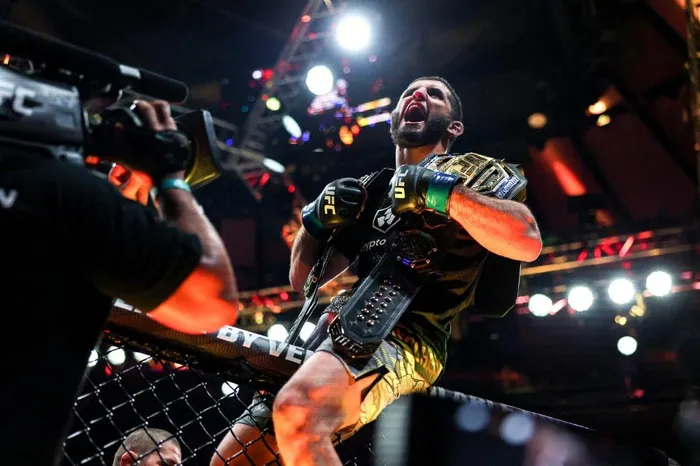
Islam Makhachev celebrates after defeating Jack Della Maddalena to win the welterweight title at UFC 322 in New York City last weekend.
Image: AFP
Islam Makhachev and his brother Kurban grew up poor in a remote village in Dagestan, a Russian republic tucked into the mountains between Georgia and the Caspian Sea. Their father farmed and drove a truck. Like many in Dagestan, both boys wanted to become great fighters, perhaps someday in the UFC, which they had seen on television.
Both had promise and hoped to train with the great Abdulmanap Nurmagomedov, a legendary Dagestani sambo and judo coach who was then preparing his son Khabib to become one of the UFC’s top champions. There was no way Islam and Kurban could afford to train together under Nurmagomedov.
Kurban was older than Islam. If either of them was going to train to fight, it would be him. But Kurban had a feeling about his brother. He saw in Islam a fighter who could grow into a champion. And so he put aside his own dream and took two jobs to help pay for Islam’s training.
“Of course I believed in him,” Kurban said over a video call before Islam’s most recent fight, speaking in Russian and interpreted by Eldar Eldarov, a childhood friend of Islam. “He showed good results, and everyone said he had great potential.”
The decision to sacrifice his own fighting hopes was difficult, Kurban explained, yet it was something he felt compelled to do.
“I didn’t want to regret not giving Islam the chance to train,” he added.
His decision proved prophetic. Islam went to work with Nurmagomedov, training alongside Khabib, who is three years older. Khabib became a professional mixed martial artist in 2008, joined the UFC in 2011 and won the organisation’s lightweight championship seven years later. He held the title until 2020, when he retired with a 29-0 record and took over his father’s coaching empire following his death.
Islam joined the UFC in 2014 and, with Khabib—now his close friend and coach—won the same lightweight title in 2022, keeping it until earlier this year when he vacated it to move to welterweight. This past Saturday at UFC 322 in Madison Square Garden, Islam claimed the belt with a unanimous decision over Jack Della Maddalena.
By winning titles in two UFC weight classes, Islam has accomplished something Khabib never did. Yet Khabib showed no jealousy. Instead, he begged UFC CEO Dana White to hand him the welterweight belt so he could wrap it around Islam’s waist. Then he lifted Islam onto his shoulders and ran a celebratory lap around the Octagon as Islam draped both his old lightweight belt and his new welterweight title over his shoulders.
“We support and help each other,” Islam later said of Khabib and the other fighters in their camp. “It’s not just for the money. When someone from our camp goes to fight, I help him.”
As Islam walked victoriously through the Garden alongside Khabib at 2am on Sunday, it was hard to tell who was happier. Both devout in their Muslim faith, they were two of the greatest UFC champions in history, uplifting their shared corner of the world.
Dagestani fighters differ from many of those elsewhere. Their land is a mix of cultures, backgrounds and languages, shaped by centuries of fighting with neighbouring regions. Children grow up wrestling even as they play. Fighting is part of the culture. Fighting for one another is too.
“No one will ask you, when you have a son, ‘Will he play a sport?’ It’s ‘What sport will he play?’” Eldarov said, sitting in a Manhattan coffee shop before the video call with Kurban. “Sambo, wrestling, judo. You need to be strong in the world to defend your family.”
Dagestani athletes dominate not only MMA but wrestling too. At the 2024 Paris Olympics, the 97-kg freestyle wrestling champion Akhmed Tazhudinov of Bahrain grew up in Dagestan, as did the bronze medallist Magomedkhan Magomedov of Azerbaijan. So too did 86-kg gold medallist Magomed Ramazanov of Bulgaria and Greece’s Dauren Kurugliev, who won bronze. Though none represented Russia, currently banned from the Olympics, Dagestani officials flew them all home days after the Games and held an arrival ceremony at the main airport in Makhachkala.
“No matter what country they represent, they are from Dagestan,” said Eldarov, who, after an MMA career of his own, is now helping Bahrain build its combat sports programme.
“Everyone in Dagestan was proud they had shown everyone that the Dagestan wrestling system is the best in the world,” he added.
It is the same bond that led Kurban to put aside his dreams so Islam could pursue his, and the same bond that led Khabib to retire undefeated so he could coach others, including Islam.
Early on Sunday, White sat at a news conference beneath the Garden stands and reflected on how many years ago, when Khabib first joined the UFC, Khabib’s father had told him that his son would become a great champion—and that Islam would follow and become a champion too.
“I’ve been in the fight business since I was 20 years old, and all I ever hear is ‘This guy is going to be a world champion; this guy is going to do this; this guy is going to do that,’” White said. “Everybody says the same thing, and almost nobody ever does what they said. And s---, it played out exactly the way his father said, which is pretty amazing.”
White then said Islam, who has tied Anderson Silva’s UFC record of 16 consecutive wins, might be only a couple of victories away from entering “GOAT territory”—Greatest of All Time—a label White has most often bestowed on Jon Jones, another champion in two weight classes.
Earlier that day, on the video call from Eldarov’s phone, Kurban said Islam’s success stems from being “very strict and disciplined”, traits instilled by their father, who insisted they always have tasks at home that required working with their hands.
“It was on the farm or anything,” Kurban said. “He just wanted us to work. He wanted us to be disciplined.”
“An old-school mentality,” Eldarov said.
When Islam first made it to the UFC, he built his parents a home in Makhachkala and then bought one for the brother who had given up his fighting ambitions so he could have his. Islam also helped Kurban open a luxury car dealership in Makhachkala. Now the brother who once worked two jobs sells Ferraris and Lamborghinis.
Kurban, through Eldarov’s interpretation, jokingly offered to sell a Ferrari to an American journalist who could never afford one, and then laughed.
Islam’s fight was still hours away, and Kurban was at home with their parents. He would watch the bout with their father, while their mother would avert her eyes, as always, not wanting to see her son get hurt. Later, after Islam’s victory, they would all have reason to celebrate — especially the brother who had made it possible, and who had perhaps fulfilled his own destiny.
In Arabic, Kurban means “sacrifice.”