

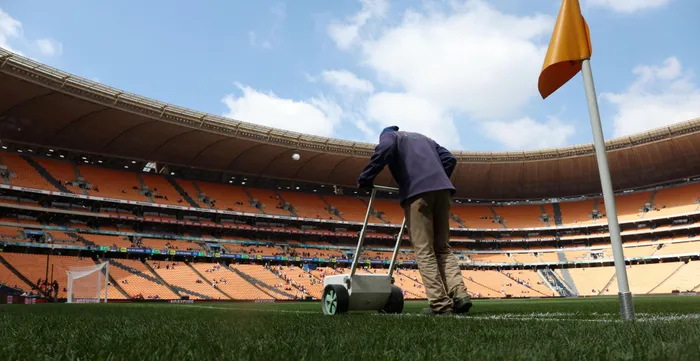
The 40-minute delay to the start of the Soweto derby between Kaizer Chiefs and Orlando Pirates was embarrassing.
Image: Backpagepix
The Soweto Derby between Kaizer Chiefs and Orlando Pirates is the crown jewel of South African sport, a vibrant explosion of colour, history, and passion that divides even the most loving of households and brings the nation to a standstill .
But on Sunday, as the scheduled kick-off time came and went with the FNB Stadium still surrounded by thousands of desperate fans, it became something else: a logistical nightmare that threatens to tarnish the prestige of one of Africa’s greatest footballing rivalries.
When a match of this magnitude starts 40 minutes late, it is not merely an "inconvenience." It is a failure of planning that borders on the dangerous.
The scenes outside the stadium have become an all-too-familiar script. Gridlocked traffic, frustrated supporters pushing against perimeter fences, and a digital ticketing system that often buckles under the sheer volume of 90 000 people trying to access a single geographical point.
On Sunday, the decision to delay the start was a "safety measure," a term that serves as a polite euphemism for the fact that organisers lost control of the flow of human traffic.
Logistically, the FNB Stadium sits in a unique pinch-point. While it is a world-class architectural marvel, its surrounding infrastructure remains trapped in a bygone era. The "last mile" of the journey for fans is a gauntlet. When you combine insufficient parking management with a culture of "fashionably late" arrivals, you create a recipe for the chaos we witnessed.
However, the blame does not rest solely with the authorities. There is a hard truth that South African football fans must face: We are our own worst enemies when it comes to match-day punctuality.
Despite repeated pleas from Kaizer Chiefs, Orlando Pirates, and the PSL to arrive at least three hours before kick-off, the African sun often sees the stands half-empty thirty minutes before the first whistle. The "late surge" is a phenomenon that no amount of turnstiles can solve if 40 000 people decide to enter the stadium simultaneously.
Yet, this does not excuse the organisers from the responsibility of evolution. In an era where technology and AI keep progressing, it is galling that the simple act of scanning a barcode and passing through a gate remains such a point of friction.
We have seen global events manage similar crowds with far more surgical precision. Why is the Soweto Derby still treated with the logistical rigour of a pre-season friendly?
The Soweto Derby deserves better because of what it represents. It is the one day where the social fabric of South Africa is woven together through 90 minutes of football.
For the fans who save their hard-earned money for months to travel from the far reaches of the Eastern Cape or Limpopo, being caught in a crush outside while the opening whistle blows is a betrayal of their loyalty.
Organisers must move beyond reactive measures. We need a radical rethinking of the precinct’s transport plan, perhaps involving mandatory park-and-ride schemes from central hubs in Johannesburg and Soweto.
Digitally, the integration of transport and ticketing needs to be seamless to prevent the bottlenecking that leads to these delays.
Simultaneously, the fans must honour the occasion. Respecting the kick-off time is a respect for the game itself. A 40-minute delay disrupts the rhythm of the players, the broadcast schedules, and the international image of the league.
If the Soweto Derby is truly to be measured against the El Clásicos and Old Firms of the world, it must be world-class from the moment a fan leaves their front door, not just when the ball is in play. Anything less is a disservice to a rivalry that remains the heartbeat of South African sport.