

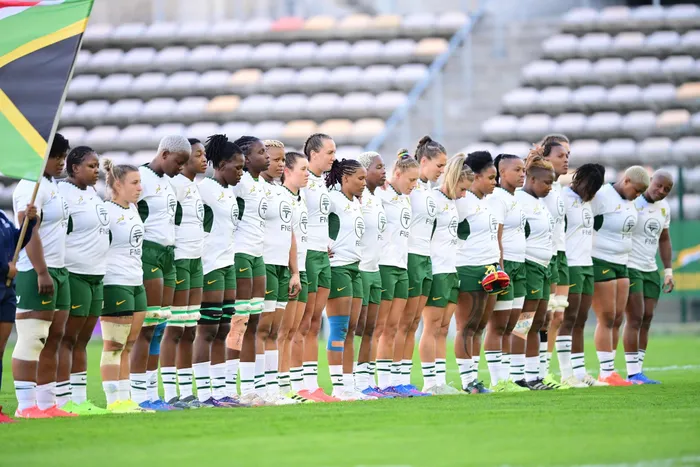
The Springbok Women inspired a nation in 2025 by reaching the quarter-final of the Rugby World Cup for the first time.
Image: BackpagePix
In a year that will be remembered as a turning point for South African women’s rugby, the Springbok Women have done more than make history — they have captured the imagination of a nation.
Their run to the 2025 Rugby World Cup quarter-finals in England, the first in the team’s history, was not just a sporting milestone but a testament to years of belief and determination. For a side that has often battled for resources, attention, and respect, 2025 has become the year in which everything clicked.
At the heart of this rise is a coaching trio who refused to accept the constraints they had to perform under: Swys de Bruin, Laurian Johannes-Haupt, and Franzel September. Their combined influence has reshaped not only the team’s rugby identity but also the confidence within the squad, professionalism, and ambition.
De Bruin gave the Women Boks a blueprint for fearless, expressive rugby — something the coach is well known for. His out-of-the-box thinking, especially during training, brought a different game. It sharpened their decision-making, their willingness to attack space, and improved their game under pressure, which saw the team close out tight pool-stage matches that previous generations would have let slip away.
But one philosophy alone does not spark a revolution.
Assistant coaches Laurian Johannes-Haupt and Franzel September have been equally instrumental, bringing continuity and an acute understanding of the women’s game in South Africa. The duo have been instrumental cogs with the forwards that laid the platform for the success.
Together, the trio, along with the other support staff, have turned the national side into a cohesive unit that plays with conviction. They became a team that not only competes with global heavyweights but also believes they deserve to be among them.
Their display against the Kiwis in the World Cup quarter-final deserved the praise, and how they built up to those kinds of clashes with mid-year matches against a tough Canadian side laid the foundation for the tournament.
One of the most inspired decisions in this new era has been the seamless blending of the Springbok Women’s Fifteens squad with the Women’s Sevens player pool. What began as a necessity — ensuring athletes had more game time — has evolved into a competitive advantage.
The Sevens players, accustomed to the high-pace, high-skill demands, and tactical precision of the shorter format, injected energy and dynamism into the fifteens setup.
Utility-back Nadine Roos led the pack with distinction, and their presence sharpened the overall standards of the squad. In turn, the Fifteens environment gave the Sevens players valuable exposure to physicality, set-piece structures, and the rhythm of longer contests.
The result was a squad of women who are not just fit and skilled, but adaptable, versatile, and accustomed to making pressure decisions on the field.
It’s no coincidence that this hybrid model has produced some of the standout performers at the tournament — players who can shift seamlessly between roles, understand multiple systems, and play with determination.
The synergy has meant that the Springbok Women arrived at the World Cup not just prepared, but battle-ready.
And South Africans have taken notice of the growth.
The Springbok Women have become more than rugby players — they are role models, and proof that passion can change a nation’s sporting landscape. And they’ve shown that it is not just the national men’s side that can bring joy to the country.
The surge of interest in the team has not been accidental. It is the result of what they have achieved in the season and the growth they’ve shown on the international stage.
They are a team willing to play bold rugby with inspiring tactics, they have coaches who care deeply about the women’s game, and players who understand the responsibility and privilege of wearing the Springboks’ green-and-gold jersey.
Yet, with all this excitement, one truth has become impossible to ignore.
If the Bok Women want to sustain this momentum crafted after a successful 2025, the women’s game needs a more professional domestic structure. SA Rugby indicated that a pro competition will start in 2026.
Right now, the success of the national women’s side is powered by heart, sacrifice, and isolated pockets of excellence. Imagine what they could achieve with fully professional provincial teams, top-tier conditioning support that the men receive, centralised pathways, and the kind of investment given to their male counterparts.
A stronger local competition would not only deepen the talent pool but also ensure that players get to the international stage more polished, resilient, and tactically mature. It is something De Bruin and his assistants have been advocating for.
The Springbok Women have shown what is possible. They have proved that when they are given the opportunity, they can rise.
If this year has taught us anything, it’s that the future of women’s rugby in South Africa is bright. And with the right support and investment, it can shine even brighter in the years to come.
Best Player: Byrhandré Dolf. The utility back scored 27 in four matches to set a new points scoring record for the Bok Women at a World Cup.
Best moment: In the dying moments of their pool match against Italy, the Bok Women came up with some massive defence to preserve a 29-24 lead. They forced a goal-line drop-out, and the ball was kicked into touch with a risky restart to end the game and seal the quarter-final spot for the first time in history.
Best quote: “If you asked me now whether I prefer coaching men’s or women’s rugby, I would tell you I prefer the women. They are so passionate, grateful for everything they get.” — Swys de Bruin