

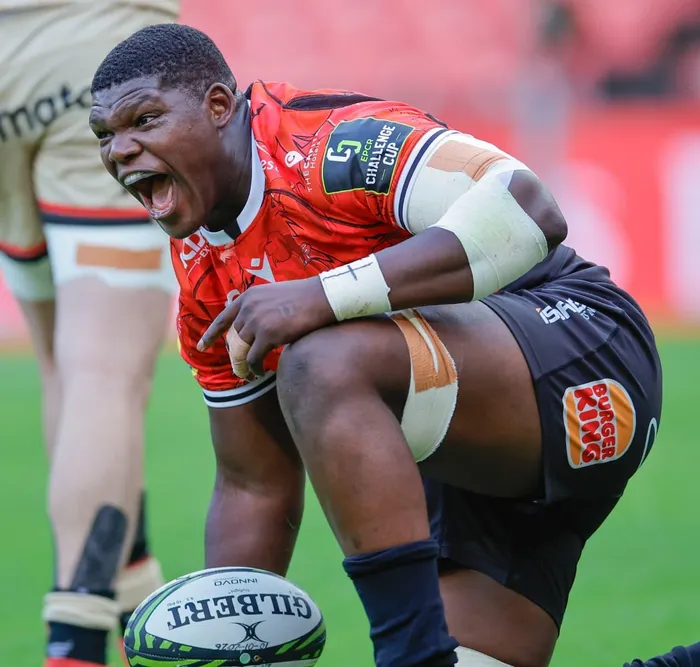
Lions flanker Batho Hlekani was named Player of the Match in debut after leaving the Sharks.
Image: @LionsRugbyCo on X
As the dust settles on the Sharks’ unfortunate season, the post-mortems can begin on why one of the wealthier, prouder unions in South Africa could not make the top eight of the United Rugby Championship and failed in the second-tier Challenge Cup.
In three of the last four URC seasons, the Durbanites finished outside of the top eight, so the issues at the Sharks have been entrenched for some time.
In fact, the Sharks have been stuttering for over a decade, probably since John Plumtree finished his first stint at Kings Park, at the end of 2012, the year he was sacked after taking the team to the Super Rugby final against the Chiefs.
Since then, coaches have come and gone, so have CEO,s and the team has been up and down like a yo-yo. Any sports team is only as good as the support structure in the admin building.
To my mind — and I have been covering the Sharks for just over three decades — the Sharks have struggled on the field because of a lack of strong, cohesive leadership off the field.
There are some very good, experienced individuals in the stadium staff, but overall, it does not appear to be the tight-knit, all-on-the-same-page operation that it was in the glory days of the Durban team, the era when Brian van Zyl captained a watertight ship that made the players proud to be on board.
At the Sharks, the head coaches have been made the scapegoats for failed seasons, which is wrong because they are only as good as the infrastructure around them. If nothing changes in the overall picture, nothing will change.
I want to discuss one area where it is evident to me that the Sharks have shot themselves in the foot — recruitment. The often random, sometimes bizarre buying of new players that don’t seem to fit is only half of it, and I could write plenty on that, starting with the buying of Galactico players who seldom play for the Sharks.
I have often suspected there has been a disconnect between the players the coaching staff wants and who the recruitment office actually buys. It sounds crazy that this could happen, but I think it has. At the Stormers, John Dobson guides the recruitment, as Jake White did at the Bulls, and Johan Ackermann currently does.
The other side of the recruitment coin is retention. This area in sports teams doesn’t get the same level of public attention as player purchasing does, but it should.
I was reminded of this when I heard that Junior Boks Luan Giliomee, Mawanda Mdanda, and Hakeem Kunene are leaving Kings Park for the Bulls, while Batho Hlkekani has been at the Lions for a while, and playing superbly.
Young players of that quality should not be leaving.
This reminded me of the brilliant Sharks Under-19 team of 2018 that swept all before them under coach Sean Everitt.
Let me remind you of some of the players in that side: Francois Klopper (now at the Bulls), Sanele Nohamba (Japan), Evan Roos (Stormers), Boeta Chamberlain (Newcastle), Thaakir Abrahams (Bulls), Dylan Richardson (Edinburgh, Phepsi Buthelezi (Sharks), Fez Mbatha (Sharks), Murray Koster (Japan), JJ van der Mescht (Northampton), Le Roux Malan (going to Cardiff), Mpilo Gumede (Bulls), Muller du Plessis (Blitzboks).
Only Buthelezi and Mbatha remain at the Sharks. I wonder how that team would have got on in senior rugby had it been kept mostly intact and allowed to mature under Everitt, with the players now in their prime at age 27? Here was a readymade team that just had to be kept together…
Interestingly, the Sharks are now bringing Koster back from Japan, and are trying to get Nohamba (Japan) and Van der Mescht (Northampton) back.
I have been informed that the Sharks’ recruitment officer has resigned, and the hunt is on for a replacement. The new appointment will be one of the most important the Sharks have made in years, and I hope that whoever it is has a forensic look at the recruitment of the last decade and that lessons are learned.