

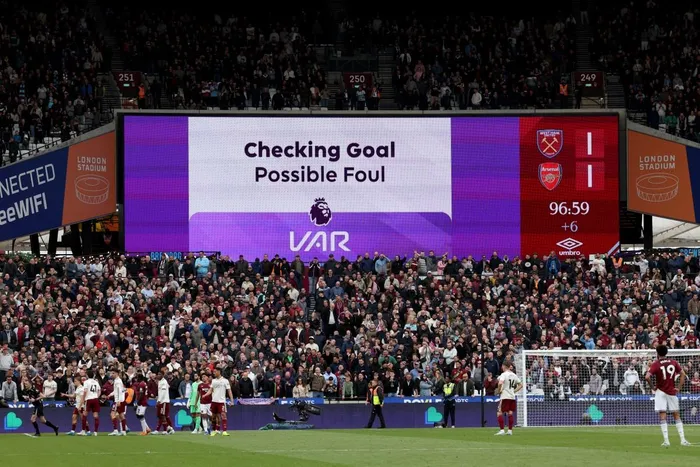
Is VAR the "miracle cure" South African football needs, or a recipe for more frustration? With R20 million in funding secured for its rollout, we look at the Premier League’s latest VAR drama and ask if the PSL is ready for the "microscopic analysis" of the beautiful game. Photo: AFP
Image: AFP
COMMENT
"To err is human, to really foul things up takes a computer."
I was reminded of this quote by US scientist Paul Ehrlich – that probably gives my age away – as I was watching the drama unfold when West Ham's 95th-minute 'equaliser' against Arsenal, which had huge implications for the English Premier League title race and relegation battle, was chalked off by VAR.
It is already been regarded as the "biggest moment in VAR history".
While I won't go into the merits of the decision, I was left wondering if the microscopic analysis of pivotal moments was VAR’s intended purpose. The technology was introduced to eliminate controversy; instead, it has simply modernised it.
Every weekend now seems to produce another flashpoint, with referees sent jogging to pitchside monitors while 60 000 supporters stand in confusion waiting for a verdict. The technology was supposed to bring clarity to modern football, yet it has often brought long delays, frustration and a fresh layer of distrust.
This matters for South African football, which is edging closer to introducing VAR following news that Safa has received R20 million in government funding for the implementation of the technology.
On paper, it sounds like progress. South African supporters have endured enough questionable officiating decisions to fill a full season of blooper reels. Coaches regularly leave post-match press conferences fuming, and club statements have become routine. Referees are under enormous pressure, often without the technological support available in Europe.
So, naturally, VAR is presented as the solution. But if the Premier League has taught us anything, it is that technology does not remove controversy from football — it merely relocates it.
The core problem is simple: many football decisions are subjective. A slow-motion replay cannot suddenly transform opinion into fact.
Was there enough contact for a penalty? Did the defender “intentionally” play the ball? Was the goalkeeper obstructed?
VAR can review the footage 15 times from six angles and people will still disagree.
In England, supporters now spend as much time debating process as they do football itself. The conversation after major matches is increasingly dominated by audio releases, offside graphics and referee interpretations rather than tactics or performances. Instead of ending arguments, VAR often extends them for days. Worse still, it changes the emotional rhythm of the game.
Football’s beauty has always lived in spontaneity — the instant eruption after a late goal, the raw chaos of celebration and the unpredictability that makes supporters keep coming back. VAR has inserted hesitation into those moments.
Fans now celebrate while glancing nervously at the assistant referee or waiting for the dreaded “checking possible offside” notification. That emotional cost is rarely acknowledged when leagues discuss VAR implementation.
There is also the South African reality to consider.
The Premier League operates with enormous financial resources, multiple camera angles and specialised VAR officials, yet still struggles with consistency. The Betway Premiership would almost certainly face even greater challenges regarding infrastructure, stadium capability and operational reliability. Imagine the reaction if a title-deciding call at a packed Soweto Derby is delayed because of technical problems or inconclusive footage.
That does not mean VAR should be rejected outright. Clear offsides, mistaken identities and certain factual decisions can undoubtedly benefit from technological assistance. Few would argue against correcting a truly obvious error. But football authorities need to stop selling VAR as a miracle cure. It isn't.
At best, it is a tool that can reduce a small percentage of mistakes. At worst, it risks creating a game where supporters don't trust the referees or the technology supposedly designed to help them. The Premier League’s experience should serve as a warning to South Africa, not simply an example to follow. Once VAR arrives, controversy does not disappear; it just comes with replay angles.