

As the US prepares to host World Cup 2026 under a cloud of geopolitical tension, we look back at US 1994 — a tournament plagued by similar doubts that went on to become the highest-attended World Cup in history. Photo: AFP
Image: AFP
There are some very real concerns regarding the Fifa World Cup 2026 hosts next month due to the current US geopolitical climate.
There were similar anxieties in 1994, especially with regard to the interest and participation of US citizens, but those worries turned out to be unfounded. The 1994 event remains the highest-attended World Cup with a near-average of 69 000 supporters in attendance per game, despite the apparent lack of popularity of the sport in the States.
Before the 1994 event, there had been major political changes around the globe. The fall of the Berlin Wall and the end of the Soviet Union saw Russia participate for the first time at the event. A unified Germany also made their first appearance at the event since 1938.
After the cynical defensive play that characterised the 1990 event, FIFA introduced the three-point system for this tournament and changed the backpass rule to encourage a more attacking playstyle, while also relaxing the offside rule.
Africa: Cameroon, Morocco and Nigeria
Asia: Saudi Arabia, South Korea
Europe: Belgium, Bulgaria, Germany, Greece, Italy, Netherlands, Norway, Republic of Ireland, Romania, Russia, Spain, Sweden and Switzerland
North America: Mexico and US
South America: Argentina, Bolivia, Brazil and Colombia
No stadium at US 94 was smaller than a 53 000-seater. Nine venues were selected across continental America to host the event, with teams having to consider various conditions. Most games were played during the afternoon in hot and humid conditions, which made for physically taxing games.
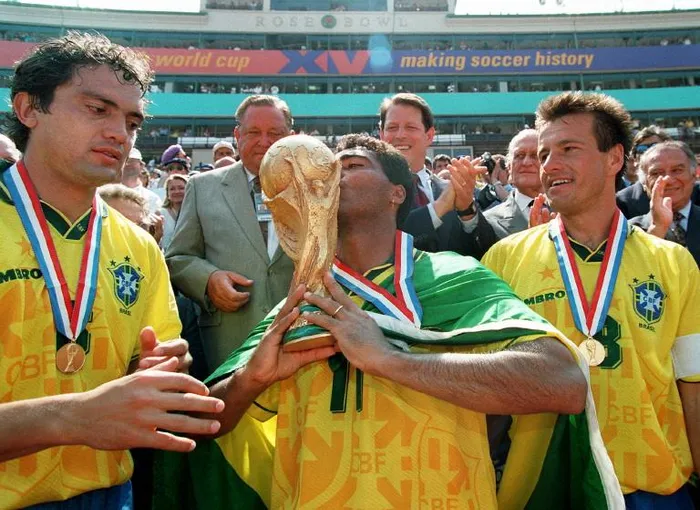
Brazilian forward Romario kisses the FIFA World Cup trophy in 1994 as his teammates Branco, left, and Dunga look on. Photo: AFP
Image: AFP
The 1990 format was retained with six groups of four. The top two teams progressed to the Round of 16, with the four best third-placed teams — Argentina, Belgium, US and Italy — also making the cut.
After his heroics in 1990, Roger Milla returned for Cameroon.
The Indomitable Lions could not replicate their Italy performance from four years earlier — they finished last in their pool — but Milla remains the oldest goalscorer in the tournament’s history at 42-years and 39-days old when he scored against Russia. There was another record in that match. Russia’s Oleg Salenko became the first player to score five goals at the World Cup, a record he still holds alone, in the 5-1 win.
By 1994, Argentina legend Diego Maradona’s substance abuse and weight issues had become a major concern. In the opening match of their campaign, against Greece, Maradona scored in a 4-0 victory. It was his last goal at the showpiece event.
After Argentina’s 2-1 win over Nigeria, Maradona was escorted off the field by nurse Sue Ellen Carpenter, holding his hand, to do a doping test. His sample returned positive for the banned substance ephedrine, and he was immediately expelled by FIFA from the competition.
In a tragic development, Colombia’s Andrés Escobar was shot dead after the tournament, possibly in relation to his own-goal against the US, which contributed to Los Cafeteros' World Cup elimination.
Round of 16: Romania 3, Argentina 2; Sweden 3, Saudi Arabia 1; Netherlands 2, Republic of Ireland 0; Brazil 1, US 0; Mexico 1, Bulgaria 1 (3-1 on penalties); Germany 3, Belgium 2; Nigeria 1, Italy 2 (aet); Spain 3, Switzerland 0
Quarter-finals: Romania 2, Sweden 2 (5-4 on penalties); Netherlands 2, Brazil 3; Bulgaria 2, Germany 1; Italy 2, Spain 1
Semi-finals: Sweden 0, Brazil 1; Bulgaria 1, Italy 2
Sweden won the third-place play-off 4-0 by beating Bulgaria.
Before the tournament kick-off, Brazil, along with a unified Germany, were considered favourites to win the event due to star players that included Romário, Rai and Dunga. Having scored 11 goals, they were unable to find their scoring boots against a still experimental Italy at the 100 000-plus Rose Bowl in Pasadena. The match ended 0-0 after extra-time, becoming the first final without a goal and the first to be settled by penalties, which Brazil won 3-2.
Most infamously, Italian talisman Roberto Baggio shanked his penalty over the bar, much like captain Franco Baresi, to hand the trophy to Brazil. It was Brazil's fourth championship, their first since 1970 and also the first time they would lift the current FIFA World Cup trophy.
Diana Ross headlined the opening ceremony at Soldier Field in Chicago, and performed I’m Coming Out.
During the performance, Ross was supposed to kick a ball into a net, which would trigger the goal to split in two. Embarrassingly, Ross missed, pulling her shot left of goal. The rigging detonated regardless, with Ross running through the split goal to finish her set confidently, if with a little bit of a bruised ego.