

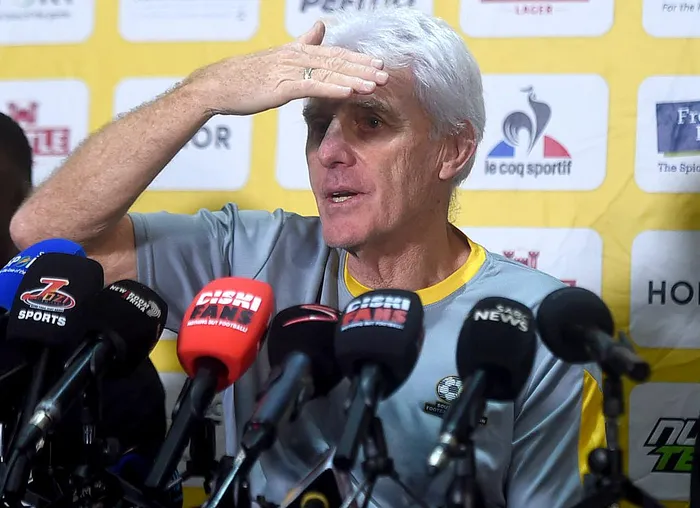
Hugo Broos will be looking forward to the 2026 Fifa World Cup draw in Washington on December 5.
Image: Itumeleng English /Independent Media
The 2026 FIFA World Cup is creeping ever closer and, with Bafana Bafana set to make their return to the global showpiece jointly hosted by Canada, the United States and Mexico, the release of the draw procedures has offered a clearer look at what may lie ahead.
South Africa now have an early sense of their possible pathway as they prepare for their fourth attempt at reaching the knockout rounds.
In the latest Fifa rankings, Hugo Broos’ side slipped from 59th to 61st in the world and dropped out of Africa’s top 10, with the Democratic Republic of Congo rising into 10th place after the official update on the 19th of November.
The World Cup draw will be held on the fifth of December 2025 in Washington DC, and it will map out the journey each nation will follow in the expanded 48-team tournament across North America.
This edition will be the first to feature 12 groups of four, and Bafana have landed in Pot-Three based on their most recent ranking—a placement that will heavily influence who they face in the group stage.
While much still depends on the draw itself, one thing is already certain: Bafana could be grouped with one of the South American giants, either Brazil or defending champions Argentina.
European heavyweights and former world champions Germany, France, and Spain also remain strong possibilities, alongside Portugal, England, Belgium, and three-time runners-up—including in 2010 on South African soil—the Netherlands. The three host nations further expand the list of potential opponents waiting in Pot-One.
Because no group can feature more than one African team, Bafana will avoid Morocco and Senegal from Pot-Two. However, the rest of the pot still contains daunting opposition. Croatia, runners-up at the 2018 tournament in Russia, remain a major threat, while Uruguay bring their pedigree as former world champions.
Colombia are another dangerous proposition. Japan, Switzerland, Iran, Korea Republic, Ecuador, Austria, and Australia round off the pot—and every single one is ranked higher than South Africa, with Australia the lowest at 26th, still 35 places above Bafana.
No matter how the final draw plays out, Broos and his men are guaranteed to face at least one global powerhouse from Pot-One and another side positioned above them in world rankings—meaning a place in the knockout rounds will almost certainly require an upset or two.
Pot-Four adds even more unpredictability. Only New Zealand, Jordan, Haiti, and Curaçao are confirmed, with the remaining slots to be filled by the European playoff winners and the two intercontinental playoff qualifiers. These sides will generally be seen as the most beatable in their groups, though the World Cup often proves that nothing is straightforward.
Beyond the group stage, the revamped World Cup format introduces two distinct pathways to the semi-finals to ensure the world’s top-ranked teams are spread evenly and avoid early clashes.
Bafana will once again be chasing their first-ever place in the knockout rounds, and the exact scale of the challenge will become far clearer when the draw takes place on 5 December in the US capital, Washington DC.