

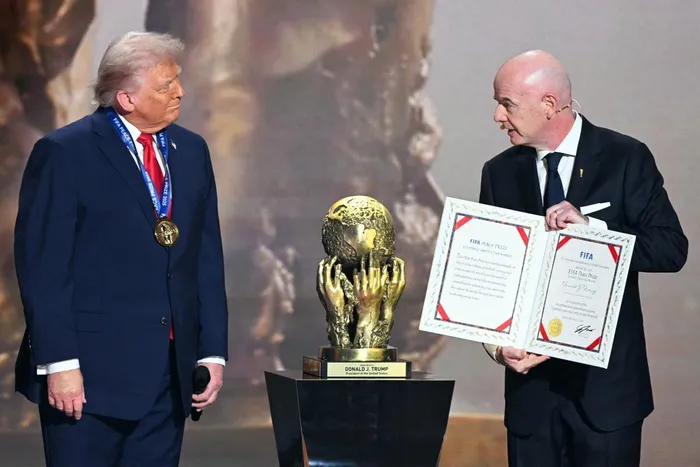
US President Donald Trump receives the FIFA Peace Prize from Fifa President Gianni Infantino during the draw for the 2026 FIFA Football World Cup set for the US, Canada and Mexico, at the Kennedy Centre, in Washington, DC in December. It is still not clear under what judgement Infantino awarded this honour to Trump.
Image: AFP
COMMENT
Growing up, I used to think that rich people’s lives were peaceful and better in every way; on a much bigger scale, I applied that same naive logic when comparing countries.
Blessed with a vivid imagination, there are few episodes where I would randomly match a person’s face to a particular country or brand based on their social status or simply my perception of them. No doubt, the faces of the rich would find themselves with the body of a first-world country, while the not-so-fortunate in life would — you guessed it — become third-world countries.
Heck, even if I say so myself, such a colourful imagination is what Hollywood screenwriters are made of.
It is funny Hollywood should pop up there, since the whole reason I find myself recounting the foolish events of my youthful mind is because of the Americas — the not-short-of-scandals hosts of the 2026 Fifa World Cup.
North America will host the global showpiece between June 11 and July 19, with the US unsurprisingly taking the lion’s share of matches (78), while Canada and Mexico scrap for a total of 13 matches each. This will be a historical event indeed — 48 men’s national teams sharing the global stage for the first time ever to give us a total of 104 matches, which will culminate in the final in New Jersey on July 19.
Anyway, back to my vivid imagination: at this stage, I am sure you can now make up your mind that the US, the ‘leaders of the free world’, no doubt fall under the ‘rich people category’ with endless peace and the most enviable life.
Man-oh-man! Are they proving my imagination naive and, to some extent, mismatched as we build up to what is potentially the biggest sporting event of all time. As far as hosting the upcoming World Cup is concerned, there is nothing peaceful or desirable about being in the shoes of Americans right now.
If it is not ‘Typhoon Trump’ wrecking relations with other countries by imposing trade tariffs, suspending Fifa member countries’ visa applications, and barring them from the US for World Cup-related events such as the tournament draw, it is gangs and cartels threatening safety and security in Mexico.
The scandals are countless, and consequently, this week the biggest World Cup-related headline is Germany and former Fifa president Sepp Blatter calling for a boycott of the 2026 tournament.
About 15 of the 2026 World Cup-qualified countries are on the list of 75 nations for which the US has announced an indefinite pause on immigrant visa processing.
Current reports suggest Category 1 seats for the final at New Jersey’s MetLife Stadium are being quoted as high as R110 000 to R117 000 due to “dynamic pricing”.
Just this week, 11 people reportedly died with a further 10 injured during a stadium attack in ongoing gang and cartel territory wars in Mexico.
South Africa is not among the 75 countries on the visa ban list, but there are deep political tensions between the two nations and there is no telling what might happen tomorrow. On the other hand, Bafana Bafana are scheduled to play two of their group-stage matches in Mexico.
Either way, politics are slowly threatening to creep onto the field, with some high-ranking members of the German Football Association calling on Uefa members to unite in boycotting the World Cup. Blatter, for related or different reasons, also joined the call for fans to boycott the tournament, and ongoing reports indicate a massive wave — about 38 000 — of World Cup-related hotel bookings have been cancelled.
The 2026 Fifa World Cup is shaping up to be a historic collision of the beautiful game and ugly politics. For a sports enthusiast like myself, all these events are very unfortunate as they threaten the development of the game, but there is no telling world leaders which way they must sway.
For now though, they must hold back from talks of boycotts as that will negatively affect the livelihoods of many individuals who live off football. It would also hurt the legacies of many celebrated football players and coaches.
One can only believe that all this noise will simmer down eventually and allow football to prevail as the main meal to be enjoyed by both the rich and poor, first and third world alike, sharing the dinner table.
Unless, of course, I am being naive yet again.
One thing is for sure: world sporting bodies are in for a bumpy ride to the US, with the Olympic Games going to Los Angeles in 2028. At least for the Men’s and Women’s Rugby World Cups, also headed stateside in 2031 and 2033, respectively, ‘Typhoon Trump’ will have subsided ... hopefully.