
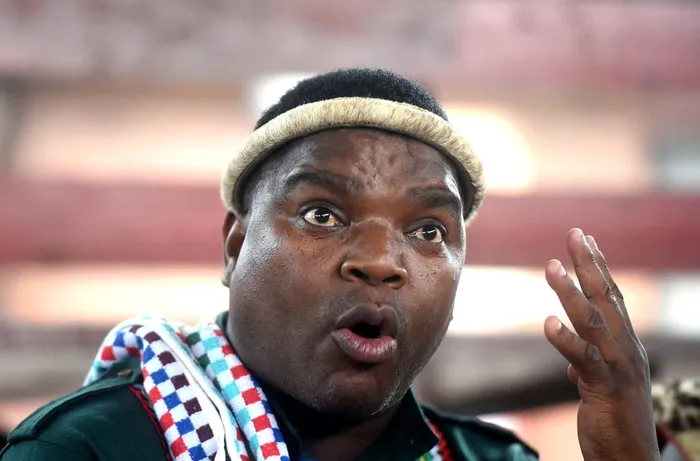
FORMER radio personality, Ngizwe Mchunu, has been taken to the South African Human Rights Commission for homophobia, hate crime, and incitement of violence following his recent social media rant against homosexual people. His rant was sparked by a recent traditional wedding of a gay couple that was dressed in Zulu traditional attire.
Image: ITUMELENG ENGLISH Independent Newspapers
Prominent human rights activist Mxolisi Makhubu has formally lodged a complaint with the South African Human Rights Commission (SAHRC) against former radio personality and cultural commentator Ngizwe Mchunu, accusing him of hate speech, incitement to violence, and ethnic mobilisation targeting South Africa’s LGBTQIA+ community.
In a 3-page submission delivered to the Commission yesterday, Makhubu argues that Mchunu’s recent remarks on social media, though later deleted, had already unleashed widespread harm. The post, which garnered more than one million views online, prompted hundreds of comments openly calling for the public execution of homosexual people.
“The fact that his original post has been taken down does not absolve him of responsibility, nor does it erase the immense damage already caused by his conduct,” Makhubu wrote.
“Once words of violence are released, they cannot be recalled, and the climate of fear they create remains long after deletion.”
Mchunu made disparaging remarks against Metro FM presenter and socialite, Somizi Mhlongo, who's openly gay. His social media rant was sparked by a recent traditional wedding of a gay couple who were dressed in Zulu traditional attire.
Somizi responded comically to Ngizwe's rant by posting a video where he seemed to be packing his bags and leaving, an instruction that came with Ngizwe's expletive-laden social media rant.
Ngizwe had said Somizi must leave South Africa with his "nation".
According to Makhubu, Mchunu’s words cannot be dismissed as mere cultural commentary. Instead, they constitute what he describes as a “direct attack on queer South Africans”, effectively seeking to deny them their cultural birthright and their place in African communities.
“This attempt to displace queer people from their culture is nothing short of diabolical,” the complaint continues.
“It is accompanied by rhetoric that emboldens calls for their murder. His conduct therefore falls squarely within the definition of hate speech and incitement to violence under South African law.”
The submission situates Mchunu’s comments within the broader climate of violence against LGBTQIA+ people, particularly in KwaZulu-Natal. Organisations such as OUT LGBT Wellbeing, Uthingo Network and Iranti have documented dozens of brutal killings of queer people in recent years, many of which remain unresolved.
Citing reports, Makhubu notes that between 2021 and 2023 alone, at least 20 LGBTQIA+ individuals were murdered in KwaZulu-Natal on the basis of their sexuality or gender identity. “These are not abstract statistics,” he warned.
“They are lives lost to hatred, prejudice and silence. To allow public figures such as Mr Mchunu to fuel this violence with impunity is to embolden killers and sanction further bloodshed.”
The complaint cited statutes criminalising hate speech and incitement, including the Promotion of Equality and Prevention of Unfair Discrimination Act (PEPUDA), the Prevention and Combating of Hate Crimes and Hate Speech Act signed into law in May 2024, and the Criminal Procedure Act.
Makhubu argues that Mchunu’s words meet the threshold for prosecution under these laws, noting that South Africa has previously pursued cases against individuals such as Penny Sparrow, Vicki Momberg, and Adam Catzavelos for racist hate speech.
“It would be a gross inconsistency for Mr Mchunu’s case to be ignored when the gravity of his utterances is arguably even greater,” the activist stated.
The activist further challenges claims that homosexuality is incompatible with African traditions, describing such arguments as both historically false and politically dangerous.
“Historical research demonstrates that African communities have long recognised and embraced diverse sexualities and gender identities,” the complaint reads.
Queer people, he said, were often regarded as healers, oracles, and mediators.
“Homophobia is a colonial import, a Western distortion imposed through missionaries and colonial law. To now claim that queerness is incompatible with African traditions is not only historically false but also a betrayal of authentic African heritage,” Makhubu added.
The complaint also draws on South Africa’s international obligations. As a signatory to the International Covenant on Civil and Political Rights, the International Covenant on Economic, Social and Cultural Rights, and the African Charter on Human and Peoples’ Rights, the country is bound to protect individuals from discrimination and incitement to violence based on sexual orientation.
To fail to act decisively, Makhubu argued, would undermine not only domestic law but also South Africa’s international standing as a defender of human rights.
Makhubu concludes his submission with a set of urgent requests to the SAHRC: to investigate Mchunu and others for hate speech, to refer the matter for prosecution, and to issue a strong public statement affirming the rights of LGBTQIA+ people to belong fully to their culture, traditions and country.
“This matter is urgent. Lives are already being lost,” he warned.
“Every day that individuals like Mr Mchunu are permitted to incite violence without consequence is another day that queer South Africans live under siege. The SAHRC has both the mandate and the moral obligation to act decisively.”
Mchunu, a former Ukhozi FM DJ and SABC1 presenter, has had run-ins with the law before. In 2021 he was arrested and charged with inciting public violence during the riots and for violating the Disaster Management Act. He was acquitted on all charges.
The SAHRC has yet to respond publicly to the complaint.