

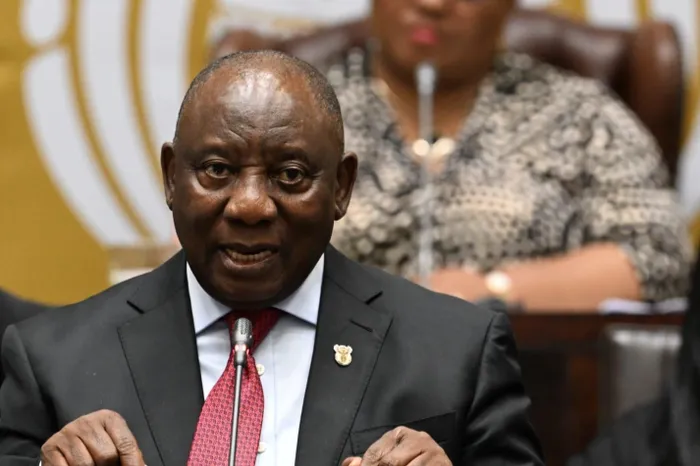
Very little has been said about the holistic reasons behind this President Cyril Ramaphosa's cabinet reshuffle within the GNU this week.
Image: X / GCIS
VERY little has been said about the holistic reasons behind this week’s cabinet reshuffle within the Government of National Unity (GNU).
Although many across various media platforms have described the occurrence as a consequence of President Cyril Ramaphosa’s prerogative, the hand of the DA leader John Steenhuisen loomed ever so large over the reshuffle.
In fact, the cabinet changes affected only the DA. For the uninitiated, Ramaphosa appointed the DA’s Alexandra Abrahams to the position of deputy minister of Trade, Industry and Competition. She was replacing Andrew Whitfield, whom the president sacked in June for undertaking an unauthorised trip to the US.
But the eye-catching appointment was that of the DA’s Willie Aucamp. He replaced Dion George, another DA appointee, as minister for Forestry, Fisheries and Environment.
According to Steenhuisen, his recommendation to the president to effect a DA-specific change was based on the need “for every public official to work towards an agreed agenda”. He elaborated as follows: “The DA currently holds 12 positions within the national executive. It is therefore imperative that these roles are occupied by the most capable individuals our party has to offer — people who bring integrity, energy, and excellence to government. Collegiality is crucial,” he said.
Now, at face value, it all seems like cabinet changes had been necessitated by Steenhuisen’s expressed standpoint. However, beneath the public relations exercise over reasons for changes lie pretty much disturbing factors that need not be relegated to the periphery of public discourse.
The appointment of Abrahams looks like a mundane fulfilment of office obligations by the president. However, it is George’s sacking that I’d like to zoom in.
Discussion among BRICS diplomats this week held that George had embarrassed the DA when it turned out that “he holds a dual citizenship of both SA and the US”. In fact, it was said that in a recent trip to the US, where he travelled as part of Team SA, George surprised some, if not all, when it transpired that he was travelling on a US passport.
Now, as far as I’m aware, it is not unlawful for anyone to hold a dual citizenship of SA and a second country of their choice. At the height of apartheid rule, it was common for many white South Africans to flaunt their status of dual citizenship. It was akin to a batch of honour. The public bragging has since subsided following the advent of democratic rule in 1994.
Claims of former minister George’s status of dual citizenship shine a torch on a matter hardly spoken about. Yet, it is a perennial elephant in the room. It stands out particularly when juxtaposed with black South Africa, where virtually everyone has only South African citizenship to their name.
As I indicated earlier, I take no umbrage with the general rule and practice of dual citizenship. However, I take a dim view of public office bearers owing their allegiance to South Africa and another country. The consequences for the ill-advised practice are dire. At once, when implemented, it places South Africa’s national security at a very high risk. The nation’s secrets get to reside with individuals who harbour divided loyalties.
Indeed, our public office-bearers do take the mandatory oath of office. But that does not mean much in practice, and in essence.
Like other nations of the world, South Africa’s foreign policy is premised on national interest and security. Being sworn in to this obligation is sacrosanct, particularly in our international relations activities.
If any public official answers to two separate and competing powers, surely we are in a precipitous territory that’ll lead to our demise.
SA’s liberal Constitution has proven itself to be out of sync with the common desires of the majority citizenry. Oftentimes, it is at odds with indigenous knowledge systems, demonstrating therefore that its authors were Western-inclined or Eurocentric in the heart of Africa.
Some may argue that Black people were integral to the team that put together the Constitution. And this factor brings me to Steve Biko’s poignant declaration when he explained that “Black” in Black Consciousness was no reference to skin colour. “Black is a state of mind,” Biko argued.
This explains the presence of several glaring clauses of our Constitution that negate the aspirations of the indigenous people who wallow in self-pity most times when they come face-to-face with the laws of their land, the land of their forebears.
The spectre of a government minister holding dual citizenship also reveals our country’s poor vetting systems. Any iota of danger to our national security ought to be sniffed out without delay, for any delay could spell huge trouble to our sovereignty.
Despite Black majority rule since 1994 — at least on paper — too little has changed in our grossly imperfect Constitution. And as Black rule gradually recedes, the chances of a pro-Black majority change in the Constitution appear more distant.
Perhaps our hope lies with the likes of Steenhuisen, who seems to share my sentiments of the need for restrictions on access to public office for dual citizenship residents.
Such changes to our laws require urgent attention. We can no longer afford any wastage of our precious time.
* Abbey Makoe is Founder and Editor-in-Chief: Global South Media Network (gsmn.co.za). Views expressed are wholly personal.
** The views expressed here do not reflect those of the Sunday Independent, Independent Media, or IOL.